


Accountability Part A is the largest of the three Compliance Standards Practice Guides. It carries six discrete clauses, each with its own ASQA-published example activities, known risks, and self-assurance questions.
To do justice to every clause, this series splits Accountability into two blogs:

Every clause, example activity, known risk and self-assurance question in this blog is lifted directly from ASQA’s Accountability Part A Practice Guide.
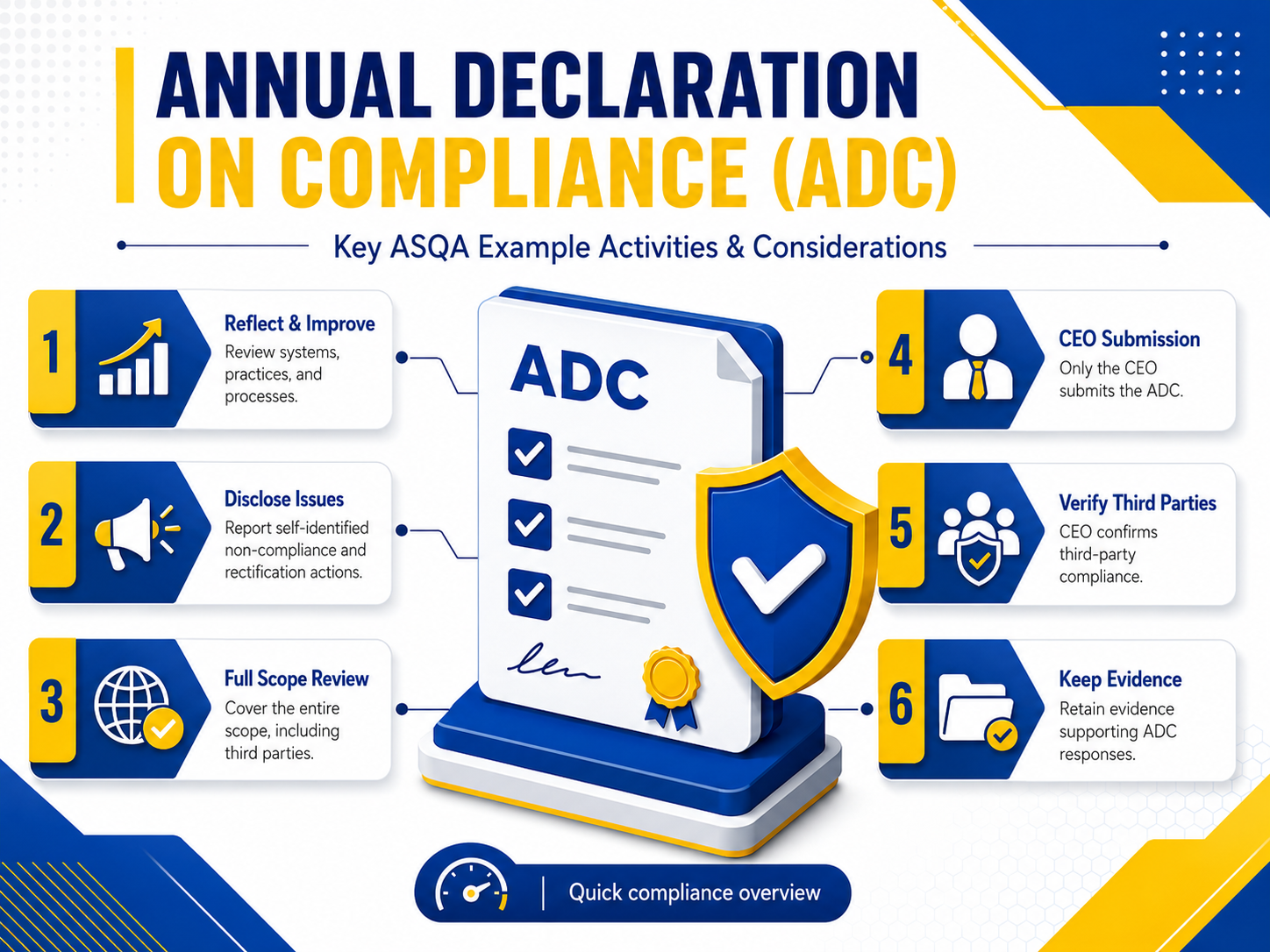
Requirement: An NVR registered training organisation must submit an annual declaration on compliance with its obligations under the Act for each annual reporting period in which the organisation is registered. An NVR registered training organisation’s annual reporting period is the period of 12 months that is specified by the National VET Regulator as the organisation’s annual reporting period. An annual declaration on compliance submitted by an NVR-registered training organisation must be in the approved form as published on the National Register by the National VET Regulator from time to time.
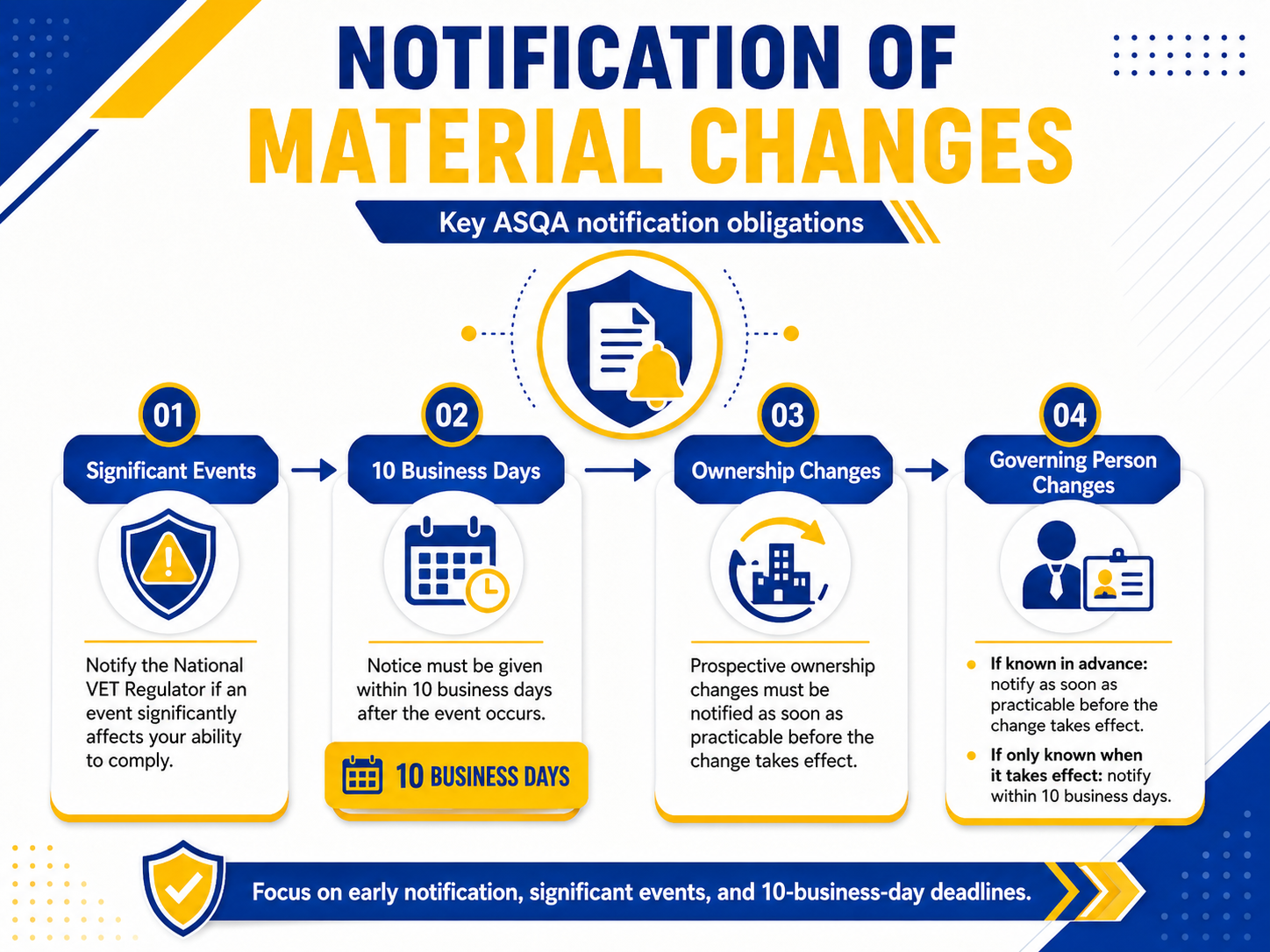
Requirement: An NVR registered training organisation must notify the National VET Regulator of the occurrence of an event that would significantly affect the organisation’s ability to comply with any of its obligations under the Act. A notice under subsection (1) must be given within 10 business days after the event occurs.
An NVR registered training organisation must notify the National VET Regulator of:
A notice under subsection (1) or (3) must be provided to the National VET Regulator in writing or electronically. After giving notice under subsection (1) or (3), an NVR registered training organisation must provide any further information relating to the notice as soon as practicable, if requested by the National VET Regulator.
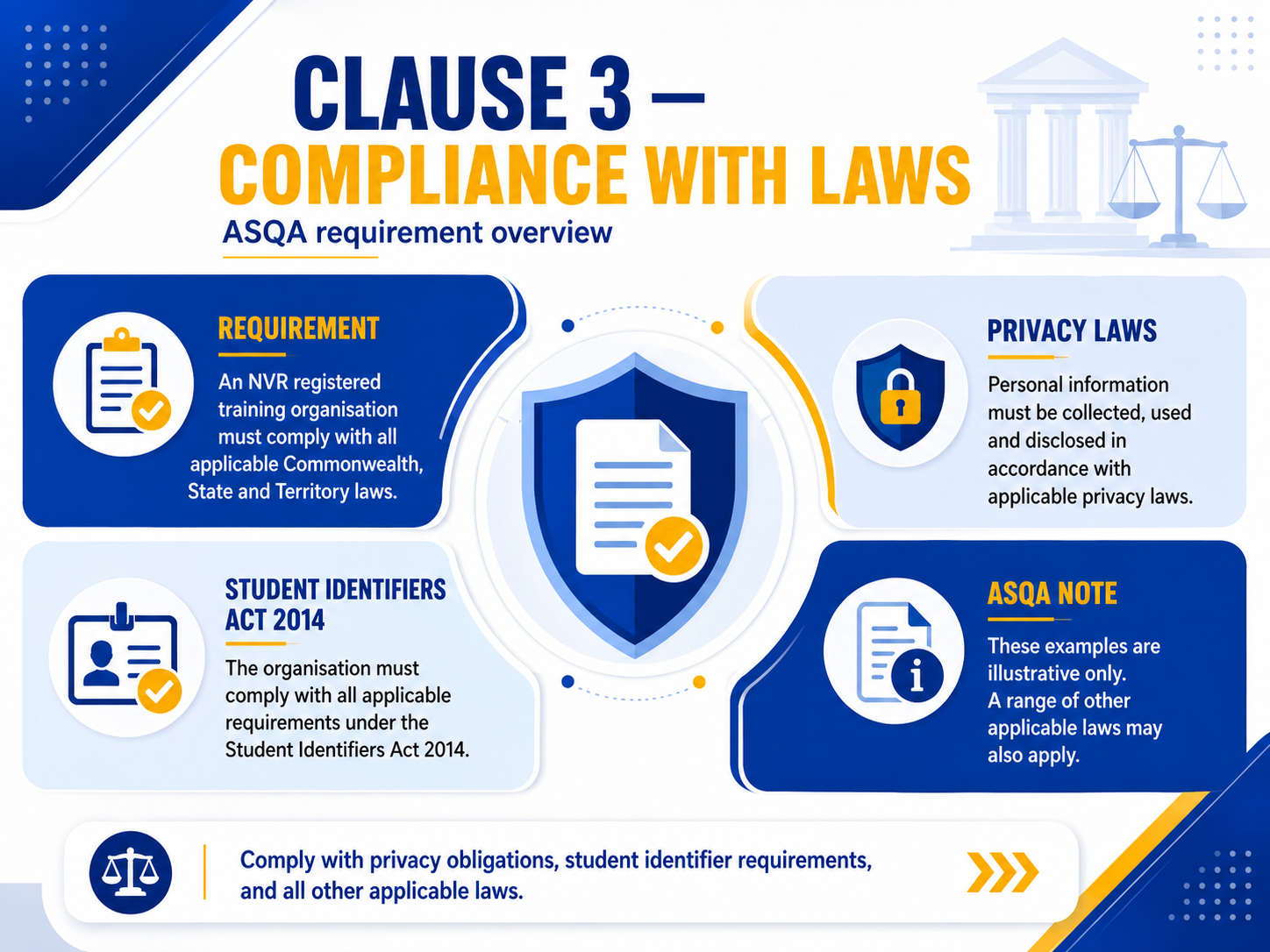
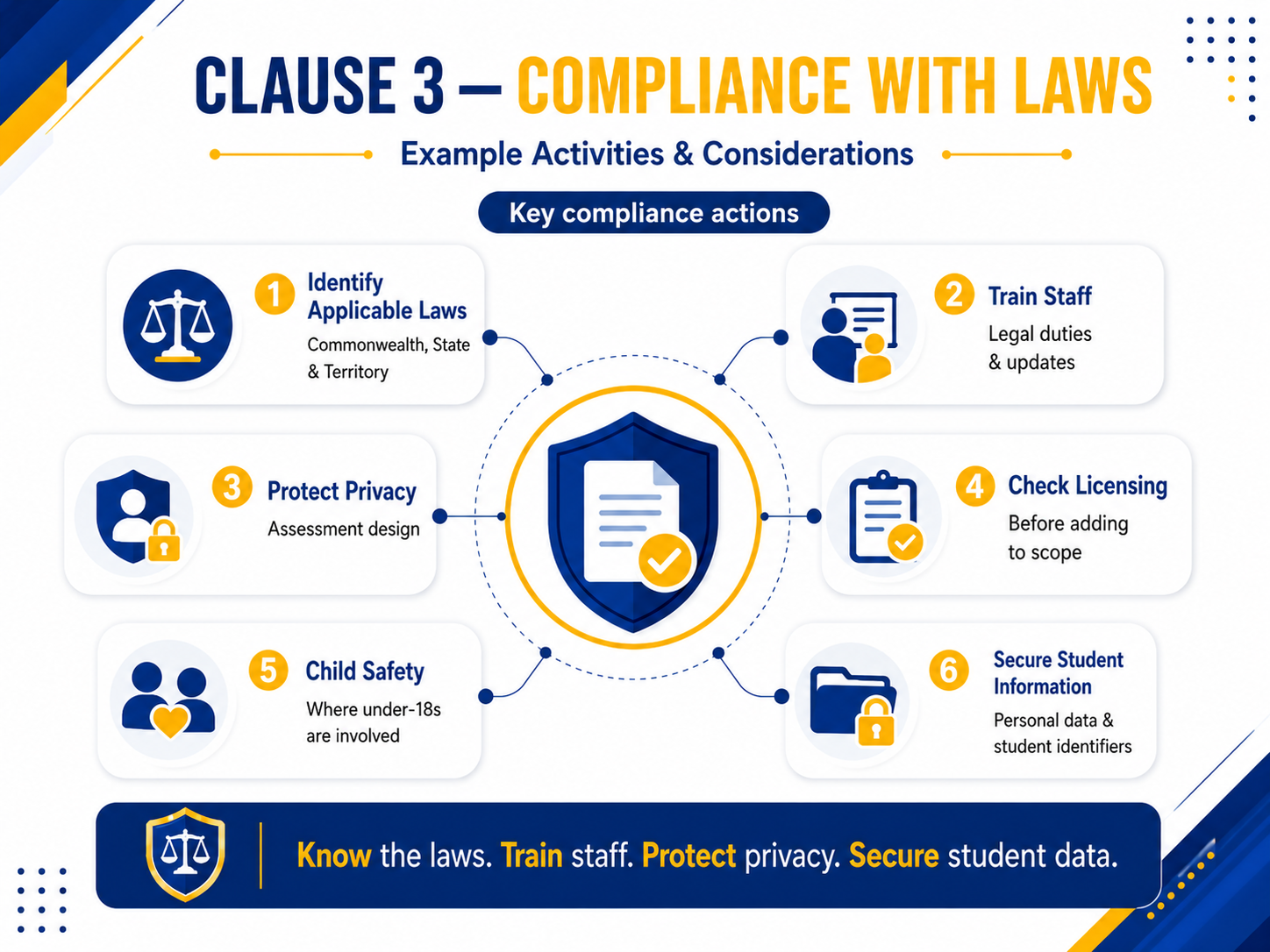
Requirement: An NVR registered training organisation must comply with all applicable Commonwealth, State and Territory laws, including, for example, by ensuring:
ASQA Note: There is a range of laws that may be applicable under this section. The examples provided in paragraphs (a) and (b) are for illustrative purposes.
How do you ensure you are completing and submitting the Annual Declaration on Compliance within the relevant reporting period?
How do you use the ADC process to demonstrate to ASQA that you self-disclose non-compliance, as well as your organisation’s rectification and continuous improvement efforts?
How do you monitor your operations to identify whether there are, or are likely to be, material changes that require notification to ASQA?
How do you identify the Commonwealth, State and Territory laws that apply to your operations?
How do you ensure your staff and third-party providers comply with these laws, including privacy laws and child protection laws?
How do you monitor changes to legislative and regulatory requirements that may affect the services that you deliver?
If you cannot answer any of these with documented evidence, the Practice Guide flags it as an Accountability gap to address.
| Clause | What ASQA’s Practice Guide expects you to demonstrate |
| Annual Declaration on Compliance | ADC submitted within the reporting period in the approved form on the National Register; CEO submits; preparatory work covers the entire scope, including third parties; self-identified non-compliance disclosed with rectification actions; evidence retained for every answer |
| Material change — events affecting compliance | Notification within 10 business days after the event |
| Material change — ownership | Notification as soon as practicable before the change takes effect |
| Material change — governing persons | Notification as soon as practicable before the change takes effect, or within 10 business days of the change taking effect, where the change cannot be determined until it takes effect |
| Material change — form and follow-up | Provided in writing or electronically; further information provided as soon as practicable if requested by the Regulator |
| Compliance with laws | Identification of all applicable Commonwealth, State and Territory laws; staff knowledge and compliance; privacy and Student Identifiers Act compliance; child safety where children are involved; secure storage of student documentation and identifiers |
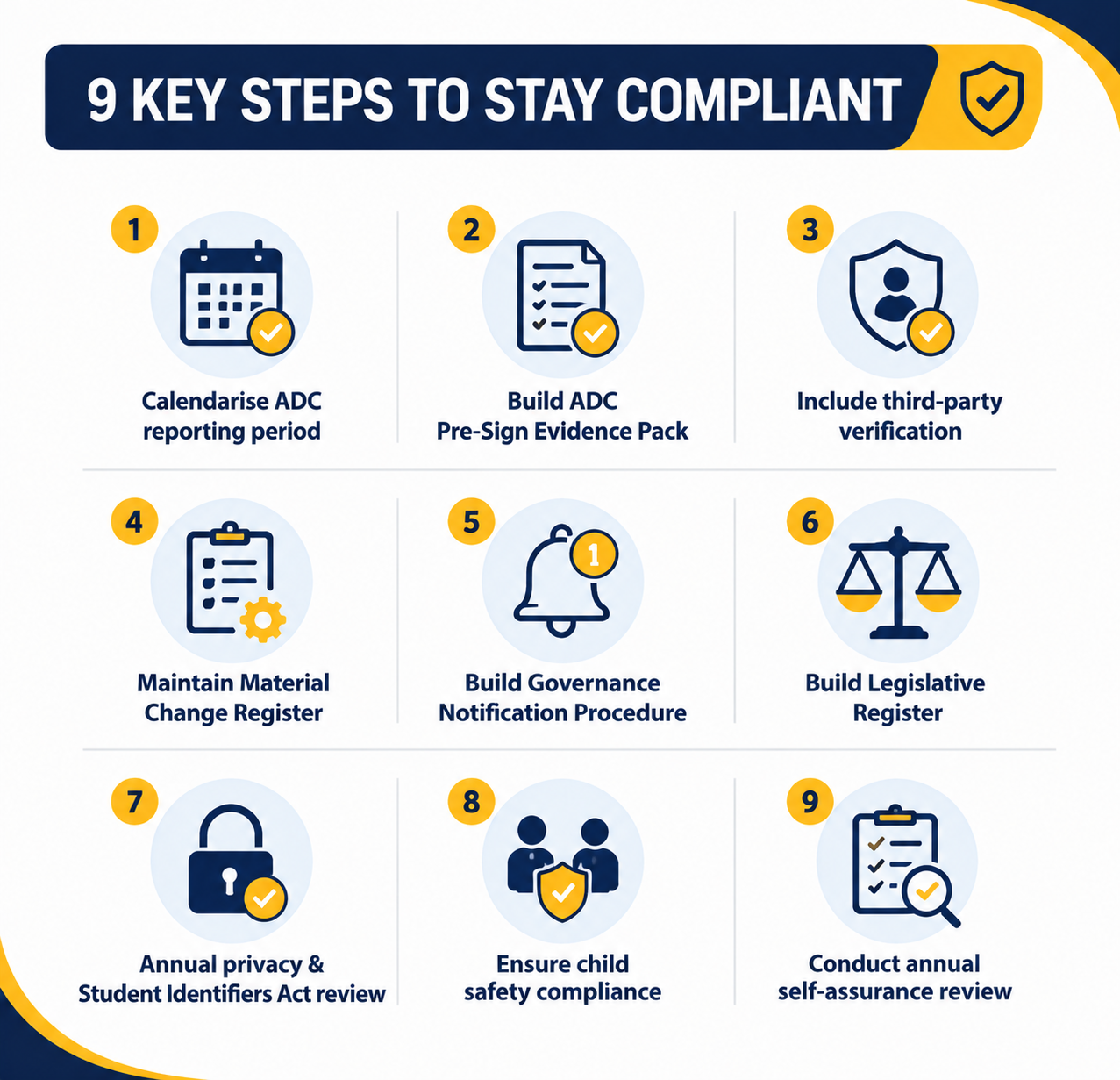
These steps mirror ASQA’s published example activities — they are not a regulatory prescription, simply a practical sequence many RTOs use to align their accountability Part A operations with the Practice Guide:
| Area | Connection |
| Information and Transparency | Marketing and advertising must align with the Australian Consumer Law and other applicable laws covered under Compliance with Laws |
| Accountability — Part B | Third-party arrangements feed directly into ADC preparation; prepaid fees and public liability obligations are part of the same Practice Guide |
| Conditions of Registration | Material change clauses connect to fit and proper persons, financial viability, and the broader conditions of registration |
| Outcome Standards — Governance | ADC self-disclosure connects to continuous improvement and risk management under the Outcome Standards governance area |
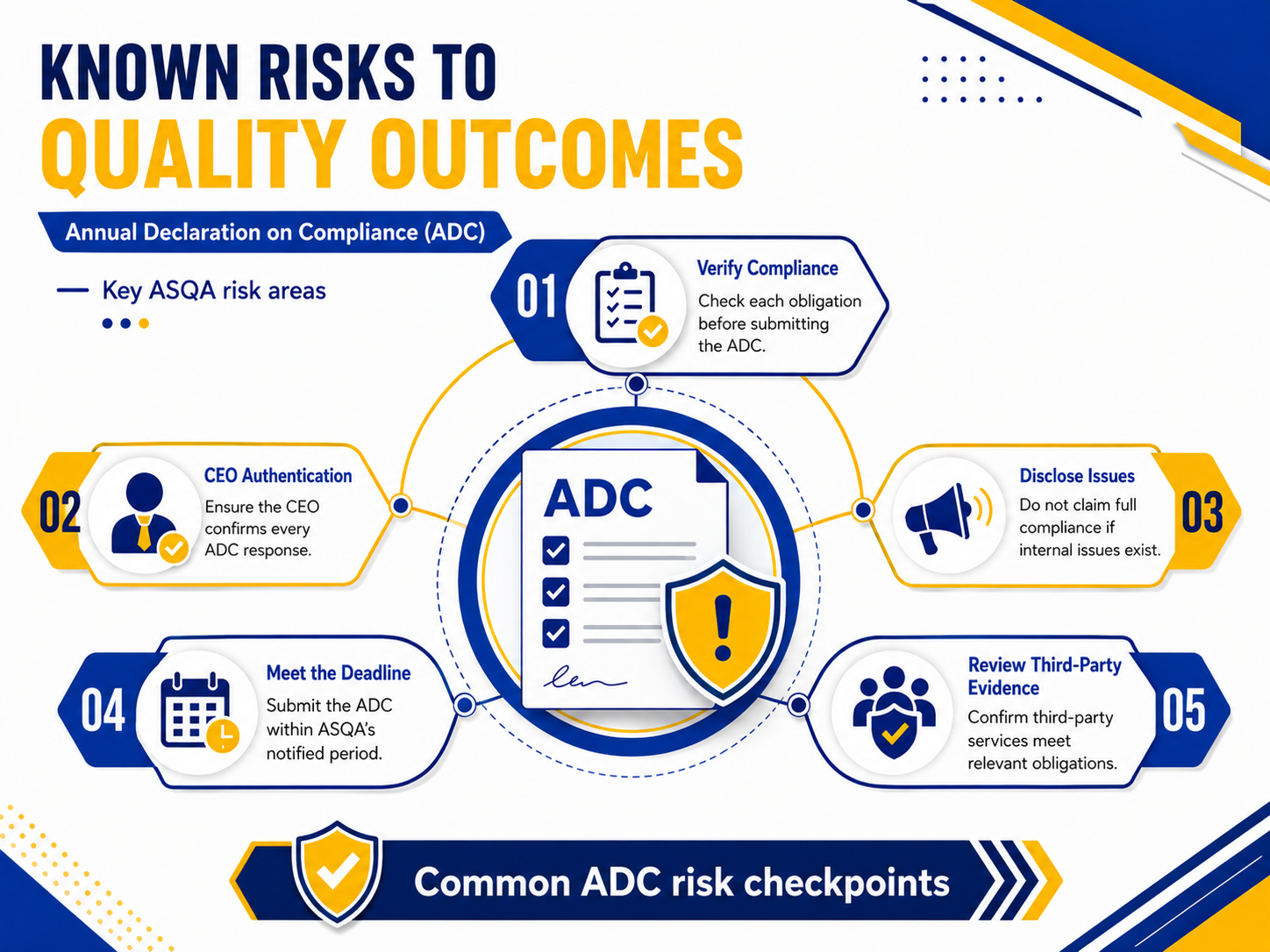
ASQA’s Practice Guide example activities state that only the CEO, as the person legally responsible for the RTO’s registration, submits the declaration to ASQA.
ASQA states the preparatory work for the ADC must cover the RTO’s entire scope of registration, including all services delivered by third parties on the RTO’s behalf.
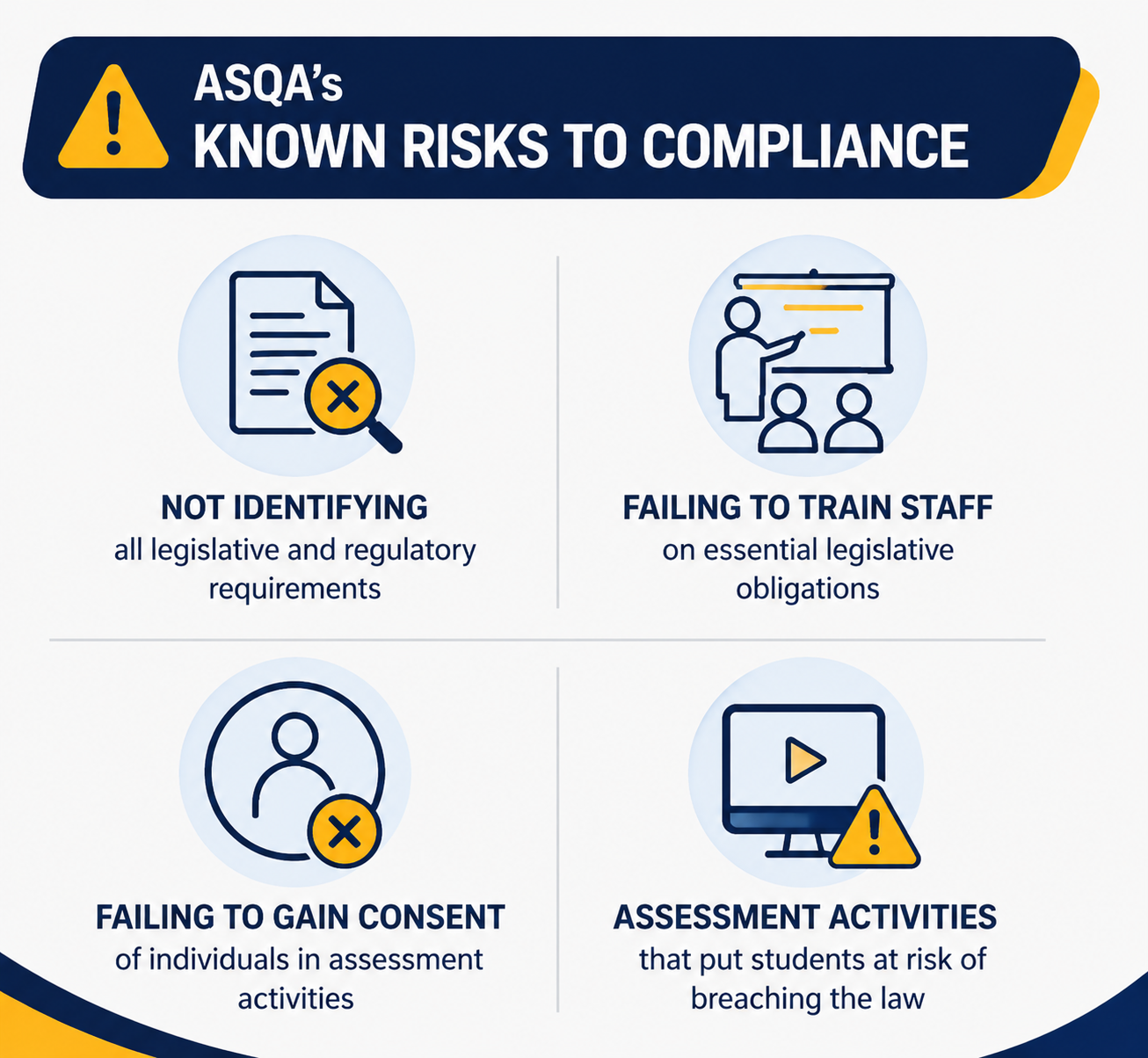
ASQA’s example activities state that the RTO discloses through the ADC any self-identified non-compliance and what rectification actions are being taken. The known risks list ‘Declaring full compliance on the ADC even though you have identified non-compliances internally – i.e. failing to disclose.’
ASQA states a notice under subsection (1) — events that would significantly affect the RTO’s ability to comply with its obligations under the Act — must be given within 10 business days after the event occurs.
ASQA states that an RTO must notify the National VET Regulator of any prospective changes to the ownership of the organisation as soon as practicable before the change takes effect.
ASQA states the RTO must notify any prospective or actual change in relation to a governing person: if the change cannot be determined until it takes effect, within 10 business days of the change taking effect; otherwise, as soon as practicable before the change takes effect.
ASQA states that a notice under subsection (1) or (3) must be provided to the National VET Regulator in writing or electronically.
ASQA states the RTO must comply with all applicable Commonwealth, State and Territory laws, including privacy laws and the Student Identifiers Act 2014. The Practice Guide notes that there are a range of laws that may be applicable; the examples provided are for illustrative purposes.
Yes. ASQA’s example activities mention the Work Health and Safety Act in the RTO’s jurisdiction(s) as an example of an applicable law to be identified.
Yes. ASQA’s example activities state: ‘Where your operations involve children (e.g. students under the age of 18), you ensure your organisation and relevant staff are fully compliant with child safety laws.’
ASQA’s example activities state that the RTO takes active steps to protect VET students’ personal and sensitive information and ensure the secure storage of VET students’ documentation and student identifiers.
“ADC Pre-Sign Evidence Pack + Material Change Notification Tracker (2025 Edition) — by VET Resources”
A practical, audit-ready evidence pack and tracker built directly from ASQA’s Accountability Part A Practice Guide. Pre-mapped to ASQA’s example activities, known risks, and self-assurance questions for the Annual Declaration on Compliance, Notification of Material Changes, and Compliance with Laws.
👉 DM “DECLARATION” on Instagram or LinkedIn, or email VET Resources to receive your free copy.
Accountability Part A — the ADC, material change notifications, and compliance with laws — is the governance posture an RTO presents to ASQA every year and at every material event. ASQA’s Practice Guide makes the requirements, examples, risks and self-assurance questions explicit; the role of the RTO is to evidence each one.
The next blog in this series unpacks Accountability Part B — third-party arrangements, prepaid fee protection measures, and public liability insurance. Subscribe so you don’t miss it.

