Why This Blog Matters
Accountability Part A series covered the Annual Declaration on Compliance, Notification of Material Changes, and Compliance with Laws. Accountability Part B covers the three operational protections inside the same Practice Guide: Third-Party Arrangements, Prepaid Fee Protection Measures, and Public Liability Insurance.
These three clauses sit closely together because each one defines how the RTO protects the integrity of its operations â through written agreements with third parties, financial protection of prepaid student fees, and insurance coverage of all RTO activities. Every clause, example activity, known risk, and self-assurance question in this blog is lifted directly from ASQAâs Accountability Part B Practice Guide.
Clause 1 â Third-Party Arrangements (Verbatim from ASQA)
Requirement: An NVR registered training organisation must ensure that where services are delivered by a third party on the organisationâs behalf, the provision of the services is governed by a written agreement that:

- Is entered into by the organisation and the third party as soon as reasonably practicable, prior to the third party delivering any of the services set out in the agreement
- Requires the third party to cooperate with the National VET Regulator where the Regulator conducts any audit of the NVR-registered training organisationâs operations
- Requires the third party to provide accurate responses to requests for information from the Regulator relevant to the third partyâs delivery of the services
- Prohibits the third party from: using the NRT logo; using the organisationâs branding; issuing any AQF certification documentation
- Contains the following particulars: the business or trading names of the parties to the agreement; the dates on which the agreement will commence and end; all the partiesâ obligations concerning the delivery of the services; and an entitlement for the organisation to regularly monitor the quality of the services being delivered by the third party
An NVR registered training organisation must notify the National VET Regulator of any written agreement made pursuant to subsection (1) within:
- 30 calendar days of the agreement being entered into or before the obligations under the agreement taking effect, whichever occurs first; and
- 30 calendar days of the agreement ending
ASQAâs Example Activities and Known Risks for Compliance (Verbatim)
- You can demonstrate that all your third-party written agreements include all information stipulated under the Standards
- Your written agreements clearly specify the roles and responsibilities of each party and how you monitor the performance of the third party to ensure the quality of services and compliance with the Standards
- You can demonstrate the systems and processes you use to identify emerging risks and promptly rectify non-compliance by your third-party providers
- You have evidence that a written agreement was in place with each of your third parties before they commenced delivery of any services
- You can demonstrate how you routinely review the suitability of your third-party arrangements and maintain currency of your written agreements
- You ensure your staff understand the definition of third parties and when a written agreement is required
- You ensure that your third parties are aware of their ongoing requirement to cooperate with ASQA
- You can demonstrate how you make your third parties aware of their obligations under the Standards and any other legislative or regulatory requirements that apply to the service/s they are delivering on your RTOâs behalf
- You can demonstrate the protocols you have in place to communicate with your third parties regarding: legislative changes that may impact their service; changes in delivery; expectations around providing support for student wellbeing, and managing complaints
- You can demonstrate how you authenticate the credentials and practices of trainers and assessors engaged by your third-party providers
- You ensure that VET students are made aware of any third-party involvement in their training and assessment, including that their AQF certification documentation will be issued by your RTO (not the third party)
- You have processes in place to notify ASQA within the required timeframe whenever you enter into, or end, a third-party arrangement
ASQAâs Known Risks to Compliance (Verbatim)
- Failing to notify ASQA of new and ceasing third-party agreements
- Failing to undertake due diligence on an organisationâs commitment, capability and capacity to deliver quality training and assessment before engaging it as a third party â for example, but not limited to: failing to undertake due diligence checks in relation to the fitness and propriety of relevant staff of the third party organisation; not comprehensively assessing the capacity of the third party to provide training support services and wellbeing support services
- Assuming that outsourcing services to third parties will release your RTO of its compliance obligations
- Allowing services to be provided by a third party before the written agreement has been signed by both parties
- Failing to invest in dedicated resources to monitor the quality and compliance of services provided by your third parties. This is of particular concern where you have many third-party arrangements
- Not being transparent with students about the role and responsibilities of your RTO versus those of the third-party provider
- Failing to inform students about how they can provide feedback or make a complaint about a third party engaged by your RTO
- Engaging offshore-based third parties that are unaware of relevant Australian laws and the VET Quality Framework
Clause 2 â Prepaid Fee Protection Measures (Verbatim from ASQA)
Requirement: Where an NVR registered training organisation or third party receives prepaid fees from or on behalf of an individual in excess of $1500 in relation to the same VET course (the threshold prepaid fee amount), the organisation must:
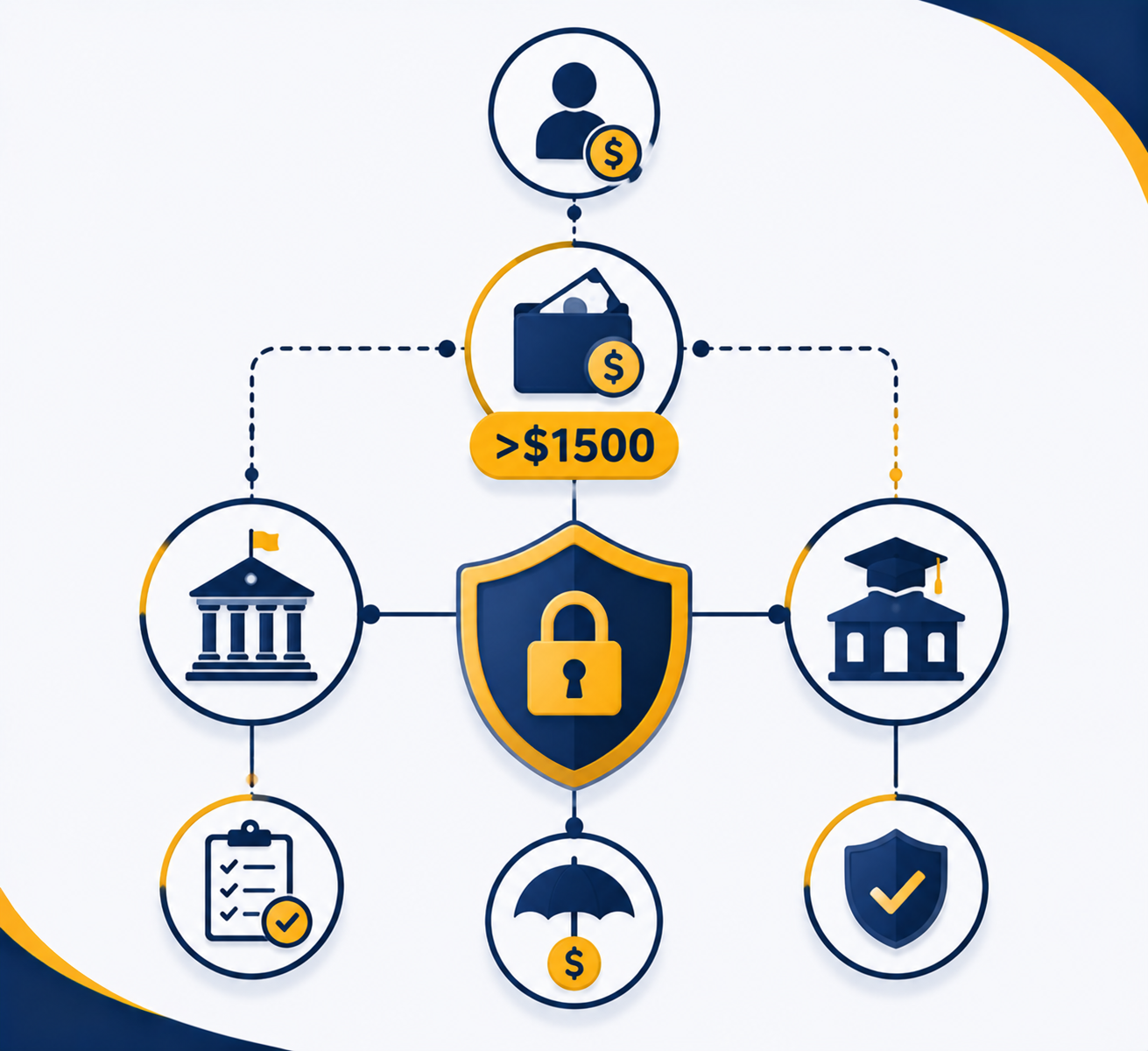
- Where the organisation is a government entity or an Australian university, comply with the requirements set out in subsections (2) and (3); or
- Where the organisation is any other NVR registered training organisation, implement one or more of the arrangements set out in subsection (4)
Requirements for Government Entities and Australian Universities (Verbatim)
The NVR registered training organisation must have a policy in place for circumstances where the organisation is unable to provide the services to which the threshold prepaid fee amount relates (prepaid fee policy). An NVR registered training organisationâs prepaid fee policy must specify how an individual who has prepaid will:

- Be placed into an equivalent course at a location suitable to the individual and receive all services for which the individual has prepaid at no additional cost to the individual; or
- Be refunded the prepaid fees for services yet to be delivered, which are in excess of the threshold prepaid fee amount
Requirements for Other NVR Registered Training Organisations (Verbatim)
The NVR registered training organisation must implement one or more of the following arrangements:

- An unconditional financial guarantee from a bank operating in Australia, provided: at all times, the guarantee is at least equal to the total amount of prepaid fees held by the organisation in excess of the threshold prepaid fee amount; and the costs of establishing and maintaining the guarantee are met by the organisation. (Note: For example, where an RTO receives prepaid fees of $2000 from three individuals (totalling $6000), the guarantee must be at least equal to $1500 â i.e. $500 multiplied by three.)
- A current membership with a tuition assurance scheme operator which, if the organisation is unable to provide services for which the individual has prepaid, must ensure: the individual will be placed into an equivalent course at a location suitable to the individual and receive all services for which the individual has prepaid at no additional cost to the individual; or if an equivalent course cannot be found â the individual will be refunded the prepaid fees which are in excess of the threshold prepaid fee amount
- Any other fee protection measure approved by the National VET Regulator
ASQAâs Example Activities and Other Considerations for Compliance (Verbatim)
- You can show how your prepaid fee policy ensures that students are adequately protected financially in accordance with this requirement
- You maintain adequate controls over how withdrawals can be made from your protected account and by whom â for example, multiple signatories for withdrawals; ensuring administrative staff are aware that the protected account is only to be used to refund a student, not for other operational expenses
- You ensure prepaid fees received through a direct enrolment are protected, no matter how the fees are collected, including where they are collected by a third-party loan provider or via online payment instalments
- Where you choose to hold an unconditional financial guarantee from a bank operating in Australia, you ensure that: the guarantee is structured so that you can promptly refund studentsâ prepaid fees in excess of $1500 in circumstances where you are no longer able to deliver the training; and you can demonstrate how the amount of the guarantee was determined; and this level is always greater than the amount of fees required to be protected
- Where you choose to implement an alternative fee protection measure, you ensure that: you apply to ASQA for approval in writing, including details of how the measure will be implemented; and the measure demonstrates an equivalent level of fee protection as that provided by an unconditional financial guarantee from a bank operating in Australia; and you wait until you receive approval from ASQA before collecting fees in excess of $1500, unless you already have another approved fee protection measure in place in the interim
- If you utilise the Tuition Protection Service to protect fees paid by international students, you ensure that you have an alternative approved fee protection measure for domestic VET students
- If you utilise the tuition protection arrangements under the VET Student Loans Act 2016 for VET Student Loans (VSL), you ensure that you have an alternative fee protection measure for non-VSL students
- You ensure that your refund policy, which students are provided with at the time of enrolment, is reflective of the prepaid fee protection requirements
ASQAâs Known Risks to Compliance (Verbatim)
- Accepting prepaid fees before determining the suitability of a prospective student for the course they are enrolling in
- Failing to ensure that your fee protection method covers all applicable student cohorts within the scope of your operations
- Incorrectly assuming that multiple pre-paid instalments of less than $1500 each for the same VET course will avoid the threshold prepaid fee amount and requirements associated with it
- Not monitoring the protected account to ensure it is always equal to or greater than the amount of fees required to be protected
- Failing to ensure that prepaid fees above $1500 that are collected through external loan providers, including âbuy now, pay laterâ providers, are appropriately protected
- Using the protected amounts and accounts to pay for business operating expenses
- Failing to have adequate controls over who within the RTO can make withdrawals from the protected account
- Failing to limit online payment gateways to $1500, where an RTO states it will not collect more than $1500 in prepaid fees
Clause 3 â Public Liability Insurance (Verbatim from ASQA)
Requirement: An NVR registered training organisation must hold public liability insurance that covers all the organisationâs operations for the entire period in which the organisation is registered under the Act.

ASQAâs Example Activities and Other Considerations for Compliance (Verbatim)
- You have evidence of how you determine appropriate and sufficient public liability insurance for your operations
- You have systems and processes in place to ensure that any additions to scope, including activities such as work-integrated learning or community-based learning, are covered under your public liability insurance
- You can demonstrate evidence of your public liability insurance, such as a certificate of currency, which: identifies that your RTO and its full scope of operations are covered by the policy; and confirms that all VET studentsâ activities are covered, or that there are no restrictions on the activities covered
ASQAâs Known Risks to Compliance (Verbatim)
- Failing to ensure your public liability covers your entire scope of operations, including where training is delivered online
ASQAâs Self-Assurance Questions Relevant to Part B (Verbatim)
- What due diligence do you undertake before engaging a particular third-party provider?
- What verification do you undertake of their trainersâ and assessorsâ qualifications?
- How do you monitor your third parties to ensure they comply with all relevant legislative and regulatory requirements?
- How do you ensure you have sufficient protected funds to be able to refund students promptly, if required?
- How do you ensure your public liability insurance is adequate and covers all VET students in all delivery settings?
If you cannot answer any of these with documented evidence, the Practice Guide flags it as an Accountability gap to address.
Summary of ASQAâs Practice Guide Expectations â Part B
| Clause | What ASQAâs Practice Guide / NVR Act expects you to demonstrate |
| Third-party arrangements â written agreement | Agreement signed before service delivery commences; cooperation with the Regulator; accurate responses to information requests; prohibitions on NRT logo, branding, and AQF certification documentation; particulars covering business names, dates, obligations, and monitoring entitlement |
| Third-party arrangements â notification | ASQA must be notified within 30 calendar days of the agreement starting (or before obligations take effect, whichever occurs first) and within 30 calendar days of the agreement ending |
| Third-party arrangements â operations | Due diligence on commitment, capability and capacity; quality monitoring; awareness of Standards and applicable laws; authentication of trainer/assessor credentials; transparency with students; complaints pathway |
| Prepaid fee threshold | Threshold prepaid fee amount = $1,500 per individual per VET course |
| Prepaid fees â government/university | Prepaid fee policy specifying placement into an equivalent course at a suitable location at no additional cost, or a refund of fees yet to be delivered above the threshold |
| Prepaid fees â other RTOs | Implement one or more of: an unconditional financial guarantee from a bank operating in Australia at all times equal to total prepaid fees above the threshold; a current membership with a tuition assurance scheme operator; or any other fee protection measure approved by the National VET Regulator |
| Prepaid fees â controls | Multiple signatories on the protected account; admin staff are aware that the account is only for student refunds; protection extends to instalments and external loan providers; refund policy aligned with the prepaid fee protection requirements |
| Public liability insurance | Coverage for all the organisationâs operations for the entire registration period; certificate of currency identifying the RTO and full scope of operations; coverage of all VET student activities, with no restrictions |
How RTOs Typically Build Accountability Part B Evidence
These steps mirror ASQAâs published example activities â they are not a regulatory prescription, simply a practical sequence many RTOs use:
- Maintain a Third-Party Register â every current and recent agreement with start and end dates, services covered, signatories, ASQA notification dates, and quality-monitoring cadence
- Lock the third-party agreement template â covering all subsection (1) particulars, prohibitions, and the entitlement to regularly monitor quality
- Build a Due Diligence Checklist â commitment, capability, capacity, fitness and propriety of relevant staff, and capacity for student support and wellbeing
- Calendarise ASQA notifications for every third-party start and end (30 calendar days)
- Document the Prepaid Fee Protection method chosen â bank guarantee, tuition assurance scheme membership, or ASQA-approved alternative
- Build a Protected Account Controls Procedure â multiple signatories, withdrawal authorities, monitoring against fees held, and a no-operating-expenses rule
- Map all collection channels â direct, third-party loan providers, BNPL, online instalments â to confirm coverage above the $1,500 threshold
- Align the refund policy provided at enrolment with the prepaid fee protection arrangement
- Maintain a Public Liability Certificate of Currency that explicitly covers the RTO and its full scope of operations, including online delivery, work-integrated and community-based learning
- Run an annual self-assurance review using ASQAâs Part B self-assurance questions and feed findings into the next ADC and the Compliance Standards Master Register
How Part B Connects to the Rest of the Compliance Standards
| Area | Connection |
| Information and Transparency | Marketing must clearly identify which services are delivered by the third party and which by the RTO |
| Accountability â Part A | Third-party performance feeds the ADC; protected fees and insurance feed the broader compliance posture and material change considerations |
| Conditions of Registration | Third-party fitness and propriety checks connect to the conditions of registration; financial viability connects to prepaid fee protection |
| Outcome Standards â Workforce | Authentication of third-party trainer and assessor credentials connects to the Quality Area 3 workforce expectations |
FAQs â Accountability Part B
ASQA states the requirement applies where services are delivered by a third party on the RTOâs behalf. The provision of those services must be governed by a written agreement that meets the particulars listed in subsection (1) of the clause.
ASQA states the agreement must be entered into by the organisation and third party as soon as reasonably practicable, prior to the third party delivering any of the services set out in the agreement.
ASQA states notification must occur within 30 calendar days of the agreement being entered into or before the obligations under the agreement taking effect, whichever occurs first; and within 30 calendar days of the agreement ending.
No. ASQA states the agreement must prohibit the third party from using the NRT logo, using the organisationâs branding, or issuing any AQF certification documentation. The Practice Guide also notes that students must be made aware that AQF certification documentation will be issued by the RTO, not a third party.
ASQA states the threshold prepaid fee amount is in excess of $1,500 from or on behalf of an individual in relation to the same VET course.
No. ASQAâs known risks list âIncorrectly assuming that multiple pre-paid instalments of less than $1500 each for the same VET course will avoid the threshold prepaid fee amount and requirements associated with it.â
ASQA states the RTO must implement one or more of: an unconditional financial guarantee from a bank operating in Australia (at all times at least equal to total prepaid fees above the threshold); a current membership with a tuition assurance scheme operator; or any other fee protection measure approved by the National VET Regulator.
Yes. ASQA states prepaid fees received through a direct enrolment must be protected, no matter how the fees are collected, including where they are collected by a third-party loan provider or via online payment instalments. The known risks list flags failing to protect prepaid fees collected through external loan providers, including âbuy now, pay laterâ providers.
No. ASQAâs example activities state administrative staff should be aware that the protected account is only to be used to refund a student, not for other operational expenses. The known risks list flags âUsing the protected amounts and accounts to pay for business operating expenses.â
ASQA states the RTO must hold public liability insurance that covers all the organisationâs operations for the entire period in which the organisation is registered under the Act. The certificate of currency should identify the RTO and its full scope of operations and confirm all VET studentsâ activities are covered or that there are no restrictions.

ASQAâs known risks list specifically flags âFailing to ensure your public liability covers your entire scope of operations, including where training is delivered online.â
Lead Magnet â Free Download
âThird-Party Agreement + Prepaid Fee Protection Register (2025 Edition) â by VET Resourcesâ
A practical, audit-ready register built directly from ASQAâs Accountability Practice Guide. Pre-mapped to ASQAâs example activities, known risks, and self-assurance questions for Third-Party Arrangements, Prepaid Fee Protection Measures, and Public Liability Insurance.
ð DM âTHIRDPARTYâ on Instagram or LinkedIn, or email VET Resources to receive your free copy.
Final Word
Part B of the Accountability Practice Guide is the operational protection layer of the Compliance Standards. ASQAâs Practice Guide makes the requirements, examples, risks, and self-assurance questions explicit; the role of the RTO is to evidence each one across written agreements, financial protection of prepaid fees, and insurance coverage of all activities.
The next blog in this series unpacks the Conditions of Registration Practice Guide. Subscribe so you donât miss it.
Related Products
-
LLND Kit â 22250VIC Certificate I in EAL (Access)
$1,300.00Original price was: $1,300.00.$450.00Current price is: $450.00. -
LLND Kit â 22251VIC Certificate II in EAL (Access)
$1,300.00Original price was: $1,300.00.$450.00Current price is: $450.00. -
LLND Kit â 22254VIC Certificate III in EAL (Employment)
$1,300.00Original price was: $1,300.00.$450.00Current price is: $450.00. -
LLND Kit â 22255VIC-Certificate III in EAL (Further Study)
$1,300.00Original price was: $1,300.00.$450.00Current price is: $450.00. -
LLND Kit â 22258VIC â Certificate IV in EAL (Further Study)
$1,300.00Original price was: $1,300.00.$450.00Current price is: $450.00.