

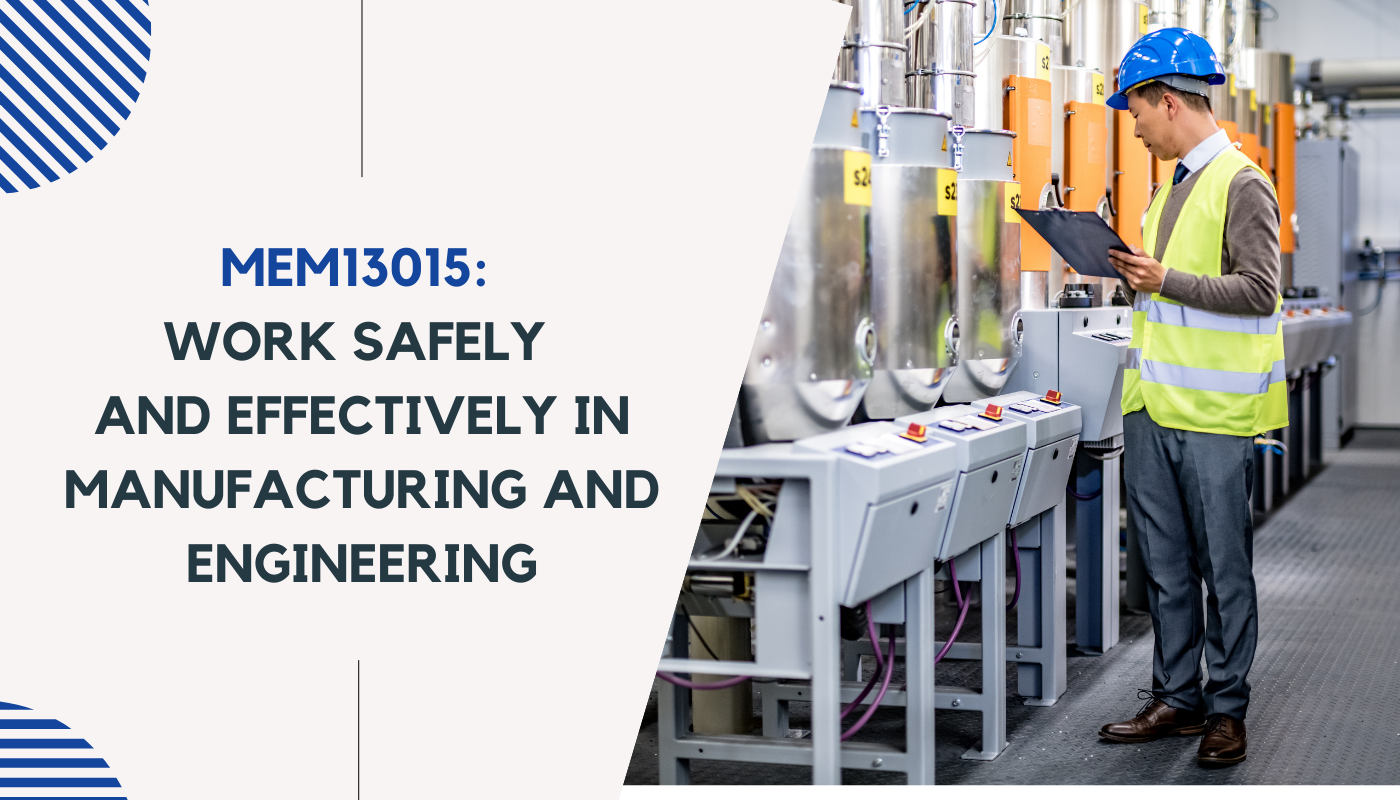
In today’s advanced manufacturing and engineering environments, workplace safety and operational efficiency are critical to success. The unit MEM13015 Work Safely and Effectively in Manufacturing and Engineering plays a vital role in preparing workers to follow safety protocols, communicate effectively, and perform tasks with accuracy. Mastery of this unit supports compliance, boosts productivity, and ensures that every team member contributes to a safe, high-performing workplace.
The MEM13015 unit, “Work Safely and Effectively in Manufacturing and Engineering,” plays a crucial role in fostering a safe and productive environment. This blog will delve into the significance of MEM13015, explore related units such as MEM2023, MEM18055, MEM05005, MEM18006, and MEM18003, and demonstrate how these components interconnect to establish a cohesive framework for manufacturing excellence.

Safety is the backbone of any successful manufacturing and engineering operation. MEM13015 Work Safely and Effectively in Manufacturing and Engineering emphasises the critical importance of identifying hazards, adhering to occupational health and safety (OHS) guidelines, and implementing best practices. By doing so, both employees and the equipment they operate are safeguarded from preventable incidents.
An essential component of MEM13015 is fostering clear communication among team members. Effective communication minimises errors, streamlines workflows, and ensures that safety instructions are followed accurately. It is also vital for conflict resolution and task coordination.
Personal Protective Equipment (PPE) is fundamental in ensuring worker safety. MEM13015 emphasises the correct usage of PPE, such as gloves, helmets, safety glasses, and protective clothing. Understanding the appropriate application of PPE ensures that workers are safeguarded against workplace hazards.
MEM2023 builds upon the foundation laid by MEM13015, focusing more comprehensively on the principles of occupational health and safety. While MEM13015 introduces the basics of safe practices, MEM2023 requires learners to apply these principles in real-world scenarios, reinforcing the importance of risk assessment, hazard identification, and emergency preparedness.
MEM2023 highlights the necessity of conducting thorough risk assessments to identify potential dangers in the workplace. This involves examining machinery, processes, and environments to pinpoint risks and implement control measures.
Effective emergency response plans are a critical part of MEM2023. Workers must be familiar with fire evacuation protocols, spill containment procedures, and first aid protocols. This level of preparedness ensures that operations remain safe, even during unforeseen incidents.
MEM18055 complements MEM13015 by focusing on the practical skills required to work safely when dismantling, replacing, and assembling engineering components. Workers must follow safety protocols to avoid accidents during component handling and machinery operation.
Precision and compliance are crucial when working with engineering components. MEM18055 trains individuals to ensure that components are dismantled and reassembled according to manufacturer specifications. This reduces downtime and prevents system malfunctions.
Welding is a critical skill in the manufacturing and engineering industries. MEM05005 emphasises the safe execution of routine welding tasks, aligning with the principles outlined in MEM13015. Welding requires adherence to strict safety protocols to prevent injuries from heat, sparks, and fumes.
Key safety precautions in welding include wearing appropriate PPE, such as welding masks, fire-resistant clothing, and gloves. MEM05005 also covers the importance of maintaining a well-ventilated workspace and ensuring proper handling of gas cylinders and electrical equipment.
MEM05005 focuses on producing high-quality welds that meet industry standards. This involves inspecting welds for defects, such as cracks or porosity, and applying corrective measures when necessary.
MEM18006 addresses the critical skill of precision fitting in engineering. Precision fitting involves ensuring that components fit together accurately to achieve optimal system performance. This unit builds on MEM13015 by reinforcing the importance of working safely and effectively while handling complex machinery.
Workers are trained to use specialised tools, such as micrometres, callipers, and torque wrenches, to achieve accurate measurements and ensure seamless assembly. MEM18006 emphasises the need for meticulous attention to detail and adherence to safety protocols.
MEM18006 also covers strategies to avoid hazards, such as over-tightening fasteners, using inappropriate tools, or failing to secure components. By following these guidelines, workers can prevent equipment damage and maintain a safe work environment.
Accurate measurement is a cornerstone of successful engineering projects. MEM18003 focuses on using tools for precise engineering measurements, reinforcing the principles of safety and effectiveness outlined in MEM13015.
Measurement tools such as rulers, protractors, and dial indicators are used to ensure that engineering components meet specified tolerances. MEM18003 trains workers to use these tools correctly, ensuring accuracy and minimising errors.
The use of measurement tools requires careful handling to avoid injuries. MEM18003 emphasises proper posture, tool maintenance, and secure handling to prevent accidents. This ensures that safety is maintained while performing intricate tasks.
The interconnection between MEM13015 and other units, such as MEM2023, MEM18055, MEM05005, MEM18006, and MEM18003, creates a comprehensive framework for developing safety-conscious and highly skilled workers. By mastering the content of these units, workers can contribute to a safer and more efficient workplace.
Ongoing training and upskilling are vital in the manufacturing and engineering sectors. By continuously reinforcing safety principles and improving technical competencies, workers can stay updated with industry advancements and maintain compliance with regulatory requirements.
Supervisors and managers play a crucial role in implementing the principles of MEM13015. They are responsible for ensuring that workers follow safety protocols, conduct regular safety drills, and provide feedback to enhance operational efficiency.
In conclusion, MEM13015 Work Safely and Effectively in Manufacturing and Engineering serves as the foundation for safe and effective practices in the manufacturing and engineering sectors. When paired with complementary units such as MEM2023, MEM18055, MEM05005, MEM18006, and MEM18003, it promotes a culture of safety, precision, and continuous improvement. By adhering to these principles, organisations can ensure compliance, minimise workplace incidents, and boost productivity.
For workers, mastering these units not only enhances their safety but also equips them with the essential skills for long-term success in the industry. Applying the knowledge gained from these units delivers a positive impact on both individual performance and organisational outcomes, highlighting the importance of comprehensive safety training in Australian manufacturing and engineering environments.
MEM13015 focuses on developing the skills and knowledge to work safely and effectively in manufacturing and engineering environments. This includes understanding safety procedures, risk management, and effective communication at the workplace.
The unit covers workplace safety protocols, hazard identification, personal protective equipment (PPE) use, emergency procedures, and how to operate machinery effectively. Tip: Pay attention to workplace safety guidelines, as they form the backbone of this unit.
No formal prerequisites are required, but having basic knowledge of workplace safety and basic machinery operations can help. It’s also useful to be familiar with common manufacturing and engineering terms.
One common challenge is grasping the safety requirements and applying them practically in the workplace. The practical assessment component can also be difficult for some learners. Tip: Ensure hands-on practice to gain confidence with safety measures.
Practice using the equipment in a controlled environment, and review the safety protocols before you attempt the assessment. Focus on learning safe operation techniques and emergency responses for the equipment you will use.
This unit aligns with the Work Health and Safety (WHS) standards in Australia, which require workers in manufacturing and engineering environments to follow strict safety procedures. It helps prepare workers to identify hazards and mitigate risks.
If unsure, always ask your supervisor or mentor for guidance. Safety is a top priority, and you should never hesitate to double-check procedures. Familiarise yourself with the safety manuals and safety officers in your workplace.
While not always mandatory, MEM13015 is highly recommended for those looking to work in these sectors, as it covers essential safety training that is valued by employers. Some employers may require this unit for certain positions.
The unit typically takes between 4 and 6 weeks to complete, depending on the training format and whether it’s part of a broader qualification. Ensure you stay on track with both theoretical and practical assessments.
MEM13015 can be taken both online and face-to-face, depending on the RTO (Registered Training Organisation). However, practical assessments will likely need to be done in person to demonstrate safety practices and equipment handling.