90 Days to a Bulletproof RTO Workforce: The Playbook ASQA Wishes Every Provider Would Read

Get a Free Sample
Table of Contents

The Hard Truth Most RTO Owners Don’t Want to Hear

Most RTOs spend 18 months reacting to workforce findings. The ones that lead the sector spend 90 days building the system. The difference isn’t the budget. It isn’t size. It isn’t even a compliance experience. It’s sequence and discipline.

Quality Area 3 is the most-failed area in 2025 audits — across credentialling, working under direction, industry currency, PD, and third-party workforce assurance. The previous four blogs in this series unpacked each Standard verbatim against ASQA‘s Practice Guides. This blog is the implementation layer — the 90-day plan that turns those expectations into evidence.

VET 3 1

If you implement only one thing from this series, implement this. It is the difference between an RTO that scrambles before audit and an RTO that stops scrambling forever.

Why 90 Days, Not 12 Months

VET 2 1

Three reasons:

  • Audit windows compress. ASQA notices arrive without warning. A 12-month plan is a 12-month risk. 
  • Workforce systems are interdependent — staffing model, credentials, working under direction, industry currency, and PD all touch each other. They must be built in parallel, not in sequence. 
  • Discipline beats duration. RTOs that drag workforce uplifts past 90 days lose momentum, lose ownership, and lose the chance to embed the system before the next intake or the next audit.

The 90-Day Playbook at a Glance

PhaseDaysThemePrimary outcome
Phase 1Days 1–30Diagnose & MapWorkforce baseline, evidence gaps, ownership
Phase 2Days 31–60Build & AuthenticateCredentialling, currency evidence, PD framework, supervision system
Phase 3Days 61–90Govern & EmbedPerformance reviews, third-party assurance, contingency, and governance reporting

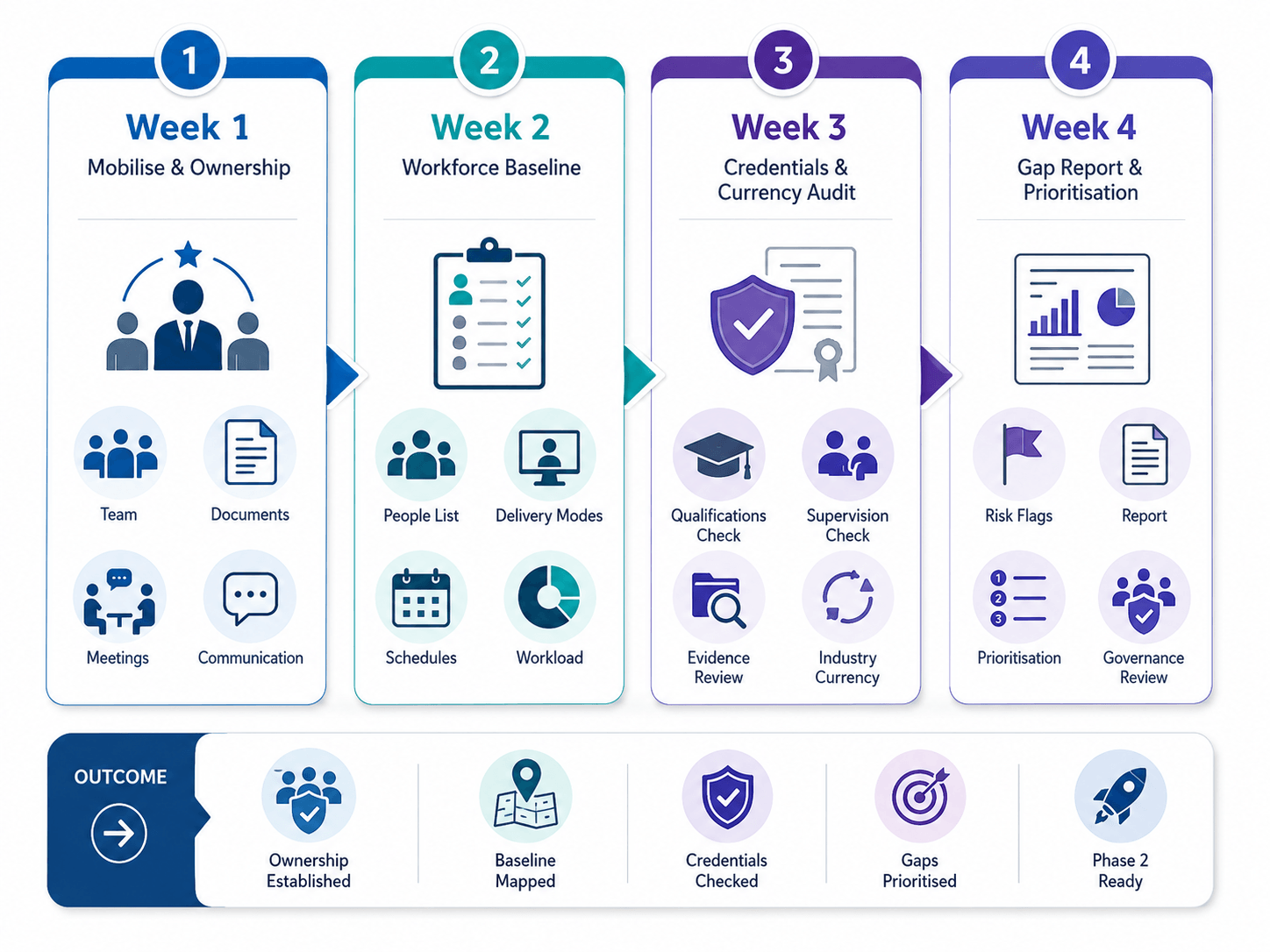
Phase 1 — Days 1–30: Diagnose & Map

The first 30 days are entirely about telling the truth. Before you build anything, you must know where you actually stand against ASQA’s Practice Guides for 3.1, 3.2 and 3.3.
VET 4 1024x768

Week 1 — Mobilise & Set Ownership 

  • Appoint a single Workforce Compliance Lead — accountable for the 90-day plan, reporting to the CEO weekly 
  • Form a working group: Compliance Manager, Lead Trainer, HR, third-party manager (if applicable), and CEO sponsor 
  • Pull the four blog references and the two ASQA Practice Guides into a shared evidence repository 
  • Set the meeting cadence: weekly working group, fortnightly steering, monthly governance update 
  • Communicate the 90-day plan internally — staff need to understand this is system-building, not blame-finding

Week 2 — Workforce Baseline (Standard 3.1)

  • List every person involved in training and assessment: direct staff, casuals, contractors, third-party trainers, industry experts 
  • Capture against each: name (or role ID), credentials held, training products delivered/assessed, mode of delivery, employment type, supervisor (if working under direction) 
  • Build the demand picture: student numbers per cohort, modes of delivery, training products on scope, third-party volume, cohort diversity, scheduled delivery hours, assessment dates 
  • Assess staffing appropriateness against the demand picture — flag gaps and over/under-resourcing

Week 3 — Credential & Currency Audit (Standards 3.2, 3.3)

  • Authenticate every TAE qualification against the Credential Policy — flag any that are unverified, superseded, or out of scope 
  • Document working-under-direction arrangements for every applicable person — supervisor, supervision plan, QA method, assessment-judgement firewall 
  • Sample current industry practice evidence per trainer per training product — flag where evidence is missing, generic, or older than 12 months 
  • Sample expert engagements — confirm written engagement scope, working-under-direction record, alongside-assessment documentation

Week 4 — Gap Report & Prioritisation

  • Produce a single Workforce Gap Report — one row per gap, mapped to Standard 3.1 / 3.2 / 3.3 and severity (Critical / High / Moderate / Low) 
  • Identify any gaps that are immediately reportable — material non-compliance with the Credential Policy or working-under-direction breaches involving assessment judgements 
  • Lock the priority list for Phase 2 — credentialling and assessment integrity gaps go first 
  • Brief governance: top five risks, top five actions, 30-day evidence

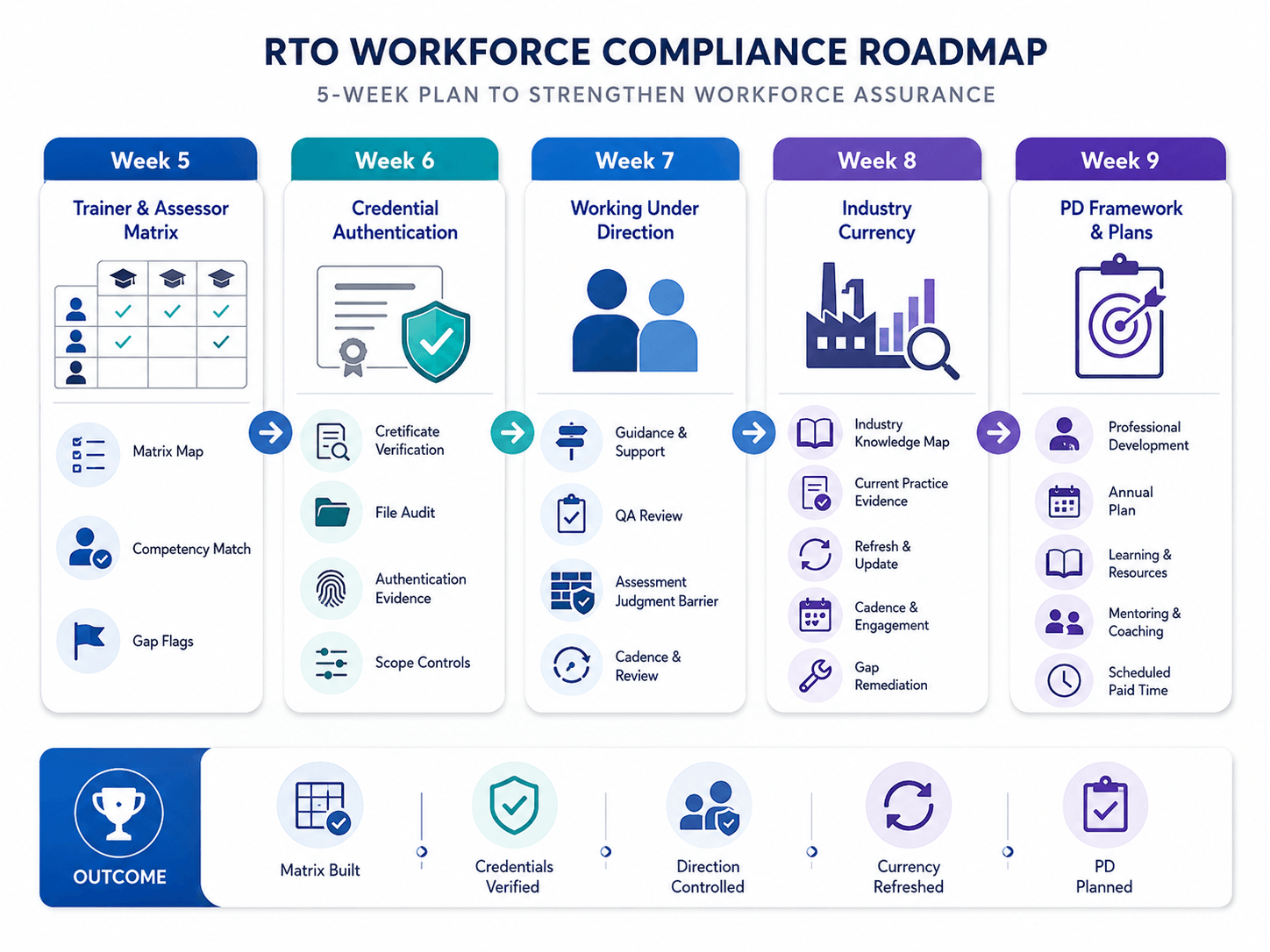
Phase 2 — Days 31–60: Build & Authenticate

Phase 2 is where systems get built, evidence gets collected, and the workforce stack starts producing audit-ready outputs.
VET 5 1024x768

Week 5 — Build the Trainer & Assessor Matrix

  • Create the master matrix mapping every trainer to every training product they deliver/assess — at the unit-of-competency level 
  • For each row: TAE credential and authentication status, vocational competencies and level, scope-of-credential boundary, working-under-direction status, current industry practice evidence count, PD status 
  • Confirm relevance and at least the level of the training product for each trainer-product pairing 
  • Flag any gap (industry competency below product level, missing credential, missing currency evidence) for remediation

Week 6 — Credential Authentication System

  • Document the credential authentication procedure — verification at recruitment, annual re-verification, and immediate re-verification on role/scope change 
  • Verify every direct staff member, third-party trainer and industry expert against the Credential Policy 
  • Document scope-of-credential controls — explicit rules preventing tasks beyond credential scope 
  • File authentication evidence in the master matrix and the staff/trainer file

Week 7 — Working-Under-Direction Framework

  • Document each working-under-direction arrangement: supervisor name, supervisor credentials, supervision and guidance arrangements (including engaging and supporting students), QA method, assessment-judgement firewall, review cadence 
  • Confirm every supervisor is appropriately skilled and qualified, and has sufficient time and support 
  • Run an assessment sample audit — confirm no under-direction staff member has signed an assessment judgement 
  • Build the QA review cadence — periodic sampling of work produced under direction

Week 8 — Industry Currency Evidence Refresh

  • Map industry competencies, skills and knowledge to each training product at the unit-of-competency level 
  • Collect at least three current industry practice evidence points per trainer per training product — drawing from ASQA’s published examples (industry work, accredited training, associations, engagement, journals, technology, legislation/licensing) 
  • Activate the industry engagement cadence — quarterly minimum — with documented outcomes feeding currency reviews 
  • Document gap analysis — where a trainer’s industry currency does not fully cover a unit, document gap and remediation

Week 9 — PD Framework & Annual PD Plans

  • Document a PD Framework — purpose, allocated time, allocated resources, role-aligned activities, current and emerging practice focus 
  • Build an annual PD Plan per trainer/assessor — covering training and assessment currency (3.2) and industry currency (3.3) 
  • Schedule role-specific PD: VET reporting, cultural awareness and student wellbeing, higher-level VET qualifications, validation/moderation, learning networks, mentoring 
  • Move PD time into paid hours — ASQA flags failure to allocate time as a known risk

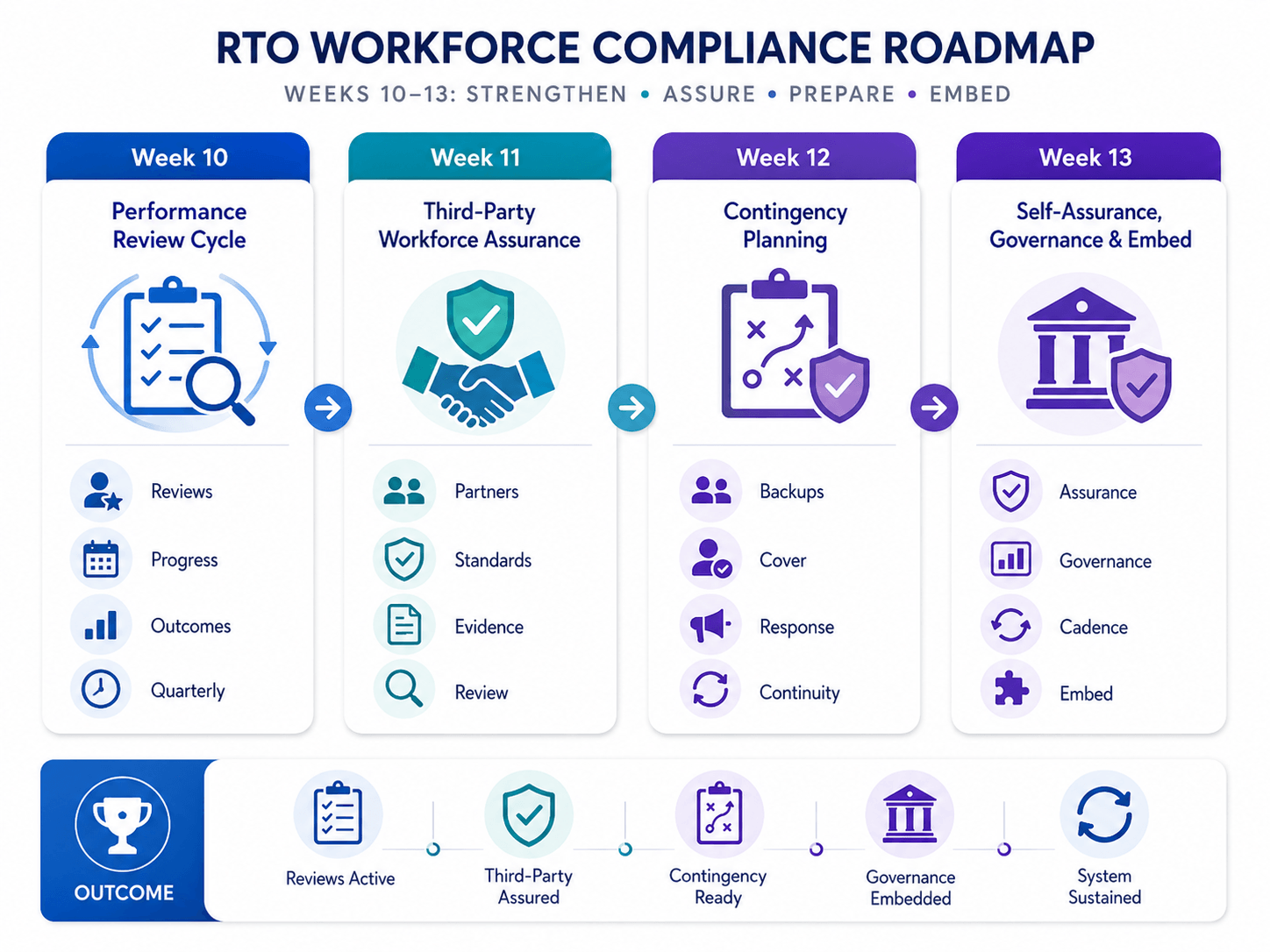
Phase 3 — Days 61–90: Govern & Embed

Phase 3 is governance — the layer that makes the system durable, auditable, and self-sustaining beyond the 90 days.
VET 6 1 1024x768

Week 10 — Performance Review Cycle

  • Stand up a quarterly performance review for every trainer and assessor — feeds directly into PD planning and currency reviews 
  • Document the review template: training and assessment skills, industry currency, working-under-direction performance (if applicable), PD progress, student outcomes 
  • Calibrate reviewer expectations — supervisors and lead trainers trained on consistent application 
  • Set the rhythm: Q1 review in Week 10; future reviews diarised at quarterly intervals

Week 11 — Third-Party Workforce Assurance

  • Document the third-party workforce assurance strategy — how the RTO ensures third parties maintain adequate levels of appropriately skilled and qualified staff 
  • Apply the same matrix, credentialing, currency and PD standards to third-party trainers as direct staff 
  • Refresh written third-party agreements to incorporate workforce evidence requirements 
  • Set quarterly third-party workforce reviews with documented outcomes

Week 12 — Contingency Planning

  • Document the contingency plan for sudden or unexpected personnel changes — backup trainer pool, casual register, succession arrangements, knowledge transfer protocols 
  • Identify single points of failure — units delivered by only one trainer, third parties without backups, supervisors without deputies 
  • Build the response protocol — who is notified, what cover is activated, how students are communicated with 
  • Test the plan at least once — a tabletop exercise simulating a sudden trainer loss

Week 13 — Self-Assurance, Governance & Embed

  • Run a self-assurance review using ASQA’s published self-assurance questions for 3.1, 3.2 and 3.3 — answer each with documented evidence 
  • Brief the governing body on the 90-day outcomes — workforce plan, credential authentication, working-under-direction, industry currency, PD framework, third-party assurance, contingency 
  • Set the ongoing governance cadence — monthly executive workforce review, quarterly governance review, annual self-assurance refresh 
  • Lock the recurring evidence rhythm: matrix refreshed quarterly, currency evidence refreshed quarterly, PD plans annually, performance reviews quarterly, third-party reviews quarterly, contingency tested annually 
  • Communicate the new normal internally — staff, third parties, governance — so the system holds beyond the 90 days 

What ‘Done’ Looks Like at Day 90

StandardEvidence in place at Day 90
3.1Documented workforce plan; staffing model mapped to ASQA’s seven demand factors; recruitment and verification procedure; third-party workforce assurance strategy; contingency plan; PD framework; performance-to-PD review loop
3.2Credential authentication system; scope-of-credential controls; working-under-direction framework with supervision, QA, and assessment-judgement firewall; supervisor capability confirmed; structured PD plan per trainer/assessor
3.3Industry competencies mapped per unit per trainer; multiple current industry practice evidence points per trainer per training product; quarterly industry engagement cadence; documented gap analysis; expert engagement governance with alongside-assessment documentation
GovernanceMonthly executive workforce review; quarterly governance review; annual self-assurance refresh; ASQA’s self-assurance questions answered with documented evidence

The Five Mistakes That Derail 90-Day Plans

  • Treating the plan as a compliance project instead of an operating system — once the 90 days end, the rhythm collapses 
  • Skipping Phase 1 diagnosis — building solutions before knowing the actual gaps 
  • Letting credentialling slip past Week 6 — every other Standard relies on it 
  • Excluding third parties from the matrix — they are inside the RTO’s compliance perimeter 
  • Not allocating paid time for PD — the framework looks compliant on paper, but fails in practice.
VET 1 1024x576

FAQs – The 90-Day Workforce Playbook

Yes. The plan is built modularly. Smaller RTOs have fewer trainers, fewer products, and fewer third parties — so the volume of work is smaller. The discipline required is the same, the duration can be the same, and the outputs are still audit-ready.

Use the playbook as your rectification plan. Phase 1 becomes your gap diagnosis, Phase 2 becomes your evidence build, and Phase 3 becomes your governance commitment to ASQA. Map every action directly to the relevant Practice Guide expectation.

Building the Trainer & Assessor Matrix at the unit-of-competency level. It surfaces credentialling, currency, working-under-direction, third-party and PD gaps in a single view — and becomes the audit’s first stop.

No. You build the system once in 90 days. After that, you operate it via quarterly reviews and annual refreshes. The matrix is updated continuously as trainers join, leave, or change scope.

Directly. The risks identified in Phase 1 feed your QA4 risk register (4.3). The improvement actions feed your CI register (4.4). The governance rhythm feeds 4.1 (leadership) and 4.2 (governance arrangements). QA3 and QA4 operate as one system.

ASQA’s Practice Guides explicitly list the example activities and known risks for 3.1, 3.2 and 3.3. The 90-day playbook is built directly against those lists. If your evidence covers the example activities and avoids the known risks, you’re audit-ready.

The Standard requires the RTO to demonstrate third-party workforce assurance — not the third party. Embed the requirement into the written agreement. Where a third party cannot meet the standard, the RTO either supports them to comply or terminates the arrangement.

Less than the cost of a single rectification cycle. Most of the cost is internal time — the Workforce Compliance Lead, the working group, and allocated PD time for trainers. The avoided cost is the conditions on registration that follow a 3.x audit failure.

Optional, but accelerates Phases 1 and 2. External support is most useful for the gap diagnosis (Week 4), the credential authentication sweep (Week 6), and the governance briefing (Week 13). The build itself is best owned internally.

Loss of executive sponsorship around Day 45. The CEO must remain visible — at the steering meeting, in the staff communications, and in the governance briefing. Without that visibility, ownership drifts and the plan stalls.

Appoint the Workforce Compliance Lead, calendarise the 13 weeks, pull the two ASQA Practice Guides into your evidence repository, and brief the governing body. Phase 1 starts the next working day.

Lead Magnet – Free Download

“90-Day Workforce Compliance Implementation Plan + Master Trainer Matrix (2025 Edition) — by VET Resources”

A ready-to-use 90-day implementation plan and Master Trainer & Assessor Matrix built directly from ASQA’s Practice Guides for Standards 3.1, 3.2 and 3.3. Includes the week-by-week plan, role-by-role accountabilities, the credential authentication procedure, the working-under-direction framework, the industry currency evidence schedule, the PD framework, the third-party assurance strategy, the contingency plan template, and the governance reporting pack.

👉 DM “PLAYBOOK” on Instagram or LinkedIn, or email VET Resources to receive your free copy.

Related Products

Disclaimer:
The information presented on the VET Resources blog is for general guidance only. While we strive for accuracy, we cannot guarantee the completeness or timeliness of the information. VET Resources is not responsible for any errors or omissions, or for the results obtained from the use of this information. Always consult a professional for advice tailored to your circumstances.

Ben Thakkar is a Compliance, Training, and Business specialist in the education industry. He has held senior management roles, including General Manager, with leading Registered Training Organisations (RTOs) and Universities. With over 15 years of experience, Ben brings extensive expertise across audits, funding contracts, VET Student Loans, CRICOS, and the Standards for RTOs 2025.

Get A Free Sample

Download Free Complete AI in VET Guide 2026

Download Free 2026 RTO READINESS CHECKLIST

Biggest Early EOFY Discount is live! Upto 80% Discount Valid till 30th June
Days
Hours
Minutes
Seconds

Request Your Free Sample, Product Info & Pricing Today

By submitting this form, you agree to the VET Resources Privacy Policy.