A Practical 60-Day Plan for Compliance Standards Readiness in 2026

Get a Free Sample
Table of Contents

Why This Blog Matters

The previous five blogs in this series unpacked the Compliance Standards clause by clause using ASQA’s verbatim Practice Guide language. This final blog is the implementation layer — a practical 60-day plan that turns those expectations into evidence inside the RTO.

The aim is not to replace ASQA Practice Guides. It is to provide a structured, source-safe sequence that RTOs can follow alongside the Practice Guides — using ASQA’s published example activities, known risks, and self-assurance questions as the working framework.

ChatGPT Image May 14 2026 09 34 40 AM

Every action in this playbook traces back to wording already published by ASQA in one of the three Compliance Standards Practice Guides.

Why 60 Days, Not 6 Months

ChatGPT Image May 14 2026 09 38 21 AM

Three reasons:

To demonstrate this, the RTO must show that:

  • ASQA Practice Guides describe a continuous self-assurance posture — they are designed to be lived, not annually project-managed 
  • The Compliance Standards are interdependent — marketing, accountability, third-party arrangements, and conditions of registration touch each other and benefit from being built in parallel 
  • Sixty days is long enough to build defensible evidence and short enough to maintain executive ownership without the plan losing momentum

The 60-Day Playbook at a Glance

PhaseDaysThemePrimary outcome
Phase 1Days 1–20Diagnose & MapCompliance Standards baseline against ASQA Practice Guides; gap report
Phase 2Days 21–45Build & EvidenceVerbatim-aligned procedures, registers, and templates across all three Practice Guides
Phase 3Days 46–60Govern & EmbedSelf-assurance review, governance reporting, ongoing rhythm

Phase 1 — Days 1–20: Diagnose & Map

The first 20 days are about telling the truth — measuring the RTO’s current evidence against ASQA’s Practice Guide expectations.
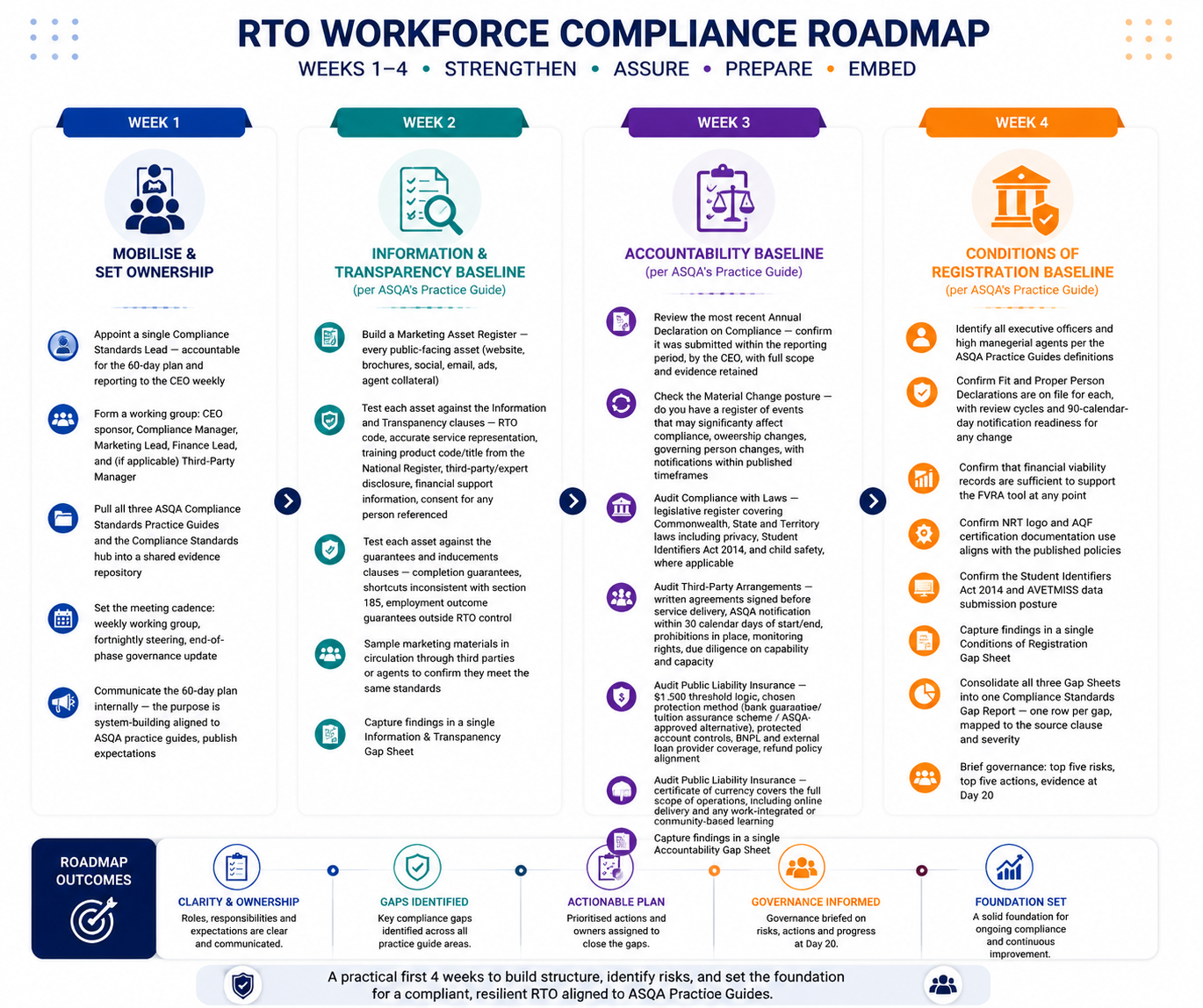
Week 1 — Mobilise & Set Ownership

  • Appoint a single Compliance Standards Lead — accountable for the 60-day plan and reporting to the CEO weekly 
  • Form a working group: CEO sponsor, Compliance Manager, Marketing Lead, Finance Lead, and (if applicable) Third-Party Manager 
  • Pull all three ASQA Compliance Standards Practice Guides and the Compliance Standards hub into a shared evidence repository 
  • Set the meeting cadence: weekly working group, fortnightly steering, end-of-phase governance update 
  • Communicate the 60-day plan internally — the purpose is system-building aligned to ASQA practice guides, publish expectations

Week 2 — Information and Transparency Baseline (per ASQA’s Practice Guide)

  • Build a Marketing Asset Register — every public-facing asset (website, brochures, social, email, ads, agent collateral) 
  • Test each asset against the Information and Transparency clauses — RTO code, accurate service representation, training product code/title from the National Register, third-party/expert disclosure, financial support information, consent for any person referenced 
  • Test each asset against the guarantees and inducements clauses — completion guarantees, shortcuts inconsistent with section 185, employment outcome guarantees outside RTO control 
  • Sample marketing materials in circulation through third parties or agents to confirm they meet the same standards 
  • Capture findings in a single Information and Transparency Gap Sheet

Week 3 — Accountability Baseline (per ASQA’s Practice Guide)

  • Review the most recent Annual Declaration on Compliance — confirm it was submitted within the reporting period, by the CEO, with full scope and evidence retained 
  • Check the Material Change posture — do you have a register of events that may significantly affect compliance, ownership changes, governing person changes, with notifications within published timeframes 
  • Audit Compliance with Laws — legislative register covering Commonwealth, State and Territory laws including privacy, Student Identifiers Act 2014, and child safety, where applicable 
  • Audit Third-Party Arrangements — written agreements signed before service delivery, ASQA notification within 30 calendar days of start/end, prohibitions in place, monitoring rights, due diligence on capability and capacity 
  • Audit Prepaid Fee Protection — $1,500 threshold logic, chosen protection method (bank guarantee/tuition assurance scheme / ASQA-approved alternative), protected account controls, BNPL and external loan provider coverage, refund policy alignment 
  • Audit Public Liability Insurance — certificate of currency covers the full scope of operations, including online delivery and any work-integrated or community-based learning 
  • Capture findings in a single Accountability Gap Sheet

Week 4 — Conditions of Registration Baseline (per ASQA’s Practice Guide)

  • Identify all executive officers and high managerial agents per the ASQA
    Practice Guides definitions 
  • Confirm Fit and Proper Person Declarations are on file for each, with review cycles and 90-calendar-day notification readiness for any change 
  • Confirm that financial viability records are sufficient to support the FVRA tool at any point 
  • Confirm NRT logo and AQF certification documentation use aligns with the published policies 
  • Confirm the Student Identifiers Act 2014 and AVETMISS data submission posture 
  • Capture findings in a single Conditions of Registration Gap Sheet 
  • Consolidate all three Gap Sheets into one Compliance Standards Gap Report — one row per gap, mapped to the source clause and severity 
  • Brief governance: top five risks, top five actions, evidence at Day 20

Phase 2 — Days 21–45: Build & Evidence

Phase 2 is where systems get built, and evidence gets aligned to the ASQA Practice Guide language.
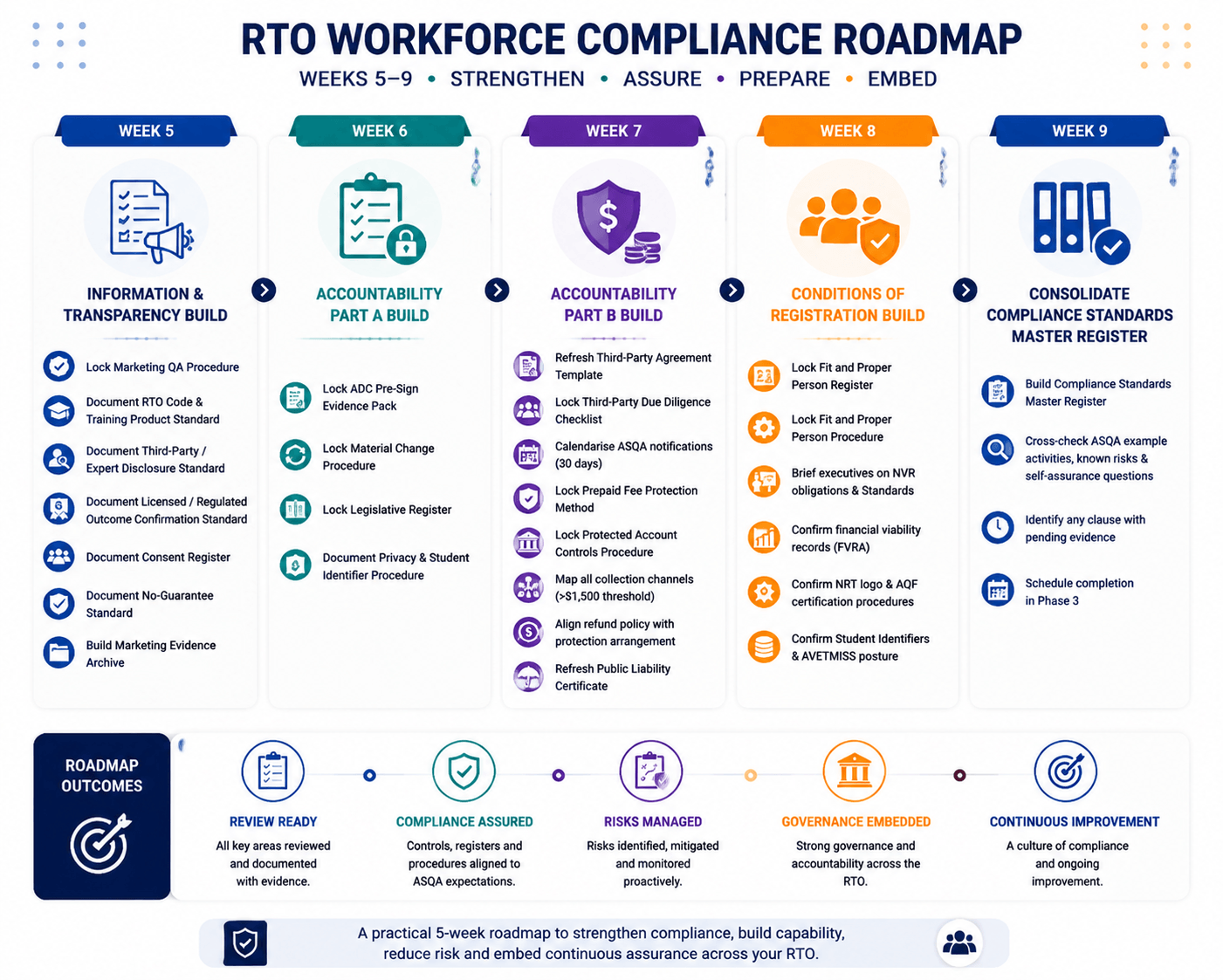
Week 5 — Information and Transparency Build

  • Lock the Marketing QA Procedure — every asset checked against Information and Transparency clauses before publication and after every scope, mode, location or delivery change 
  • Document the RTO Code & Training Product Reference Standard — every asset that mentions training products carries the code and title from the National Register 
  • Document the Third-Party / Expert Disclosure Standard — every asset that references services delivered by a third party or expert clearly identifies which party delivers what (including recruitment and delivery) 
  • Document the Licensed / Regulated Outcome Confirmation Standard — written confirmation from the relevant industry regulator on file before any ‘licensed’ or ‘regulated’ claim 
  • Document the Consent Register — recording prior consent of any person featured in marketing or advertising materials 
  • Document the No-Guarantee Standard — completion, shortcut and employment-outcome rules, with staff and agent training 
  • Build the Marketing Evidence Archive sufficient to produce materials if requested by ASQA

Week 6 — Accountability Part A Build

  • Lock the ADC Pre-Sign Evidence Pack — one row per ADC question, evidence linked, self-identified non-compliance and rectification actions disclosed 
  • Lock the Material Change Procedure — events affecting compliance notified within 10 business days; ownership changes notified as soon as practicable before the change; governing person changes notified per the published rule 
  • Lock the Legislative Register — Commonwealth/State/Territory laws applicable to the RTO, including privacy, Student Identifiers Act 2014, work health and safety, and child safety, where applicable 
  • Document the Privacy & Student Identifier Procedure — collection, use, disclosure, secure storage, and student consent for assessment activities

Week 7 — Accountability Part B Build

  • Refresh the Third-Party Agreement Template — covering all subsection (1) particulars, prohibitions on NRT logo/branding / AQF certification, monitoring entitlement, and Regulator cooperation clauses 
  • Lock the Third-Party Due Diligence Checklist — commitment, capability and capacity, fitness and propriety of relevant staff, capacity for student support and wellbeing 
  • Calendarise ASQA Practice Guides notifications for every third-party start and end (30 calendar days) 
  • Lock the Prepaid Fee Protection Method — bank guarantee in Australia / tuition assurance scheme / ASQA-approved alternative — with documentation of how the amount was determined and how it remains at all times equal to or greater than fees required to be protected 
  • Lock the Protected Account Controls Procedure — multiple signatories, withdrawal authorities, monitoring against fees held, no-operating-expenses rule 
  • Map all collection channels — direct, third-party loan providers, BNPL, online instalments — to confirm coverage above the $1,500 threshold 
  • Align the refund policy provided at enrolment with the prepaid fee protection arrangement 
  • Refresh the Public Liability Certificate of Currency — full scope of operations, online delivery, work-integrated and community-based learning explicitly covered

Week 8 — Conditions of Registration Build

  • Lock the Fit and Proper Person Register — every executive officer and high managerial agent listed with declaration date and review cycle 
  • Lock the Fit and Proper Person Procedure — appointment due diligence, ongoing monitoring against section 4 of Schedule 1 matters, refresher reviews, 90-calendar-day notifications 
  • Brief executive officers and high managerial agents on their NVR Act obligations and the Standards — record acknowledgement 
  • Confirm financial viability records support the FVRA tool at any time and feed prepaid fee protection 
  • Confirm NRT logo and AQF certification documentation procedures align with the published policies 
  • Confirm Student Identifiers and AVETMISS posture

Week 9 — Consolidate the Compliance Standards Master Register

  • Build a single Compliance Standards Master Register that links every clause from the three Practice Guides to the relevant procedure, register, evidence file, owner, and review cycle 
  • Cross-check that every ASQA published example activity, known risk, and self-assurance question has a corresponding row in the Master Register 
  • Identify any clause where the evidence is still pending — schedule completion in Phase 3

Phase 3 — Days 46–60: Govern & Embed

Phase 3 makes the system durable — moving from project to operating rhythm.
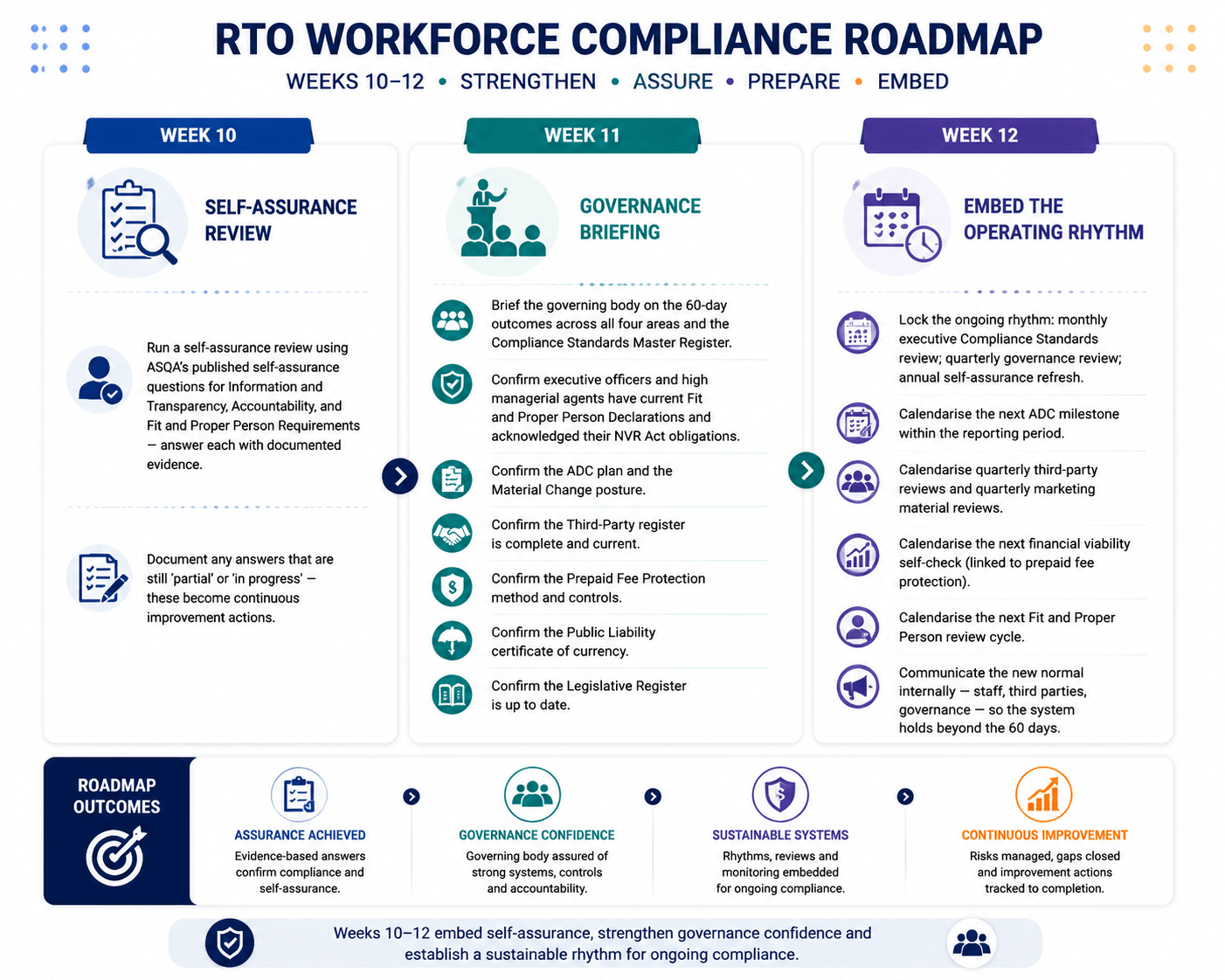
Week 10 — Self-Assurance Review

  • Run a self-assurance review using ASQA’s published self-assurance questions for Information and Transparency, Accountability, and Fit and Proper Person Requirements — answer each with documented evidence 
  • Document any answers that are still ‘partial’ or ‘in progress’ — these become continuous improvement actions

Week 11 — Governance Briefing

  • Brief the governing body on the 60-day outcomes — Information and Transparency, Accountability (A and B), Conditions of Registration, and the Compliance Standards Master Register 
  • Confirm executive officers and high managerial agents have current Fit and Proper Person Declarations and have acknowledged their NVR Act obligations 
  • Confirm the ADC plan, the Material Change posture, the Third-Party register, the Prepaid Fee Protection method, the Public Liability certificate, and the Legislative Register

Week 12 — Embed the Operating Rhythm

  • Lock the ongoing rhythm: monthly executive Compliance Standards review; quarterly governance review; annual self-assurance refresh 
  • Calendarise the next ADC milestone within the reporting period 
  • Calendarise quarterly third-party reviews and quarterly marketing material reviews 
  • Calendarise the next financial viability self-check (linked to prepaid fee protection) 
  • Calendarise the next Fit and Proper Person review cycle 
  • Communicate the new normal internally — staff, third parties, governance — so the system holds beyond the 60 days

What ‘Done’ Looks Like at Day 60

Practice GuideEvidence in place at Day 60
Information and TransparencyMarketing Asset Register; Marketing QA Procedure; RTO code & training product reference standard; third-party/expert disclosure standard; licensed/regulated outcome confirmation standard; consent register; no-guarantee standard; marketing evidence archive 
Accountability — Part AADC Pre-Sign Evidence Pack; Material Change Procedure aligned to 10-business-day and ‘as soon as practicable’ rules; Legislative Register; Privacy & Student Identifier Procedure
Accountability — Part BThird-Party Agreement Template aligned to subsection (1); Due Diligence Checklist; 30-calendar-day notification calendar; chosen Prepaid Fee Protection method; Protected Account Controls Procedure; channel mapping for $1,500 threshold; refund policy alignment; Public Liability certificate covering full scope 
Conditions of Registration Fit and Proper Person Register; Fit and Proper Person Procedure with 90-calendar-day notification readiness; financial viability records; NRT/AQF procedures; Student Identifiers and AVETMISS posture 
GovernanceCompliance Standards Master Register; self-assurance review against ASQA’s published questions; monthly executive review, quarterly governance review, annual refresh calendarised 

Five Mistakes That Derail 60-Day Plans

Treating the plan as a one-off project rather than the start of an operating rhythm

Skipping Phase 1 diagnosis and building solutions before knowing the actual gaps

Excluding third parties from the build — third parties are inside the RTO’s compliance perimeter

Letting executive sponsorship drift after the first fortnight, the CEO should remain visible at every steering meeting

Treating ASQA’s example activities as optional — they are the practical illustration of compliance and should be reflected in the RTO’s evidence

FAQs – The 60-Day Compliance Standards Playbook 

Yes. The plan is built modularly. Smaller RTOs have fewer assets, fewer third parties, and fewer governing persons — so the volume of work is smaller. The discipline required is the same and the outputs are still ASQA-aligned.

The same playbook can be used as the rectification plan. Phase 1 becomes the gap diagnosis, Phase 2 becomes the evidence build, and Phase 3 becomes the governance commitment. Map every action directly to the relevant ASQA Practice Guide clause.

Building the Compliance Standards Master Register that links every clause from the three Practice Guides to the relevant procedure, register, owner, and review cycle. It exposes evidence gaps quickly and becomes the working tool for the governance rhythm.

No. The system is built once in 60 days. After that, you operate it via monthly executive reviews, quarterly governance reviews, and an annual self-assurance refresh aligned to ASQA’s published self-assurance questions.

The Outcome Standards are the quality of services delivered to VET students. The Compliance Standards are the integrity of the sector. ASQA assesses both. Most evidence in this playbook supports the governance, risk and continuous improvement expectations of the Outcome Standards as well.

ASQA’s Practice Guides explicitly publish the example activities, known risks, and self-assurance questions for each clause. The 60-day playbook is built directly against those lists. If your evidence covers the example activities, addresses the known risks, and answers the self-assurance questions with documented support, the posture is ASQA-aligned.

The Standards require the RTO to demonstrate third-party assurance — not the third party. Embed the requirement into the written agreement (Accountability Part B). Where a third party cannot meet the standard, the RTO either supports them to comply or reconsiders the arrangement.

Most of the cost is internal time — the Compliance Standards Lead, the working group, and allocated executive time. Specific external costs may include refreshed certificates of currency, tuition assurance scheme membership, or a financial guarantee from a bank operating in Australia depending on the prepaid fee protection method chosen.

Optional but accelerates Phases 1 and 2. External support is most useful for the gap diagnosis (Week 4), the third-party agreement template refresh (Week 7), the Fit and Proper Person review (Week 8), and the governance briefing (Week 11). The build itself is best owned internally.

Loss of executive sponsorship around Day 30. The CEO should remain visible — at the steering meeting, in the staff communications, and in the governance briefing. Without that visibility, ownership drifts and the plan stalls.

Appoint the Compliance Standards Lead, calendarise the 12 weeks, pull the three ASQA Compliance Standards Practice Guides into the evidence repository, and brief the governing body. Phase 1 starts the next working day.

Lead Magnet – Free Download

“60-Day Compliance Standards Implementation Plan + Master Compliance Register (2025 Edition) — by VET Resources”

A practical, audit-ready 60-day plan and Master Compliance Register built directly from ASQA’s three Compliance Standards Practice Guides — Information and Transparency, Accountability, and Fit and Proper Person Requirements. Includes the week-by-week plan, owner/role accountabilities, the marketing QA standard, the ADC pre-sign pack, the third-party register, the prepaid fee protection structures, the public liability checklist, the Fit and Proper Person procedure, and the governance reporting pack.

👉 DM “PLAYBOOK” on Instagram or LinkedIn, or email VET Resources to receive your free copy.

Related Products

Disclaimer:
The information presented on the VET Resources blog is for general guidance only. While we strive for accuracy, we cannot guarantee the completeness or timeliness of the information. VET Resources is not responsible for any errors or omissions, or for the results obtained from the use of this information. Always consult a professional for advice tailored to your circumstances.

Ben Thakkar is a Compliance, Training, and Business specialist in the education industry. He has held senior management roles, including General Manager, with leading Registered Training Organisations (RTOs) and Universities. With over 15 years of experience, Ben brings extensive expertise across audits, funding contracts, VET Student Loans, CRICOS, and the Standards for RTOs 2025.

Get A Free Sample

Download Free Complete AI in VET Guide 2026

Download Free 2026 RTO READINESS CHECKLIST

Biggest Early EOFY Discount is live! Upto 80% Discount Valid till 30th June
Days
Hours
Minutes
Seconds

Request Your Free Sample, Product Info & Pricing Today

By submitting this form, you agree to the VET Resources Privacy Policy.