


AI can absolutely support vocational education. It can save time, help with administration, improve communication, and assist with lower-risk support tasks. But when it comes to ASQA-oriented compliance, audit-ready training and assessment resources, and the practical realities of RTO delivery, AI is not enough on its own.
That work still requires experienced RTO professionals.
The reason is simple. Vocational education is not just about generating content quickly. It is about creating resources that are accurate, compliant, contextualised, defensible in audit settings, aligned to training package requirements, and practical for real trainers, assessors and learners. That level of judgement cannot be outsourced to automation.
Under the 2025 Standards, this becomes even more important. RTOs are expected to demonstrate quality outcomes, sound governance, clear accountability and systems that are fit for purpose. That means resource quality matters more than ever, and expert review is not optional.AI can help in vocational education, but expert RTO resource providers remain essential. For complex compliance expectations, audit readiness and trustworthy delivery materials, providers still need resources developed and reviewed by experienced VET and compliance specialists.
AI in vocational education refers to the use of artificial intelligence tools to support selected parts of training delivery, learner communication, administration, data analysis and workflow efficiency.
In an RTO environment, AI may be used to:

These uses can be valuable when they are handled carefully and checked properly.
However, there is a major difference between using AI to support workflows and relying on AI to create compliant RTO resources.
That is where many providers need to be careful.
AI has genuine value in vocational education when it is used in the right places.
1. Administrative efficiency
AI can reduce time spent on repetitive internal tasks such as routine emails, notes, reminders, summaries and workflow support.
2. Communication support
It can help teams prepare draft messages for students, internal updates, meeting summaries and simple support communication.
3. Basic data insights
AI can help identify patterns in attendance, engagement or learner progression data, which may support earlier intervention.
4. Productivity support for staff
It can assist teams with brainstorming, first drafts, planning ideas and administrative organisation.
These are useful benefits. They can improve efficiency and free up time for more important work.
But these are secondary support functions.
They are not the same as designing compliant learning and assessment resources, interpreting Standards, validating assessment logic, or producing materials that can stand up to audit scrutiny.
Use AI where it saves time — but rely on experts where compliance matters most.
Access RTO Assessment Resources
This is the core issue.
AI can help with speed, but RTO resources require far more than speed. They require compliance knowledge, training package understanding, contextual judgement and practical VET experience.
AI can generate polished wording, but it does not genuinely understand the compliance intent behind the Standards, the training product, or the practical risks during audit, validation, or resource review.
If a resource is poorly designed, non-compliant, or not fit for purpose, the responsibility sits with the RTO — not the AI tool.
AI often produces content that sounds authoritative while containing subtle compliance gaps, weak assessment logic, vague statements, or incorrect assumptions.
Experienced RTO developers adjust content based on learner profile, delivery mode, volume, LLND needs, industry context, and assessor usability.
Audit-ready resources require expert judgement in mapping, assessment evidence, learner instructions, trainer guidance, usability, structure, and risk evaluation.
The 2025 Standards make quality, accountability and fit-for-purpose systems even more important. That raises the bar for any RTO relying on training and assessment materials.
When the compliance environment becomes more outcomes-focused, the quality of the resource itself becomes even more important. RTOs need materials that are not only usable, but also clearly designed, defensible and appropriate to the learner and delivery context. ASQA says the 2025 Standards took effect on 1 July 2025, are outcome-focused, and are supported by non-prescriptive Practice Guides that include known risks to quality outcomes and self-assurance questions for providers.
That is why expert RTO resource providers matter.
| An experienced resource provider team brings: | This is especially important for: |
|
|
These are not areas where an RTO should rely on unreviewed AI outputs.They are areas where experience, trust and specialist compliance knowledge matter most.
| Area | What AI Can Help With | What Expert RTO Resource Providers Must Still Do |
| Administration | Draft emails, reminders, summaries and workflow support | Maintain oversight, records, compliance controls and final accountability |
Learner communication | Prepare simple support content or message drafts | Ensure clarity, suitability, tone and learner appropriateness |
Data insights | Highlight trends in engagement, attendance or progression | Interpret the data properly and take appropriate action |
Resource drafting | Generate first-pass ideas, sample wording or structural suggestions | Design compliant, contextualised, audit-ready resources aligned to training requirements |
Assessment support | Suggest draft questions or feedback language | Build valid assessment tools, evidence requirements, mapping logic and assessor guidance |
Compliance support | Assist with basic drafting or internal summaries | Apply real compliance judgement, risk awareness, validation thinking and audit readiness |
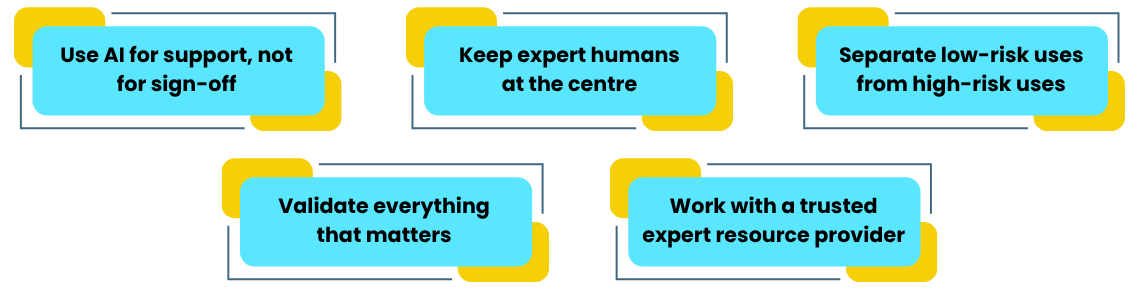
Use AI for support, not for sign-off
AI can help your team move faster, but it should never be the final authority on resource quality, compliance or assessment integrity.
Keep expert humans at the centre
Training resources, assessment tools and compliance-critical documents should always be developed, reviewed or approved by experienced RTO and compliance professionals.
Separate low-risk uses from high-risk uses
AI is far more suitable for lower-risk productivity tasks than for complex resource development or compliance interpretation.
Validate everything that matters
Any AI-assisted draft used in training, assessment or student-facing documentation should be checked for:
Work with a trusted expert resource provider
If your RTO needs learning and assessment resources that support audit readiness and confident delivery, the safest path is to use resources produced and reviewed by specialists who understand both compliance and practical implementation
AI can help with productivity. Expert resources help with compliance confidence.
Explore VET Resources for audit-ready support
Yes. AI can help with administration, communication support, internal productivity and some lower-risk workflow tasks. It can be a useful support tool when applied carefully.
No. AI should not be relied on to create fully compliant, audit-ready RTO resources without expert human development, review and quality assurance.
Because resource quality in the VET sector depends on compliance judgement, training package understanding, assessment design expertise and practical RTO experience. These are not things AI can reliably handle on its own.
Because the 2025 Standards focus strongly on quality outcomes, accountability and systems that are fit for purpose. That makes the design and defensibility of training resources more important, not less.
The safest uses are lower-risk support activities such as drafting routine communication, summarising internal notes, helping with scheduling or supporting internal productivity tasks.
The riskiest uses include unreviewed assessment development, compliance interpretation, student-facing assessment tools, mapping documents and anything involving personal or sensitive learner data.
No. Trainers and assessors remain responsible for delivery, learner support, assessment decisions and quality outcomes.
No. AI can assist with drafting and summarising, but it cannot replace professional compliance judgement or audit-focused decision-making.
A trustworthy resource provider understands the VET sector, develops materials with compliance in mind, produces practical and usable documents, and applies expert review before resources reach the RTO.
Because expert-developed resources are far more likely to be accurate, contextualised, usable, compliant and defensible in practice.
Yes. That is the best use of AI. Let AI help with speed and support tasks while expert teams remain responsible for compliance-critical resource development.
RTOs should take a balanced approach: use AI where it adds efficiency, but keep experienced professionals in control of resource design, compliance decisions and quality assurance.
