The pre-enrolment review is mandatory. A formal LLND test is not. Standard 2.2 of the Outcome Standards for RTOs 2025 requires you to review each prospective student’s skills before enrolment, including language, literacy, numeracy and digital literacy. You must then advise whether the training product suits them.
However, the standard does not name a specific test or tool. Therefore, most RTOs use a structured LLND assessment because it is the easiest way to prove the review happened. This guide explains what the rule says, what auditors look for and how to build a defensible process.
What is LLND testing?
LLND testing is a pre-enrolment check of a prospective student’s language, literacy, numeracy and digital literacy skills. RTOs use the results to judge whether a course suits the person and what support they may need.
Let’s define the key terms:
RTO (Registered Training Organisation): a provider registered to deliver nationally recognised vocational education and training (VET).
LLND: language, literacy, numeracy and digital literacy. Earlier standards focused on LLN only. The 2025 Standards add the digital element.
ACSF (Australian Core Skills Framework): the national framework that describes core skills across five levels. Most LLN tools benchmark against it.
ADCF (Australian Digital Capability Framework): a framework some digital literacy tools use to describe capability levels.
ASQA (Australian Skills Quality Authority): the national VET regulator for most RTOs. Victorian and Western Australian RTOs may instead deal with their state regulator.
Note that “test” is industry shorthand. Many providers now call it an LLND “review” or “conversation”. That wording better reflects what the standard asks for.
What does Standard 2.2 actually require?
Standard 2.2 sits in Quality Area 2 (VET Student Support). In plain terms, it says students must be advised before enrolment about whether the training product suits them. That advice must take their skills and competencies into account.
The key points are:
Timing: before enrolment, not after.
Scope: skills and competencies, including LLND.
Output: advice to the student about suitability.
Evidence: you must be able to show the review and the advice occurred.
The wording does not say “every learner must sit a standardised test”. Instead, it sets an outcome. Consequently, your method must be reasonable, consistent and documented.
ASQA’s student support guidance reinforces this. By the end of a pre-enrolment conversation, you should know the student’s LLND levels and whether they need support. You should also explain their options and the expectations they must meet.
Important: read the legislative text yourself. The Standards sit within the National VET Regulator (Outcome Standards for Registered Training Organisations) Instrument 2025, alongside the Compliance Standards instrument. Furthermore, your regulator’s guidance may be more specific than this article.
Why does LLND testing matter in 2026?
The rule changed the timing. Previously, many RTOs completed LLN checks after enrolment. Under the 2025 Standards, the review must happen first.
As a result, enrolment workflows needed rebuilding. The 2025 Standards took effect on 1 July 2025, so 2026 is the first full year in which auditors expect mature systems.
Moreover, the stakes are practical as well as regulatory. Enrolling a student who cannot read a workplace procedure or use a learning management system sets them up to fail. That leads to withdrawals, complaints and weaker completion data.
How does a compliant LLND review work?
A defensible process follows a clear sequence. Here is a practical model.
Set course-specific requirements. Decide the LLND levels a student needs for each qualification. Publish them in your pre-enrolment information.
Collect evidence before enrolment. Use a structured assessment, a guided interview, prior education records or a mix. Match the depth to the course.
Benchmark the results. Map outcomes to the ACSF (and a digital framework where relevant).
Make a suitability decision. Compare the student’s levels with course demands.
Advise the student. Explain the outcome, the support available and any alternative pathways. Do this before enrolment is finalised.
Record everything. Keep results, the advice given and the student’s acknowledgement.
Review periodically. Check that your tools and benchmarks still fit your courses.
For example, a short First Aid course and a Diploma carry very different literacy demands. Industry commentators therefore expect regulators to treat them differently. Your process should show that proportionality.
Is the rule stricter for funded training or specific courses?
Sometimes, yes. Standard 2.2 is the baseline. Funding contracts and other programs can add their own rules.
For example, a Department of Employment and Workplace Relations (DEWR) practice illustration states that applicants for subsidised training must complete an LLN assessment. Similarly, state funding agreements often prescribe pre-training reviews. Therefore, check your contract as well as the Standards.
Digital literacy needs thought too. Commentators note that it matters most where learners must use online platforms or digital tools. If your course is fully face-to-face with paper-based assessment, a lighter digital check may be reasonable. Even so, document your reasoning.
What are the benefits of a structured LLND process?
Audit readiness: clear records show you met Standard 2.2.
Better placement: students enter courses that match their skills.
Targeted support: trainers know who needs help from day one.
Fewer withdrawals: early support reduces avoidable dropouts.
Stronger reputation: students and employers trust providers that enrol responsibly.
Every approach has trade-offs. However, most challenges have practical fixes.
Student anxiety. Many people fear “tests”. Fix: frame it as a review designed to help them succeed, as many providers now do.
Digital access gaps. Some applicants lack devices or confidence. Fix: offer assisted or supervised completion.
Marking consistency. Different staff may mark differently. Fix: use marking guides and moderate regularly.
Over-reliance on scores. A number alone does not tell the full story. Fix: combine results with a conversation.
Third-party agents. Brokers or marketing partners may skip steps. Fix: keep the review under your control and monitor it.
Course mapping. Generic tools may not reflect your qualifications. Fix: set per-course benchmark levels.
What are the best practices for LLND testing?
Review before enrolment, always. Build it into your workflow so it cannot be skipped.
Scale to the course. Apply higher benchmarks to higher-level qualifications.
Use the ACSF. It gives you a recognised, defensible reference point.
Combine methods. Pair an assessment with a short interview.
Document the advice. Record what you told the student and what they decided.
Link to support. If a gap appears, offer a clear pathway, such as foundation skills training or reasonable adjustments.
Train your staff. Admissions teams need confidence interpreting results and having honest conversations.
Audit your own files. Sample enrolments quarterly and fix gaps early.
What are the common mistakes to avoid?
Running the LLN check after enrolment, which was the old habit.
Treating a pass mark as the whole review, with no advice to the student.
Using one generic tool for every course, regardless of difficulty.
Skipping the digital literacy element entirely.
Failing to record the suitability advice.
Enrolling students who clearly need support without offering any.
Assuming a vendor’s tool is automatically “compliant”. Compliance depends on how you use it.
What tools and resources can help?
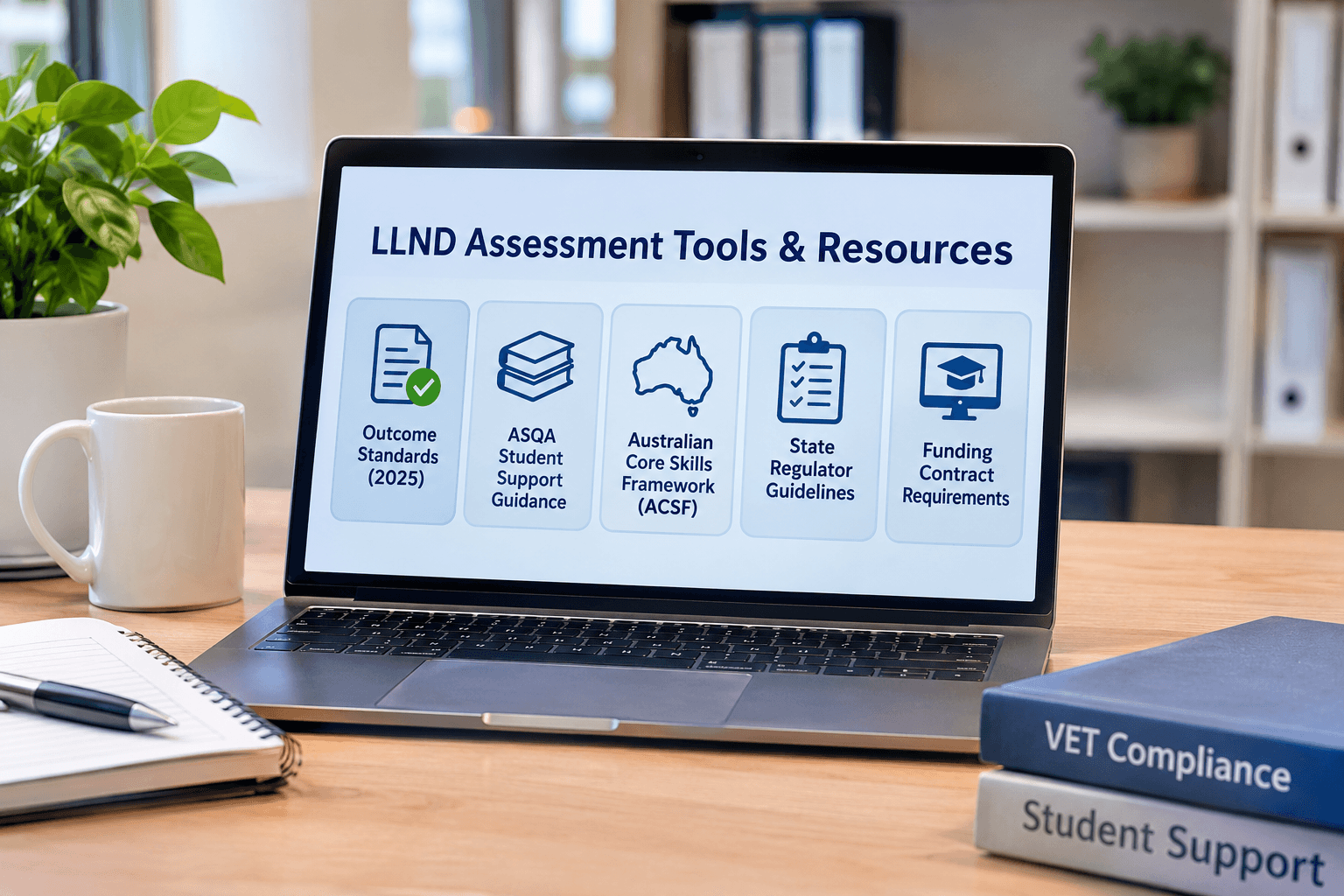
Several providers sell LLND assessment tools. They typically include marking guides, ACSF mapping and reporting. Some digital literacy tools map to the ADCF.
Useful reference points include:
The Outcome Standards for RTOs 2025 and the DEWR Standards for RTOs page
ASQA’s “Spotlight on Student Support” guidance
The Australian Core Skills Framework
Your state regulator’s guidelines (for example, VRQA in Victoria)
Your funding contract, if you deliver subsidised training
Any commercial tool is only a support. Ultimately, the responsibility for compliance sits with your RTO.
What future trends should RTOs watch?
Greater regulatory focus on evidence. Expect auditors to test whether advice actually shaped enrolment decisions.
More digital capability checks. As delivery moves online, digital literacy will carry more weight.
Adaptive and automated tools. Providers are adopting tools that adjust question difficulty and generate reports.
Integration with student support. Linking LLND results to learner support plans will become standard practice.
Ongoing guidance updates. Regulators may issue further clarification, so monitor ASQA and DEWR updates.
Frequently asked questions
The review is mandatory; a specific test is not. Standard 2.2 requires every RTO to consider a prospective student’s skills, including LLND, before enrolment and advise on suitability. Most RTOs use a structured assessment because it produces clear evidence. Check your regulator’s guidance and any funding contract for stricter requirements.
No. The standard sets an outcome rather than naming a tool. You may use a commercial assessment, an in-house tool or a guided interview. However, your method must be consistent, suited to the course and documented. Benchmarking against the ACSF is widely used and easy to defend.
Yes. Standard 2.2 refers to advice “prior to enrolment”. Before the 2025 Standards, many providers completed LLN checks afterwards. That practice no longer meets the requirement. Therefore, build the review into your application and enrolment process, and finalise enrolment only after you have advised the student.
The standard includes digital literacy within the skills you consider. However, the depth should reflect the course. A fully online qualification demands more digital capability than a short face-to-face course. Document your reasoning for each course so auditors can see the decision was deliberate.
A low result is not automatically a “fail”. Instead, it triggers advice. You should explain the gap, outline support options and discuss alternatives, such as foundation skills training or a different qualification. The student may still enrol if they understand the expectations and support is in place.
Self-assessment can contribute, but it is risky alone. Some RTOs pair a short self-assessment with follow-up questions. Because people often over- or underestimate their abilities, it is safer to combine self-assessment with objective evidence, such as a task-based assessment or prior education records.
Standard 2.2 applies to VET students enrolling in training products generally. In practice, the review for a short, low-complexity course can be lighter than for a diploma. Even so, you still need to make and record a suitability decision. Keep the evidence proportionate and consistent.
Keep them for as long as your regulator, funding contract and records policies require. Retain the results, the advice given and any student acknowledgement. Because requirements vary, confirm the retention period with your regulator before setting your policy.
Conclusion: what should RTOs do next?
Summary: Standard 2.2 makes the pre-enrolment LLND review mandatory in 2026. It does not prescribe a particular test. Instead, it expects you to review each student’s skills, advise on suitability and keep evidence.
Key takeaway: a structured LLND assessment, paired with a documented conversation, is the most defensible route.
Next step: audit your last 20 enrolment files this week. Check that each one shows a pre-enrolment LLND review, clear advice and a record of the outcome. Then fix any gaps and confirm any funding-contract requirements.
This article is general information, not legal or compliance advice. Always check the current Standards and your regulator’s guidance.
DEWR, Standards for RTOs 2025: https://www.dewr.gov.au/standards-for-rtos
VRQA, “Guideline 1: 2025 Standards for RTOs”: https://www2.vrqa.vic.gov.au/guidelines-standards-vocational-education-and-training-providers/guideline-1-2025-standards-rtos
DEWR, “Practice Illustration: Enrolment, Language, Literacy and Numeracy Assessment”: https://www.dewr.gov.au/download/17361/practice-illustration-enrolment-language-literacy-and-numeracy-assessment/41638/practice-illustration-enrolment-language-literacy-and-numeracy-assessment/docx
CloudAssess, “Standards for RTOs 2025: Guide to Revisions and Changes”: https://cloudassess.com/blog/revisions-to-standards-for-rtos/
RTO Superhero Podcast, “LLND in the Real World: What RTOs Must Know About Standard 2.2”: https://vivacity.buzzsprout.com/1013356/episodes/17329035-llnd-in-the-real-world-what-rtos-must-know-about-standard-2-2
Disclaimer: The information presented on the VET Resources blog is for general guidance only. While we strive for accuracy, we cannot guarantee the completeness or timeliness of the information. VET Resources is not responsible for any errors or omissions, or for the results obtained from the use of this information. Always consult a professional for advice tailored to your circumstances.
Ben Thakkar is a Compliance, Training, and Business specialist in the education industry. He has held senior management roles, including General Manager, with leading Registered Training Organisations (RTOs) and Universities. With over 15 years of experience, Ben brings extensive expertise across audits, funding contracts, VET Student Loans, CRICOS, and the Standards for RTOs 2025.