


Assessment is the foundation of quality vocational education and training. Every competency decision made by a Registered Training Organisation (RTO) must be supported by assessment practices that are fair, valid, reliable, and compliant with regulatory expectations. This is where the Principles of Assessment and Rules of Evidence become critical.
The 4 principles of assessment are Fairness, Flexibility, Validity, and Reliability. The rules of evidence in VET are Validity, Sufficiency, Authenticity, and Currency. Together, these requirements help trainers and assessors make accurate competency decisions while ensuring compliance with the Standards for RTOs and the expectations of the Australian Skills Quality Authority (ASQA).

Assessment remains one of the most scrutinised areas during regulatory audits because it directly affects the integrity of qualifications issued by RTOs. If assessment practices are poorly designed or evidence is insufficient, learners may be awarded competencies they have not genuinely achieved. This can impact employers, industries, and the reputation of the VET sector as a whole.
In this guide, we explain the principles of assessment and rules of evidence, how they apply in practice, common compliance risks, and what RTOs can do to strengthen assessment quality and audit readiness.
The principles of assessment provide a framework for designing and conducting assessments that produce accurate and consistent competency decisions. These principles ensure learners are assessed fairly and that assessment outcomes are reliable.
The four principles of assessment are:
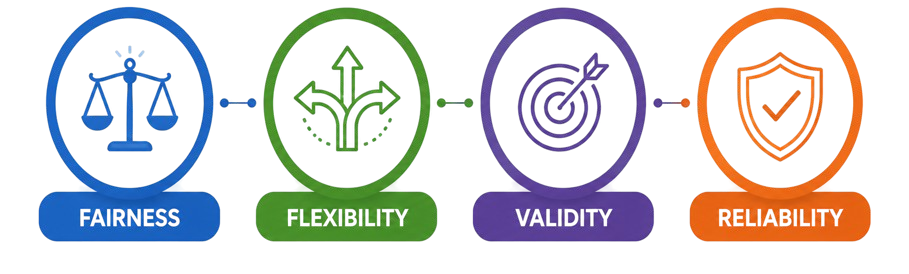
Every assessment tool, assessment process, and competency judgement should reflect these principles.
Fairness requires that assessment processes consider the individual needs of learners while maintaining the integrity of the assessment outcome.
Learners should clearly understand:
Fairness also includes the application of reasonable adjustments where appropriate.


Reasonable adjustments may involve:
Any adjustment must not compromise the competency requirements of the unit being assessed.
Example of Fairness
A learner with a language barrier may be provided with additional time and verbal clarification of instructions. However, they must still demonstrate the same skills and knowledge required by the unit of competency.
When learners understand the assessment process and are provided with appropriate support, assessment outcomes are more likely to be accurate and equitable.
Flexibility recognises that learners gain skills and knowledge through different pathways.
Some learners may develop competency through formal training, while others gain experience through employment, volunteering, or previous education.
Flexible assessment practices allow assessors to consider:
Flexibility is particularly important in Recognition of Prior Learning (RPL) assessments.

Example of Flexibility
An experienced supervisor undertaking an RPL process may provide workplace documentation, participate in professional discussions, and undergo practical observation rather than completing traditional classroom-based assessments.
Flexibility helps ensure assessment reflects real-world skills and experience while maintaining compliance requirements.
Validity is one of the most important principles of assessment.
A valid assessment measures exactly what it is intended to measure. Assessment activities must directly align with the requirements of the unit of competency.
A valid assessment should:
Poor validity is a common cause of assessment-related non-compliance.

Example of Validity
If a unit requires learners to operate machinery safely, a written quiz alone would not provide sufficient evidence. Practical observation and demonstration would be necessary to confirm competence.
Valid assessments provide confidence that competency decisions accurately reflect learner capability.
Reliability ensures that assessment decisions remain consistent regardless of who conducts the assessment.
If two qualified assessors review the same evidence, they should reach the same conclusion regarding competency.
Reliability can be strengthened through:

Example of Reliability
An observation checklist containing clear performance benchmarks helps different assessors evaluate learners consistently.
Reliable assessment systems reduce subjectivity and strengthen the defensibility of competency decisions.
While the principles of assessment focus on how assessments are designed and conducted, the rules of evidence focus on the quality of evidence used to make competency decisions.
Assessors must collect evidence that supports a confident and defensible judgement of competence.
The four rules of evidence are:
These rules help ensure evidence accurately demonstrates a learner’s skills and knowledge.
Evidence must directly relate to the competency being assessed. The assessor must be satisfied that the evidence demonstrates the required skills, knowledge, and performance outcomes.
Valid evidence should:
A completed workplace project demonstrating planning, implementation, and evaluation skills may provide valid evidence for a project management unit. Evidence unrelated to the competency requirements cannot support a valid assessment decision.
Sufficiency refers to having enough evidence to make a confident judgement of competence.
Assessors should consider:
A single piece of evidence is rarely enough to demonstrate full competency.
If a unit requires learners to perform a task in multiple situations, one successful demonstration may not be sufficient. Additional observations may be necessary to confirm consistency. Sufficient evidence helps reduce the risk of inaccurate competency decisions.
Authenticity means the evidence genuinely belongs to the learner being assessed. Assessors must verify that submitted work and demonstrated performance are the learner’s own.
Methods for verifying authenticity include:
When learners submit workplace projects, assessors may conduct follow-up questioning to confirm their understanding and involvement in the work. Authenticity has become increasingly important as online learning and digital submissions continue to grow.
Currency refers to whether evidence demonstrates current competence.
Skills and knowledge can become outdated due to:
Assessors must determine whether evidence reflects current industry expectations.
Evidence collected ten years ago may not accurately demonstrate current competency in industries experiencing significant regulatory or technological change. Current evidence provides greater confidence that learners can perform effectively in today’s workplace.
Although they are closely connected, the principles of assessment and rules of evidence serve different purposes.
| Principles of Assessment | Rules of Evidence |
| Focus on assessment design and delivery | Focus on evidence quality |
| Applied during assessment planning | Applied during the assessment judgment |
| Fairness | Validity |
| Flexibility | Sufficiency |
| Validity | Authenticity |
| Reliability | Currency |
Both frameworks work together to support high-quality assessment outcomes.
Assessment remains a significant focus area for regulatory bodies because it directly influences qualification integrity.
When assessment systems are weak:
During audits, assessors commonly review:
Strong assessment systems help demonstrate compliance and protect the reputation of the RTO.
Many assessment-related non-compliances arise from recurring issues.
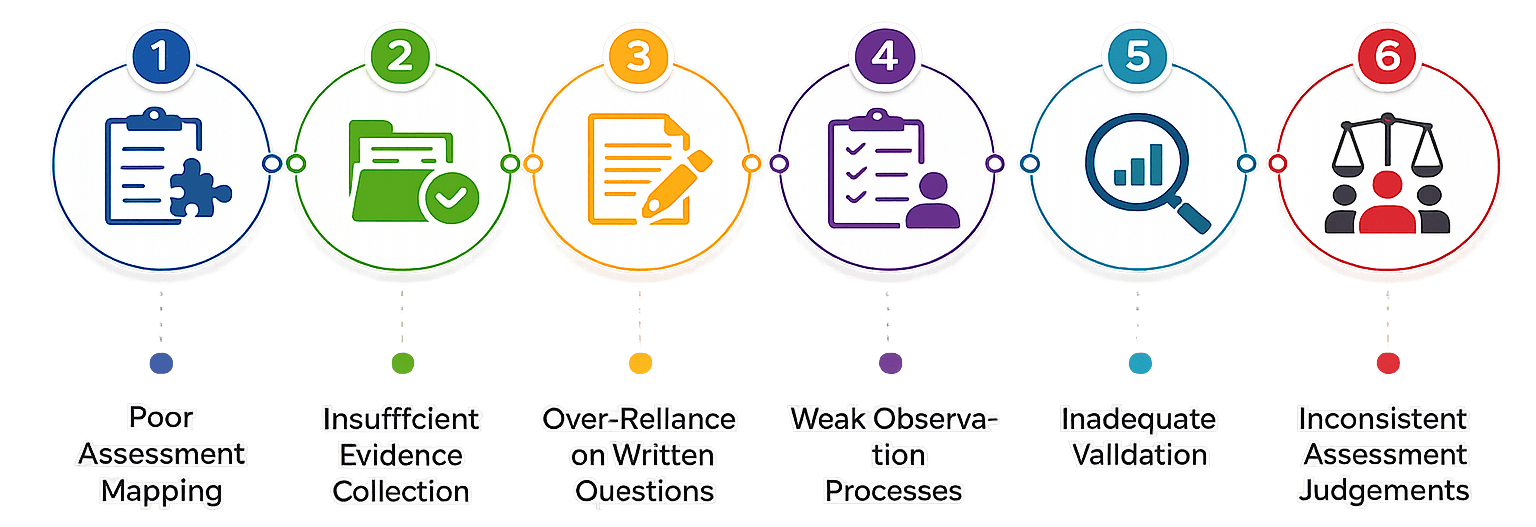
Assessment tools do not adequately address all unit requirements.
Learners are deemed competent without enough evidence.
Practical competencies are assessed through theory alone.
Observation tools lack sufficient detail to support competency decisions.
Validation activities fail to identify weaknesses in assessment tools and practices.
Assessors apply different standards when evaluating evidence.
Addressing these issues can significantly improve compliance outcomes.
RTOs can strengthen assessment quality by implementing effective quality assurance processes.
Assessment tools should be reviewed whenever:
Validation should focus on:
Assessors should regularly update:
Using multiple evidence sources provides stronger support for competency decisions.
Examples include:
The four principles of assessment are Fairness, Flexibility, Validity, and Reliability.
The rules of evidence are Validity, Sufficiency, Authenticity, and Currency.
They help ensure assessment practices are fair, consistent, accurate, and aligned with competency requirements.
They ensure assessors collect appropriate evidence before making competency decisions.
Yes. They are fundamental requirements underpinning quality assessment practices within Australia’s VET sector.
Regular validation, robust assessment mapping, assessor calibration, and effective evidence collection processes can significantly strengthen compliance outcomes.
The Principles of Assessment and Rules of Evidence form the foundation of effective assessment within Australia’s vocational education and training sector. Together, they ensure competency decisions are fair, flexible, valid, reliable, and supported by sufficient, authentic, and current evidence.
For RTOs, applying these principles consistently is essential not only for compliance but also for maintaining qualification integrity, supporting learner success, and meeting industry expectations. By investing in strong assessment tools, effective validation processes, and ongoing assessor development, organisations can strengthen assessment quality and confidently demonstrate compliance during regulatory audits.


