


The RTO model that got you here may not get you through 2027. The answer is not panicking. It is a sharper strategy, better numbers, and decisive execution.
For more than 16 years, I have worked in and around the RTO sector, speaking with owners, executives, and teams who are trying to deliver quality training while navigating constant change.
Lately, one question has been coming up again: “What do we do now?”
The concern is understandable. State-funded training is becoming harder to access and manage. International education legislation is moving. Migration settings continue to affect demand. ASQA’s regulatory approach is becoming more outcomes-focused, evidence-led and data-informed. Meanwhile, wages, technology, facilities, insurance, marketing and student acquisition costs do not stand still.
This article brings together the practical lessons I am seeing across the sector. It is not a prediction of doom, and it is not a promise of easy growth. It is a call to take control: understand the numbers, make deliberate choices, and build an RTO that can perform under pressure.

At VET Advisory Group, our view is straightforward: an RTO is sustainable when it can consistently fund quality delivery, meet its obligations, withstand disruption, and still generate an acceptable return. That requires four systems to reinforce one another:
If one system fails, the others eventually feel it. High enrolments can still destroy cash if delivery is underpriced. Aggressive cost cutting can weaken assessment and student support. A perfect compliance folder does not rescue a course nobody wants. Growth that depends on one contract, market, or agent is exposure disguised as success.
The pressure is not coming from one direction. It is a convergence of funding, international education, migration, regulation, and operating costs. The exact impact differs by state, scope, cohort, and delivery model, but every RTO should test its assumptions against the following shifts.
| Pressure | What it can mean | Management response |
|---|---|---|
| State funding | Tighter access, contract concentration, and stronger performance expectations can make revenue less predictable. | Model funded delivery at course level; understand contract conditions; prepare a non-funded growth pathway. |
| International education | ESOS and CRICOS changes can affect market entry, agent practices, course settings, and strategic options. | Stress-test international forecasts; review recruitment arrangements; keep decisions aligned with current official guidance. |
| Migration settings | Visa and migration policy can change student demand, course mix, and conversion rates. | Do not treat migration-linked demand; build scenarios and diversify cohorts. |
| ASQA approach | Outcomes, evidence, intelligence, and earlier risk identification place more emphasis on what the RTO can demonstrate in practice. | Strengthen governance data, self-assurance, and evidence at the point of delivery. |
| Cost and technology | Rising fixed costs and fragmented systems erode margin, while unmanaged AI introduces new risks. | Simplify workflows, consolidate systems, and apply responsible AI with human oversight. |
For example, Victoria states that current Skills First arrangements will be maintained for 2027 and that no new training providers will be invited to apply for a contract. Nationally, the Department of Education describes a range of ESOS changes, including a temporary suspension of new CRICOS applications to ASQA from 19 May 2026 to 19 May 2027 and rules affecting some onshore transfer commissions. RTOs should check the exact application, exceptions, and commencement dates before making decisions.
ASQA’s 2026–30 Corporate Plan also describes a shift from prescriptive towards outcomes-focused regulation under the 2025 Standards, supported by evidence, intelligence, and digital systems. Its plan specifically recognises that migration and visa changes may affect international enrolments and provider financial viability. This makes financial management and compliance management part of the same strategic conversation.
There are only three broad levers available to an RTO facing margin pressure. The right answer depends on the evidence—not habit, hope or fear.
| Response | Best fit | Main danger |
|---|---|---|
| Increase revenue | The RTO has capacity, a defensible offer, and credible demand. | Buying enrolments that are unprofitable or operationally unsustainable. |
| Reduce cost | Revenue is constrained, and the cost base contains duplication, idle capacity, or low-value work. | Cutting delivery quality, student support, or capability. |
| Do both | The model needs a structural reset rather than a temporary patch. | Trying too many initiatives without priorities, ownership, or cash control. |
Do not manage the RTO from the bank balance or total enrolment count. Build a management view by qualification, funding source, campus, delivery mode, cohort, employer, agent and acquisition channel. At minimum, know:

Then ask the uncomfortable question: if this course disappeared tomorrow, which costs would genuinely disappear with it? That answer separates accounting allocation from a real business decision.

Profit is essential, but cash keeps the doors open. Prepare a rolling 13-week cash forecast and a longer downside scenario. Model plausible shocks: delayed funding, weaker international starts, a lost employer contract, higher refunds, lower conversion, or an unexpected remediation program.
Set clear trigger points for action. For example: when a cash runway falls below the board-approved threshold; when one revenue source exceeds the organisation’s concentration limit; or when a course remains below its contribution target for consecutive intakes. These are internal governance settings, not regulatory benchmarks, and they should reflect the RTO’s risk profile.
Diversification does not mean adding random qualifications. The safest opportunities are usually adjacent to capabilities the RTO already performs well: known industries, existing trainers, employer relationships, established resources and demonstrated learner demand.
Options may include employer-funded delivery, domestic fee-for-service programs, relevant short courses or skill sets, different learner cohorts, carefully selected geographic markets, or commercialising legitimate expertise and resources. Every opportunity should pass five games:

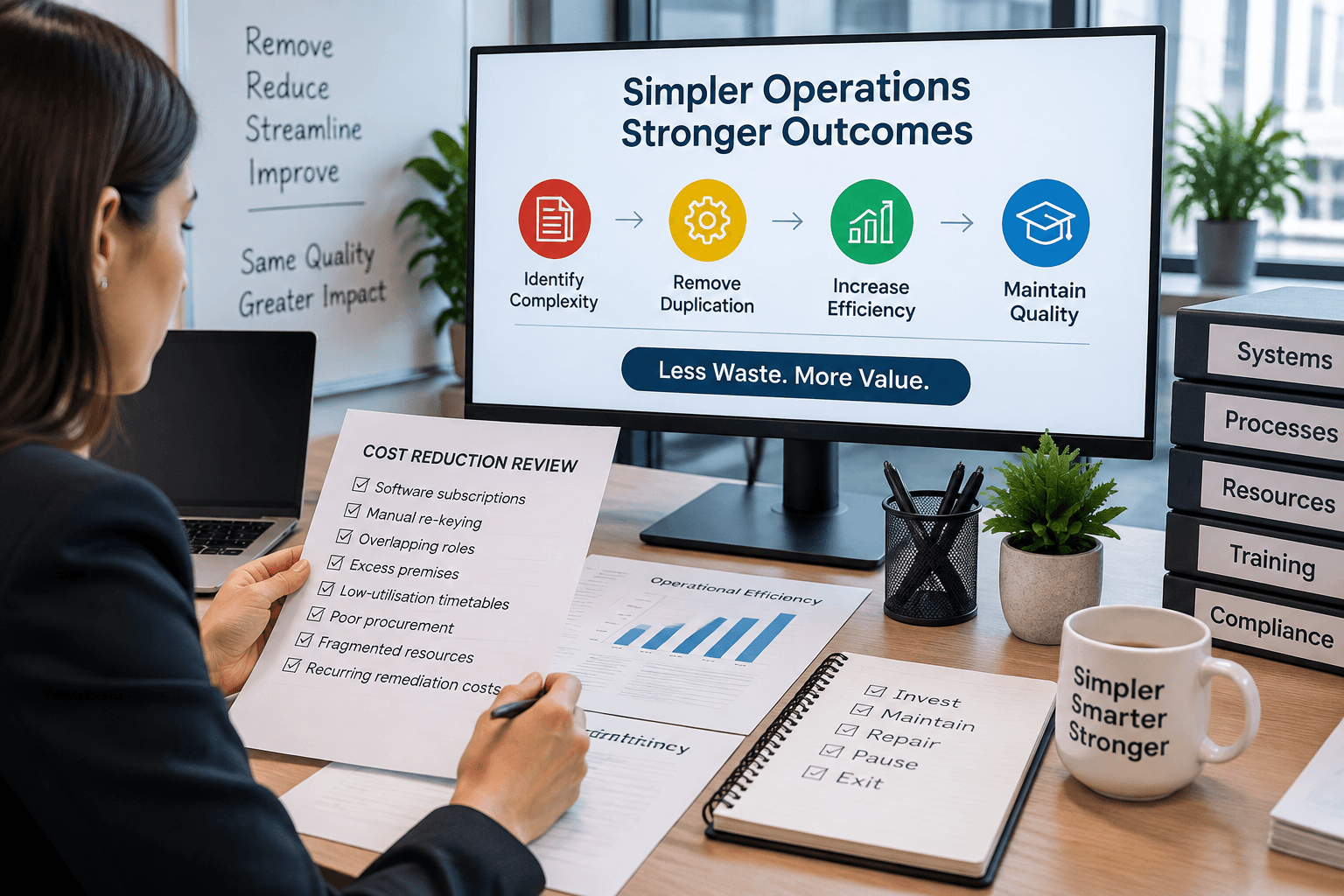
The best cost program removes waste, duplication, and low-value complexity. Review software subscriptions, manual re-keying, overlapping roles, excess premises, low-utilisation timetables, poor procurement, fragmented resource libraries, and courses with recurring remediation costs.
Classify each course and delivery stream as invest, maintain, repair, pause or exit. Protect the capabilities that directly support training quality, assessment integrity, student wellbeing, records, and regulatory assurance. A cheaper business that cannot deliver or evidence quality is not sustainable; it is merely delaying the cost.
AI can help draft routine communications, summarise internal material, classify enquiries, surface trends, support scheduling, prepare first-pass reports, and make knowledge easier to find. Used well, it can release people from repetitive work and improve consistency.
But AI should not become an invisible decision-maker. ASQA’s responsible-use principles emphasise governance, human oversight and accountability, security and privacy, equity and wellbeing, and alignment with the training product, industry and learner cohort. Qualified people must remain accountable, particularly for assessment and decisions affecting student outcomes.
Before deploying any AI use case, document the purpose, approved data, human reviewer, quality checks, privacy and security controls, recordkeeping, failure response, and review date. Never enter personal or sensitive information into an unapproved tool. Start with a low-risk, measurable workflow and prove the result before scaling.


Compliance should live where work happens in role design, systems, calendars, approvals, evidence capture, dashboards, and management meetings. If evidence is assembled only before an audit, management lacks visibility during the period when problems can still be prevented.
A practical assurance rhythm includes course-level indicators, sampling, validation, trainer capability monitoring, student feedback, complaints and appeals trends, assessment turnaround, placement controls, third-party oversight and corrective-action closure. The board or governing body should be able to connect financial pressure with risks to delivery and student outcomes.
| Period | Priority | Outputs |
|---|---|---|
| Days 1–30 | Diagnose | Course and cohort profitability; 13-week cash forecast; revenue concentration; refund and debtor exposure and manual-work risk map. |
| Days 31–60 | Decide | Invest/maintain/repair/pause/exit choices; two adjacent revenue opportunities; cost removals; system consolidation; AI governance; downside actions. |
| Days 61–90 | Execute | Launch one controlled revenue pilot; renegotiate or remove low-value spend; automate one low-risk workflow; implement dashboard and quarterly assurance rhythm. |
The objective is not to produce another strategy document. It is to create decisions, owners, dates and visible measures. Momentum comes from completing the first controlled cycle, learning quickly and repeating what works.

Uncertainty does not remove your ability to lead. It makes disciplined leadership more valuable. You may not control funding policy, migration settings, regulation, or the economy. You do control how quickly you see reality, how intelligently you allocate resources, and how consistently you execute.
The sustainable RTO of 2027 will not necessarily be the biggest. It will be the one that knows where it creates value, protects cash, earns trust, adapts without losing quality, and makes evidence-based decisions before pressure becomes crisis.
Start with the numbers. Choose the movies. Assign ownership. Then act.
Download the RTO Survival and Sustainability Guide 2026–27
A practical, detailed guide designed to help RTO leaders move from uncertainty to a structured 90-day response.
A sustainable RTO generates sufficient margin and cash to fund quality delivery, meet liabilities and withstand disruption. It understands performance at course and cohort level, manages revenue concentration, and integrates financial decisions with and student outcomes.
It depends on the evidence. If demand and delivery capacity are strong, revenue growth may be appropriate. If the cost base is duplicated or underutilised, cost reduction may be necessary. Many RTOs need both—but cuts must not undermine quality, support or assurance.
Start with adjacent opportunities that use proven capabilities and trusted relationships, such as employer-funded programs, domestic fee-for-service delivery, relevant short courses or skill sets, and carefully selected cohorts or markets. Test demand, margin, cash, capability and before scaling.
Use AI first in lower-risk administrative workflows, with approved data, documented controls, and human review. Protect privacy and security, monitor quality and bias, retain appropriate records, and keep qualified people accountable for assessment and student-impacting decisions.
A concise dashboard should connect cash runway, profitability, revenue concentration and liabilities with training quality, assessment integrity, student experience, trainer capability, third-party oversight and corrective actions.


