

Under the Standards for RTOs 2025, Standard 1.3 requires RTOs to pre-validate all assessment tools before they are used with students.
That means:

- Every assessment tool must be reviewed before first use
- Pre-validation checks alignment with the training product (training.gov.au)
- Gaps, errors, or contextualisation issues must be fixed before students are assessed
- Evidence of pre-validation must be kept as part of your compliance records
This is a must-have requirement – not optional. Done correctly, pre-validation prevents the most common non-compliances in RTO audits.
Why Pre-Validation Matters
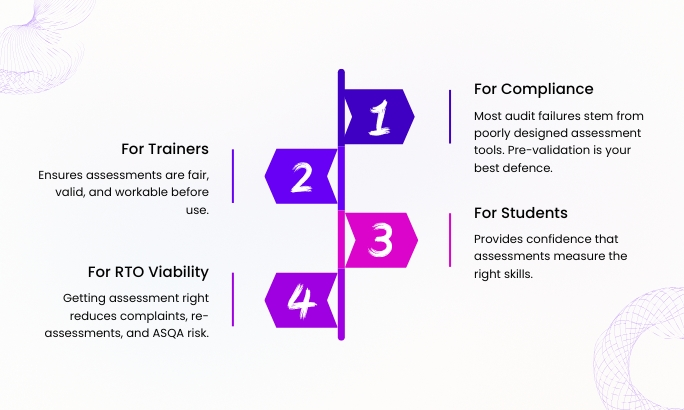
- For Compliance: Most audit failures stem from poorly designed assessment tools. Pre-validation is your best defence.
- For Trainers: Ensures assessments are fair, valid, and workable before use.
- For Students: Provides confidence that assessments measure the right skills.
- For RTO Viability: Getting assessment right reduces complaints, re-assessments, and ASQA risk.
Put simply: If you “check before you test,” you avoid 90% of compliance headaches later.
Common Issues with Pre-Validation
From my experience, these are the biggest mistakes RTOs make:
Tick-and-Flick Pre-Validation
- Forms filled in with “yes/no” answers only.
- No detailed comments or analysis.
Failure to Identify Gaps
- Tools don’t cover all elements/performance criteria.
- Marking guides don’t show what constitutes a correct answer.
Poor Contextualisation
- Generic tools copied from resource vendors.
- Not adapted to the RTO’s cohort, industry context, or delivery mode.
No Link to Continuous Improvement
- Issues identified in pre-validation but never corrected.
- No record of improvements made.
Missing Evidence
- RTOs can’t produce pre-validation forms at audit.
- No evidence that trainers or industry reps reviewed tools.
Case Study: Business Diploma RTO
Audit Context:
An RTO delivering the BSB50120 Diploma of Business was audited under Standard 1.3.

Findings (Non-Compliance):
- Pre-validation forms were completed but had only “yes/no” responses, with no commentary.
- Assessment tasks did not map correctly to the unit of competency (several elements missing).
- Tools were purchased from a resource vendor but not contextualised to the RTO’s business cohort (e.g., tasks referenced industries irrelevant to their students).
- No evidence of industry input during pre-validation.
Compliant Approach:
- Pre-validation conducted by trainers, compliance manager, and industry representative.
- Form required detailed responses for:
- Coverage of each element/PC/knowledge evidence/performance evidence
- Assessment conditions and workplace relevance
- Marking guide clarity
- Cohort contextualisation
- Identified gaps were corrected before use (e.g., adding workplace-relevant scenarios).
- Records kept in the compliance register, with updates logged in the continuous improvement register.
Outcome:
- Assessment tools were found to be compliant at the audit.
- Students received realistic and fair tasks.
- RTO reduced the risk of re-assessment disputes.
Self-Assurance for Standard 1.3
ASQA expects RTOs to check themselves before the audit. Here’s how:
Establish a Pre-Validation Process
- Every assessment tool must be pre-validated before first use.
- Include trainers, compliance staff, and industry reps where possible.
Use a Structured Form
- Cover all areas: mapping, clarity, resources, conditions, contextualisation, marking guide.
- Require detailed comments, not just yes/no.
Document Outcomes
- Record gaps identified and changes made.
- Keep evidence in a central compliance register.
Link to Continuous Improvement
- Add pre-validation outcomes to your continuous improvement register.
- Review and update tools regularly.
Self-Assurance Tip: Treat pre-validation as your insurance policy. If done properly, it prevents assessment non-compliances – the number one risk area for RTOs.
FAQs on Standard 1.3
It’s the process of reviewing and checking assessment tools before they are used with students to ensure they meet training.gov.au requirements.
Yes. It is a must requirement. Every RTO must keep evidence of pre-validation for all assessment tools.
- Pre-validation happens before tools are used (preventative).
- Validation happens after assessment has occurred (review of judgements).
Trainers, assessors, compliance managers, and ideally industry representatives.
Completed pre-validation forms, mapping documents, meeting minutes, and records of changes made.
Pre-validation that is “tick-and-flick,” missing detail, or has no evidence of improvements.
Getting pre-validation right is one of the biggest compliance wins your RTO can achieve.

Disclaimer:
The information presented on the VET Resources blog is for general guidance only. While we strive for accuracy, we cannot guarantee the completeness or timeliness of the information. VET Resources is not responsible for any errors or omissions, or for the results obtained from the use of this information. Always consult a professional for advice tailored to your circumstances.