Introduction
Credit Transfer (CT) is designed to make life easier for students — and for RTOs. When done right, it:

- Prevents students from repeating what they’ve already completed.
- Saves delivery resources for RTOs.
- Maintains the integrity of Australian qualifications.
But when done wrong, CT is a frequent source of non-compliance, especially in audits.
What Standard 1.7 Requires
Your RTO must demonstrate that:
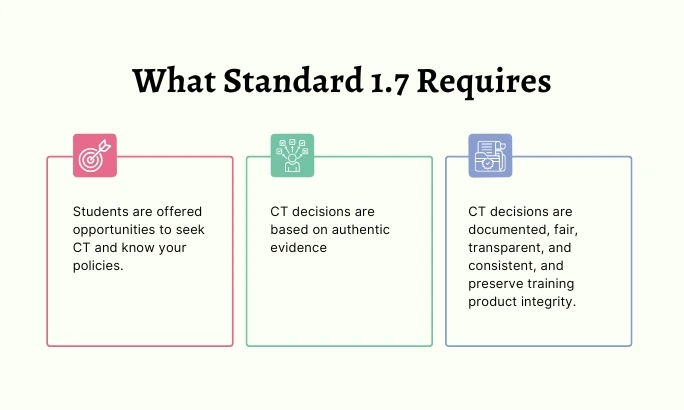
- Students are offered opportunities to seek CT and know your policies.
- CT decisions are based on authentic evidence:
- AQF certification documentation, or
- Authenticated VET transcript from the USI system.
- CT decisions are documented, fair, transparent, and consistent, and preserve training product integrity .
The Correct Credit Transfer Process (Step by Step)
Policy & Application Form
- RTO must have a Credit Transfer Policy and Credit Transfer Form available at enrolment.
- Students apply formally, attaching evidence.
Evidence Submission
- Student provides an AQF certificate/statement of attainment, or USI transcript.
- Evidence must be certified or authenticated.
Initial Review by Admin
- Admin checks whether the unit codes are the same or marked equivalent on training.gov.au.
- If equivalent → proceed.
- If non-equivalent → CT cannot be granted (student may apply for RPL instead).
Verification of Authenticity
- With so many qualifications now cancelled by ASQA, RTOs must verify authenticity.
- Best practice: check the USI transcript service rather than relying only on paper certificates.
Approval & Sign-Off
- CT decisions should be authorised by a qualified staff member or compliance manager, not left only to admin.
- This ensures decisions are consistent and correct.
CRICOS Considerations
- If the student is on a student visa, course duration must be reduced in PRISMS if CT shortens the length of study.
- Failure to do so is a common non-compliance for CRICOS providers.
Record Keeping
- Store the completed CT Form, evidence, sign-off, and final decision in the student management system (SMS).
Common Credit Transfer Non-Compliances
From audits and consultancy, here are the most frequent issues:
- No formal CT form or process — decisions handled informally.
- Accepting evidence without verifying authenticity via USI transcripts.
- Granting CT for non-equivalent units.
- Admin staff approving CT without understanding equivalence rules.
- No manager or compliance officer sign-off.
- For CRICOS providers: failing to update PRISMS duration when CT reduces study length.
Case Study – CRICOS Provider Audit
Context:
A CRICOS RTO delivering Certificate IV in Accounting and Bookkeeping had multiple international students requesting CT.
Findings (Non-Compliance):
- CTs were granted using uncertified certificates.
- No CT application forms on file.
- Admin staff approved CT without checking equivalence.
- Course duration in PRISMS was not reduced, breaching ESOS requirements.
Rectification:
- Introduced a structured CT Form with checklist.
- Verified all transcripts using the USI service.
- Required compliance manager sign-off for all CT decisions.
- PRISMS updated to reflect reduced study durations.
Outcome:
- Audit rectification accepted.
- RTO processes became consistent, fair, and compliant.
Self-Assurance for Standard 1.7
Ask yourself:
- Do we have a CT policy and form that is visible to students?
- Are all certificates/transcripts authenticated through USI?
- Are non-equivalent units clearly explained and redirected to RPL?
- Do all CT decisions have manager sign-off?
- For CRICOS: are PRISMS updates consistently made when CT reduces study length?
If the answer to any of these is “no,” you’re at high audit risk.
FAQs on Standard 1.7
- CT: Recognition of prior formal study, proven by AQF certificate or USI transcript.
- RPL: Recognition of prior informal or non-formal learning, based on mapped evidence.
Yes, if:
- Units are non-equivalent.
- Evidence is not authentic.
- Licensing/regulatory requirements prevent it.
- Use the USI transcript service.
- Contact the issuing RTO.
- Require certified copies if originals aren’t available.
- A compliance manager or qualified assessor should review and authorise.
- Admin staff alone should not make final decisions.
- It’s a breach of ESOS requirements.
- Students may end up studying longer than their visa allows.
- This is a serious non-compliance at audit.
To help you stay compliant with Standard 1.7, we’ve created:
📥 Free Credit Transfer Form Template – includes application, verification, and approval sections.
Disclaimer:
The information presented on the VET Resources blog is for general guidance only. While we strive for accuracy, we cannot guarantee the completeness or timeliness of the information. VET Resources is not responsible for any errors or omissions, or for the results obtained from the use of this information. Always consult a professional for advice tailored to your circumstances.