Standard 2.3

Standard 2.3 VET Student Support: The Complete Guide to Delivering Excellence Under the 2025 Standards

The 2025 Standards have fundamentally transformed student support from an afterthought into a cornerstone of quality VET delivery. Standard 2.3 represents one of the most significant compliance changes RTOs face, requiring systematic, proactive, and accessible support throughout every student’s training journey.

Understanding Standard 2.3: The Support Revolution

Outcome Standard 2.3: “VET students have access to support services, trainers and assessors and other staff to support their progress throughout the training product”.

This isn’t just about having support available – it’s about demonstrating how you determine, deliver, and make support accessible to every student.

Standard 2.2

The Four Critical Performance Indicators

Performance Indicators

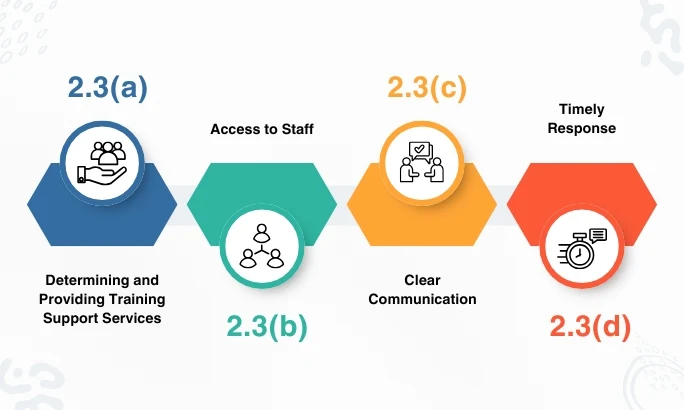
2.3(a): Determining and Providing Training Support Services
RTOs must demonstrate how they determine what support each student needs and how they make these services available

2.3(b): Access to Staff
Students must have genuine access to trainers, assessors, and support staff

2.3(c): Clear Communication
Students must be informed about how and when they can access support staff

2.3(d): Timely Response
Student queries must receive timely responses.

What This Means in Practice: Beyond Compliance From Reactive to Proactive Support

Old Approach

Students request help when they're already struggling.

New Requirement

RTOs must proactively identify support needs and provide ongoing assistance throughout training.

Audit Reality Check

In my experience auditing RTOs, those with systematic proactive support have 40% higher completion rates and significantly fewer complaints. ASQA now expects this level of engagement as standard practice.

The Full Spectrum of Required Support Services

According to ASQA’s Practice Guide, RTOs must provide access to:

Pre Enrolment LLND Testing

Academic Support:

  • Resources including readings, exercises, and practice tests
  • Language, literacy, and numeracy (LLN) support
  • Tutorials, including online tutorial support
  • One-on-one time with trainers and assessors

Technical Support:

  • Assistive technology
  • Specialized IT/technical support
  • LMS and digital platform assistance
Suitability Advice
Digital Skills Included

Progress Monitoring:

  • Systems for monitoring student progress
  • Early intervention for at-risk students
  • Reasonable adjustments when needed

Implementation Framework: Your Complete Action Plan

Phase 1: Support Service Mapping (Days 1-30)

1

Conduct Support Needs Analysis

  • Analyze your current student demographics
  • Identify common support challenges by qualification
  • Map existing support services and gaps
  • Document specific needs for different cohorts (online vs. face-to-face, domestic vs. international)
2

Develop Support Service Menu

Create a comprehensive catalog of available support services:

  • Academic tutorials and study groups
  • LLN support programs
  • Digital literacy assistance
  • Mental health and wellbeing resources
  • Career guidance and industry connections
3

Staff Resource Allocation

  • Define trainer/assessor availability schedules
  • Establish contact points and response timeframes
  • Create support staff role descriptions
  • Implement staff training programs

Phase 2: Access Systems Implementation (Days 31-60)

1

Communication Infrastructure:

  • Multiple contact methods (phone, email, chat, video)
  • Clear office hours and preferred contact times
  • Online booking systems for appointments
  • Emergency contact procedures
2

Response Time Standards:

  • Email queries: 24-48 hours maximum
  • Phone calls: Same day return call
  • Urgent issues: Immediate response protocols
  • Complex queries: Acknowledgment within 24 hours with timeline for resolution
3

Documentation Systems:

  • Student support request tracking
  • Response time monitoring
  • Support outcome evaluation
  • Continuous improvement feedback loops

Phase 3: Proactive Monitoring Systems (Days 61-90)

1

Early Warning Systems:

  • Academic progress monitoring dashboards
  • Attendance tracking and intervention triggers
  • Assignment submission monitoring
  • Engagement level indicators
2

Intervention Protocols:

  • Risk identification criteria
  • Escalation procedures
  • Support plan development
  • Regular review and adjustment processes

The CRICOS Dimension: International Student Support

International Students

Additional Requirements for International Students

CRICOS RTOs must provide enhanced support addressing:

  • Cultural adaptation assistance
  • English language development beyond initial requirements
  • Academic skills development
  • Immigration and visa support information
  • Emergency contact and crisis support

Best Practice Integration

Successful CRICOS providers integrate Standard 2.3 requirements with:

  • ESOS Act compliance obligations
  • Genuine Student requirement support
  • Cultural competency training for all staff
  • Specialized international student orientation programs
Best Practice Integration

Technology Solutions for Scale and Efficiency

Digital Support Platforms

  1. Learning Management System Integration:

    • Built-in communication tools
    • Progress tracking and alerts
    • Resource libraries and FAQ sections
    • Appointment booking systems
  2. Customer Relationship Management (CRM):

    • Student interaction tracking
    • Automated follow-up systems
    • Support request management
    • Performance analytics
  3. Communication Technologies:

    • Live chat functionality
    • Video conferencing capabilities
    • Mobile-responsive support portals
    • Multi-language support options

Automation Without Dehumanization

  1. Appropriate Automation:

    • Initial query acknowledgments
    • Appointment confirmations
    • Resource recommendations
    • Progress milestone celebrations
  2. Human Touch Required:

    • Complex problem-solving
    • Emotional support
    • Career guidance
    • Assessment feedback and discussion

Measuring Success: KPIs and Continuous Improvement

Essential Metrics

Response Time Performance:

  • Average query response time
  • Percentage of queries answered within standards
  • Peak volume management effectiveness

Student Satisfaction:

  • Support service satisfaction ratings
  • Accessibility and availability feedback
  • Outcome effectiveness measures

Academic Impact:

  • Completion rate improvements
  • Grade point average changes
  • Time-to-completion metrics
  • Withdrawal rate analysis

Continuous Improvement Framework

Response Time Performance:

  • Average query response time
  • Percentage of queries answered within standards
  • Peak volume management effectiveness

Quarterly Strategic Assessment:

  • Support service effectiveness against completion outcomes
  • Resource allocation optimization
  • Staff development needs identification
  • Technology upgrade requirements

Annual Strategic Planning:

  • Market demands and student demographics evolution
  • Competitive analysis of support service offerings
  • Budget allocation for support service enhancement
  • Long-term technology and staffing strategies

Detailed FAQ: Standard 2.3 Compliance

Support Service Determination

ASQA expects systematic assessment, including pre-enrolment LLND testing, ongoing progress monitoring, and regular check-ins. Document individual support plans based on assessment outcomes and adjust as students progress.

No. Support should be tailored to individual needs, but all students must have access to the same range of support options. Document your decision-making process for different support levels.

Yes, but you remain responsible for ensuring quality and accessibility. ASQA specifically mentions the risk of “not regularly reviewing the support services that are being provided by third parties”.

Access to Staff

This depends on your delivery model but must include regular, scheduled contact opportunities. Online RTOs can’t rely solely on email – you need phone, video, or live chat options with defined availability windows.

No specific frequency is mandated, but access must be meaningful for the training product. Complex qualifications require more frequent access than simple skill sets. Document your rationale for contact frequency.

For domestic students, reasonable business hours are generally acceptable. International students may require extended hours due to time zone differences. Always provide emergency contact procedures.

Communication Requirements

Multiple methods, including enrolment materials, student handbooks, LMS announcements, and regular reminders. ASQA expects proactive communication, not just information buried in documentation.

Contact details, office hours, preferred contact methods, response time expectations, types of support available, and escalation procedures for urgent issues.

Keep records of information provided, student acknowledgments, orientation session attendance, and any follow-up communications about support services.

Response Time Management

While not specifically defined, industry best practice suggests 24-48 hours for standard queries, same-day for urgent issues. Document your response time standards and measure performance against them.

Acknowledge receipt promptly and provide a timeline for resolution. Keep students informed of progress and any delays. This demonstrates responsiveness even when solutions take time.

Implement triage systems, use auto-acknowledgments, provide estimated response times, and have escalation procedures. Consider temporary staff increases during peak periods like enrolment.

Special Considerations

Standard 2.3 works together with Standard 2.4 (reasonable adjustments). Ensure support services are accessible, provide assistive technology, and make reasonable adjustments to support delivery methods.

You must make services available and communicate about them, but can’t force usage. Document your outreach efforts and maintain records of attempted contact for non-responsive at-risk students.

Even short courses require some level of support access. Scale your approach to the course duration and complexity, but ensure basic contact mechanisms and query response procedures are in place.

Technology and Innovation

Technology can support compliance, but can’t replace human contact for complex issues. Use automation for initial responses and routine queries, but ensure human escalation paths are clear and accessible.

Use technology to handle routine tasks and information provision, freeing staff for meaningful student interaction. The goal is enhanced, not reduced, human connection.

Mobile-responsive platforms are increasingly important, especially for younger students and those in remote areas. Ensure all support channels work effectively on mobile devices.

The Bottom Line: Transform Your Support Culture

After 15 years of auditing RTOs, I can confidently say that Standard 2.3 represents the most significant opportunity for competitive advantage in the 2025 Standards. RTOs that embrace this transformation will see:

1

Improved Student Outcomes:

  • Higher completion rates
  • Better employment outcomes
  • Increased student satisfaction
  • Stronger industry reputation
2

Operational Benefits:

  • Reduced complaint rates
  • Lower staff turnover
  • More efficient resource utilization
  • Enhanced audit readiness
3

Market Advantages:

  • Premium positioning capability
  • Word-of-mouth referrals
  • Higher student retention
  • Expanded market opportunities

Implementation Success Factors

check icon Leadership Commitment: Support transformation requires executive sponsorship and adequate resource allocation.
check icon Staff Development: Invest in training staff on proactive support approaches and customer service excellence.
check icon System Integration: Ensure support processes are embedded in all operational systems, not added as afterthoughts.
check icon Continuous Improvement: Regularly evaluate and enhance support effectiveness based on student outcomes and feedback.

Common Implementation Pitfalls to Avoid

Checkbox Compliance

Simply meeting minimum requirements without focusing on student success outcomes.

Technology Over-Reliance

Using automation to reduce rather than enhance human interaction.

Reactive Mindset

Waiting for students to request help rather than proactively identifying and addressing needs.

Inadequate Resources

Under-investing in staff time and technology infrastructure needed for effective support delivery.

Poor Communication

Failing to clearly communicate support availability and access procedures to students.

The Future Of VET Is Student Centric

Conclusion: The Future of VET is Student-Centric

Standard 2.3 isn’t just a compliance requirement – it’s a blueprint for building sustainable, successful VET operations in an increasingly competitive market. RTOs that view this as an opportunity rather than a burden will emerge as leaders in the transformed VET landscape.

The students who succeed in your programs become your best marketing asset. The support you provide today determines the reputation you’ll have tomorrow. Make Standard 2.3 your competitive advantage.

Disclaimer:
The information presented on the VET Resources blog is for general guidance only. While we strive for accuracy, we cannot guarantee the completeness or timeliness of the information. VET Resources is not responsible for any errors or omissions, or for the results obtained from the use of this information. Always consult a professional for advice tailored to your circumstances.

Related Products

Get Free Sample


    TALK TO OUR EXPERTS NOW! DIAL 1800 959 958

      Get A Free Sample