

Every failed audit I’ve reviewed in 16+ years of consulting has the same fingerprint. It isn’t the trainer. It isn’t the LMS. It isn’t the assessment tool. It’s the leader who delegated compliance and disappeared.
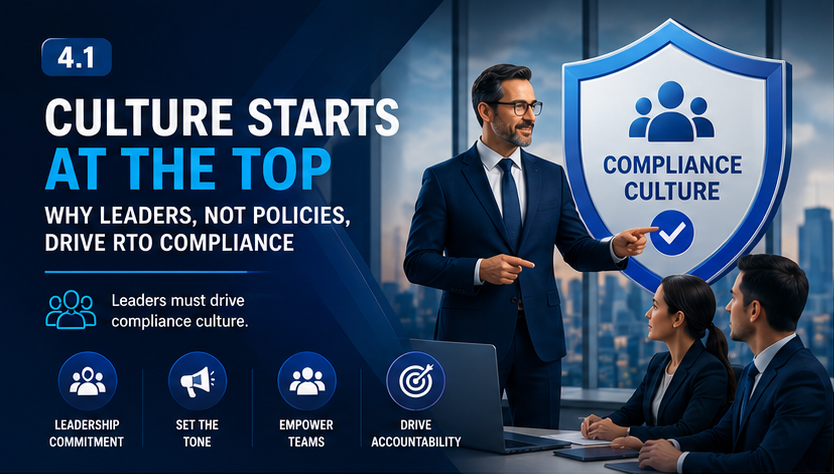
Standard 4.1 under the new Outcome Standards exists because ASQA finally codified what the sector has always known — compliance is a leadership behaviour before it is a document. The 2025 Standards are deliberately outcomes-based. That means ASQA is no longer just reading your policies; they’re observing whether your leaders live them.

This blog unpacks Standard 4.1 the way a 20-year operator would — not the textbook way. We’ll cover what the Standard actually says, the human psychology behind why most RTOs fail it, the ASQA Practice Guide expectations, a leader’s playbook, FAQs, and a free downloadable lead magnet at the end.

Outcome Standard 4.1 requires that an NVR registered training organisation operates with integrity and maintains accountability for the delivery of quality services.
To demonstrate this, the RTO must show that:
Translation: ASQA is now testing the person at the top — their decisions, their behaviour, and the culture they create — not just the QMS folder.
Here’s the psychology most consultants skip.
Humans copy authority. In any organisation, behaviour flows downward. If the CEO treats compliance as a tax, the GM treats it as a chore, the trainer treats it as paperwork, and the student receives a diluted experience. ASQA’s Practice Guide on Leadership and Accountability explicitly references this — governing persons must lead the culture, not delegate it.
Three psychological forces decide whether your RTO will pass or fail an audit:
The 2025 Standards essentially weaponise these psychological realities into regulatory expectations.
There is a correct order to building Standard 4.1 evidence. Most RTOs do it backwards — they start with documents and finish with culture. The right sequence is:
Skip step 1 or 2 and the rest is theatre.
ASQA released 19 Practice Guides to support transition to the 2025 Standards, including 3 specifically for Quality Area 4 – Governance. The Leadership and Accountability Practice Guide makes four expectations very clear:
| Expectation | What it means in practice |
|---|---|
| Fit and proper persons | Police checks, declarations, conflicts of interest registers, ongoing suitability reviews |
| Diligent, informed decisions | Evidence-based decisions linked to data, student feedback, risk and financial position |
| Culture of integrity | Visible leader behaviours, staff training, whistleblower-safe channels, ethical marketing |
| Accountability for outcomes | Owning rectifications, CARs, complaints and student outcomes at the governance level |
Self-assurance is the ASQA lens — can you identify, evidence and respond to risks before ASQA does?
After 16+ years sitting across hundreds of audits, validations, rectifications and CRICOS applications, here’s what separates the RTOs that pass cleanly from the ones that crumble:

These are the recurring reasons RTOs fail Quality Area 4 in 2025:
Governance meetings exist but minutes don’t show evidence-based decisions
Risk registers are static — created once, never reviewed
Conflicts of interest are undeclared or unmanaged
CEO or director can’t articulate the Standards in their own words during interview
Continuous improvement is reactive, not systemic
Third-party arrangements lack governance oversight
Material changes not notified within the new 10-business-day rule
Compliance isn’t a cost centre. It’s your licence to operate, your brand moat, and your insurance against catastrophic regulatory action. The RTOs that will dominate the next decade aren’t the cheapest — they’re the most trusted.
Under the 2025 Standards, ASQA is explicitly maturing its regulatory and assessment approach, and increasing transparency. That means audit outcomes will be sharper, more public, and more consequential. Leaders who hide behind their compliance manager will be the first ones exposed.e.

Governing persons include the people responsible for the executive decisions of the RTO — typically directors, CEOs, and senior officers as defined under section 186 of the NVR Act and the Fit and Proper Person Requirements.
Expect to provide governance meeting minutes, risk and CI registers, conflict of interest declarations, staff communications, code of conduct, complaint handling records, and decisions traceable to data and student feedback.
ASQA doesn’t prescribe a frequency, but the Practice Guide expectation aligns with monthly meetings for medium-to-large RTOs and at least quarterly for smaller providers.
The old Standards focused heavily on document compliance. The 2025 Standards focus on outcomes — actual leadership behaviour, evidence of diligence, and a demonstrable culture, not just policy documents.
Yes. The Standard is principle-based, not prescriptive. A sole director can comply if they document decisions, manage risk, evidence diligence, and demonstrate fit-and-proper status.
Self-assurance means the RTO can identify, evidence, and respond to risks and improvement opportunities before ASQA does. It is the central lens of the 2025 Standards.
Yes. Governing persons remain accountable for third-party arrangements, CRICOS obligations, and all delivery — including agent and partner conduct.
Governance meetings without evidence of risk-based, data-informed decisions. Minutes that record attendance but no rationale or actions.
Through current police checks, declarations, conflict of interest registers, and ongoing review of governing persons against the Fit and Proper Person Requirements under section 186 of the NVR Act.
Reset your governance meeting cadence and agenda, refresh all registers (Risk, CI, COI, Governance), document the leadership rationale for recent decisions, and run a self-assurance review using the ASQA Practice Guide questions.
“The RTO Leader’s Standard 4.1 Self-Assurance Toolkit (2025 Edition)”
A practical, audit-ready toolkit built from the ASQA Practice Guide – Leadership and Accountability. Includes:
👉 DM us “TOOLKIT” on Instagram or LinkedIn, or email the team at VET Advisory Group to receive your free copy.
Standard 4.1 isn’t asking you to be a better administrator. It’s asking you to be a better leader. ASQA has read the room — they know that culture, not paperwork, is what protects students and the integrity of VET.
Lead from the front. Document the why. Build the culture. The compliance follows.