



– AI by role • RTO leadership

AI for RTO CEOs and Leaders: save time without losing oversight.
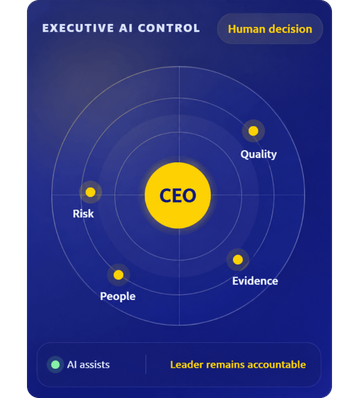
AI can help a CEO see patterns, prepare decisions and reduce administrative work. It cannot carry the accountability when an RTO gets the decision wrong.
Untitled Design 3

– The short answer

Use AI to prepare the decision—not to own it.
An RTO CEO can use approved AI tools to structure information, test assumptions, find patterns, prepare questions and draft management documents. The leader must still verify the evidence, understand uncertainty, consult the right people and make the final decision.
Hands On Workshop Training

Delegate preparation:

summaries, options, questions, draft structures and action lists.

Hands On Workshop Training 2

Keep accountability:

compliance conclusions, risk acceptance, student-impacting decisions and organisational commitments.

Hands On Workshop Training 3

Retain evidence:

approved inputs, reviewer corrections, decision rationale, owner and follow-up.

– 01 • The leadership boundary

The CEO needs better visibility—not automated confidence.

ASQA’s leadership and accountability guidance says governing persons should act diligently, make informed decisions and be able to explain how they access information about performance, compliance and improvement. It also emphasises documented accountabilities and delegations. Read ASQA’s Leadership and Accountability Practice Guide.

That makes AI useful for an executive when it improves the quality, timeliness and traceability of information. It becomes dangerous when fluent output is mistaken for verified evidence.

AI may help the CEO

  • Consolidate approved reports
  • Identify patterns and gaps
  • Generate questions and options
  • Draft plans and communications
  • Track actions and review dates

The CEO must retain

  • Final compliance conclusions
  • Acceptance of material risk
  • Strategic and financial decisions
  • Student and workforce accountability
  • Accuracy of declarations and reports
Audit reality
A polished AI summary is not evidence that a control operates. A leader should be able to move from each claim to its source, owner, date, reviewer and current status.

– 02 • CEO AI workbench

Ten workflows that can save time and strengthen control.
Begin with one bounded workflow. Define the information source, approved tool, output, human reviewer, decision owner and evidence before use.
01
Strategy
EXECUTIVE MANAGEMENT

Prepare a weekly executive brief

AI assists: consolidates approved operational reports into decisions, exceptions, trends and overdue actions.

Leader checks: source completeness, material omissions, conflicting data and owners.

Retain: source list, corrected brief, decisions and assigned actions.

02
Strategy
MEETINGS

Turn meetings into accountable actions

AI assists: structures notes into decisions, actions, owners, due dates and unresolved questions.

Leader checks: whether decisions are accurately represented and authority is clear.

Retain: approved minutes and action register—not an unchecked transcript.

03
Strategy
STRATEGY

Draft and challenge a business plan

AI assists: structures objectives, assumptions, options, dependencies, risks and measures.

Leader checks: market evidence, financial assumptions, regulatory constraints and organisational capacity.

Retain: assumptions register, evidence sources and approval history.

04
Strategy
OPERATIONS

Review operational performance

AI assists: compares trends in enrolments, progression, completions, complaints, validation and corrective actions.

Leader checks: data quality, cohort differences, causes versus correlations and local context.

Retain: approved dataset, analysis questions, verified findings and management response.

05
Strategy
SELF-ASSURANCE

Prepare an evidence-led self-assurance review

AI assists: organises approved evidence, identifies unanswered questions and drafts a gap summary.

Leader checks: whether documented controls operate, whether evidence is current and whether gaps are disclosed.

Retain: review scope, evidence index, human findings and improvement actions.

06
Strategy
RISK

Prepare a risk and incident briefing

AI assists: groups incidents, near misses and complaints; suggests questions and possible treatments.

Leader checks: severity, affected people, legal or regulatory escalation and residual risk.

Retain: verified facts, risk-owner decision and treatment monitoring.

07
Strategy
WORKFORCE

Plan capability and professional development

AI assists: compares role requirements, performance evidence, emerging needs and planned delivery.

Leader checks:fairness, consultation, current competence and individual circumstances.

Retain: agreed capability plan and human-approved development decisions.

08
Strategy
TRAINING QUALITY

Prepare a training and assessment oversight pack

AI assists: summarises validation, industry engagement, feedback, moderation and resource-review findings.

Leader checks: training product context, qualified judgement, risk to students and action effectiveness.

Retain: source findings, responsible manager response and governing-person review.

09
Strategy
GOVERNANCE

Draft a board or management report

AI assists: turns verified information into a consistent decision paper with options and recommendations.

Leader checks: accuracy, materiality, conflicts, confidentiality and whether the recommendation is supported.

Retain: final paper, declared corrections, decision and minutes.

10
Strategy
CONTINUOUS IMPROVEMENT

Connect findings to improvement

AI assists: de-duplicates findings, links themes and drafts measurable actions.

Leader checks: priority, resources, owner, measure, completion evidence and whether change improved outcomes.

Retain: approved improvement register and effectiveness review.
– 03 • Better instructions

Use the CONTROL prompt method.

A good executive prompt defines the boundary before requesting the output.

1

Context

Describe the RTO, decision and audience.

1

Objective

State the exact decision-preparation task.

1

Named sources

Restrict the analysis to approved evidence.

1

Tests

Define standards, criteria and questions.

1

Restrictions

State what it must not infer or decide.

1

Output

Specify a scannable format and uncertainty.

1

Leader review

Require gaps and human decisions to be flagged.

CONTROL
Reusable executive prompt
Act as a structured analysis assistant, not a compliance decision-maker. Using only the approved sources listed below, prepare an executive brief for [decision]. Separate verified facts, conflicting evidence, missing evidence, risks and questions requiring human judgement. Do not declare compliance, invent evidence or make a final decision. For every material statement, identify its source. Finish with: decisions required, responsible owner, proposed due date and evidence needed to close the action.

Self-assurance prompt starter

Organise the supplied evidence against the stated review questions. For each question, show: evidence provided, evidence date, responsible role, apparent gap, conflicting evidence and the human verification required. Treat absence of evidence as “not demonstrated”—not as non-compliance. Do not make a final compliance conclusion.

Business-plan challenge prompt starter
Challenge this draft plan using the stated assumptions and evidence. Identify unsupported assumptions, capacity constraints, regulatory dependencies, risks to student outcomes, missing measures and decisions that require financial or VET expertise. Provide options; do not choose the strategy.
Placeholder

– 04 • Five-principle leadership map

Every executive workflow should pass five tests.
8 1

Governance and integrity

Is the use approved, owned, risk-assessed, monitored and consistent with quality VET?

8 1

Human oversight

Which qualified person reviews the output and remains accountable for the decision?

8 1

Privacy, security and records

What information enters the system, where does it go and what record must be retained?

8 1

Equity and wellbeing

Could the workflow create bias, exclusion, surveillance, distress or an inaccessible pathway?

8 1

Training, industry and cohort alignment

Does it support—rather than dilute—training product, workplace and learner requirements?
– 05 • CEO self-assurance

Twelve questions a leader should be able to answer.
12

leadership questions

Placeholder
The CEO evidence test

For every “yes”, ask: Show me the source, owner, review date, exception history and evidence that the control works in practice.

1. Governance and integrity

  1. Where is AI used across the RTO, including embedded and unofficial use?
  2. Who owns each use, risk, control and review decision?
  3. How does leadership know practice matches the approved policy?

2. Human oversight

    4. Which decisions may AI assist, and which may never be delegated?
    5. Can the RTO retrieve evidence of qualified human review for higher-impact outputs?
    6. How are errors, exceptions and concerns escalated to a person with authority?

3. Privacy, security and records

    7. Which systems are approved to handle organisational or student information?
    8. Can the RTO explain data location, provider access, retention and required records?

4. Equity and wellbeing

    9. How are accessibility, digital confidence, culture and potential bias tested?
    10. Is an equivalent human-supported pathway available where AI is unsuitable?

5. Training and cohort alignment

    11. How are AI-assisted resources validated against training product and industry requirements?
    12. How does the RTO confirm that students still demonstrate their own competence?

– 06 • Information boundary

Do not begin with the tool. Begin with the information.

Living, VET-specific guides to what each tool can help with, where it can create risk and what a responsible RTO workflow looks like.

17

Generally safer starting material

  • Publicly available regulatory guidance
  • Approved templates and de-identified examples
  • Aggregated operational data approved for the system
  • Non-confidential planning assumptions
17

Requires explicit approval and safeguards

  • Student or staff information
  • Assessment evidence and outcomes
  • Complaints, incidents and wellbeing information
  • Commercial, legal or confidential records
17

Do not enter into an unapproved public tool

  • Identifiable or sensitive personal information
  • Credentials, access keys or security details
  • Unreleased board, financial or legal material
  • Third-party confidential or copyrighted content
The OAIC advises organisations to complete due diligence, embed human oversight, understand provider access and privacy risk, and avoid entering personal—particularly sensitive—information into publicly available generative AI tools as a matter of best practice.

Author:

Ben Thakkar.

Experience supplied: more than 16 years in VET and experience across more than 300 audits.

Last reviewed: 2 August 2026.

Status: general educational guidance; confirm current official requirements and obtain advice appropriate to your RTO.

– 07 • First 30 days

Start with control, then scale the time saving.
AI is new. Responsibility for quality training and valid assessment is not.

Our role is to translate emerging AI issues into the practical systems, evidence and decisions familiar to Australian RTOs.

Week 1

See the current state
  • Nominate an accountable AI governance owner.
  • Discover current tools and use cases.
  • Stop or restrict obvious unsafe practices.

Week 2

Select one workflow
  • Choose a low-volume, reversible executive task.
  • Define sources, restrictions and human review.
  • Record the use in the AI register.

Week 3

Test the control
  • Compare AI output with the source evidence.
  • Record corrections and time actually saved.
  • Ask an uninvolved person to challenge the result.

Week 4

Decide whether to scale
  • Review benefit, error, risk and staff feedback.
  • Approve, modify, suspend or prohibit the workflow.
  • Set monitoring and next-review dates.

– 08 • Five-part article validation

How this guide was checked.
AI is new. Responsibility for quality training and valid assessment is not.

Our role is to translate emerging AI issues into the practical systems, evidence and decisions familiar to Australian RTOs.

13

VET subject matter

Workflows reflect real RTO leadership, training, quality and operational decisions.

13

Auditor lens

Claims distinguish guidance from requirements and connect conclusions to evidence.

13

Marketing lens

The value is clear, scannable and useful before any contact invitation appears.

13

SEO and AI search

The page answers the role-specific question directly, uses structured headings and cites primary sources.

13

Behavioural psychology

The article moves from uncertainty to control without guaranteeing compliance or using exaggerated fear.


Editorial validation is not a legal opinion, regulatory approval, licensed psychological assessment or independent certification.

– About the author

Ben Thakkar

Ben has more than 16 years’ experience in the VET sector and experience across more than 300 audits. His work focuses on translating complex RTO obligations into practical systems, resources and evidence-led decisions.

– Frequently asked questions

Questions RTO leaders ask about AI.

AI may organise approved evidence, identify unanswered questions and draft a review structure. It cannot observe whether practice occurs, determine whether evidence is sufficient or make the CEO’s final compliance conclusion.

It can help structure and challenge a plan, but leadership must verify market evidence, training capacity, financial assumptions, regulatory dependencies and risks to students before approval.

Define the workflow first. Then assess provider controls, information handling, access, record keeping, human oversight and contractual terms. Approval should be based on the use case and risk—not brand popularity.

Use proportionate evidence such as named approval fields, tracked corrections, decision records, version history, meeting minutes or quality sampling. The record should show what was reviewed, by whom, against which criteria and with what outcome.

Do not promise a universal number. Measure the actual workflow: preparation time, correction time, error rate, decision quality and any new governance work. Scale only when the demonstrated benefit outweighs the risk and control cost.

Australian Achiever Awards 2026
Australian Achiever
Awards 2026
HIGHLY RECOMMENDED

Get A Free Sample

Download RTO Risk Register

Download RTO Risk Register

Download Conditions of Registration Compliance Tracker

Download Training and Assessor Manual

Download Standard 4.2 Self-Assessment Audit Checklist

Download Free Complete AI in VET Guide 2026

Download Free 2026 RTO READINESS CHECKLIST

Our August Sale is now live! Get up to 71% off selected resources until 30 August 2026.

Days
Hours
Minutes
Seconds

Request Your Free Sample, Product Info & Pricing Today

By submitting this form, you agree to the VET Resources Privacy Policy.