


There is a phrase that appears almost word-for-word in trainer CVs across the sector: “20 years’ industry experience.” Under the 2025 Standards, that phrase — on its own — does not satisfy Standard 3.3.
ASQA’s Practice Guide for Trainer and Assessor Competencies makes the expectation explicit: industry competencies, skills and knowledge must be relevant, at least to the level of the training product being delivered, and current. Currency is an active, ongoing demonstration — not a historical claim

This blog walks through Standard 3.3 clause by clause using ASQA’s verbatim Practice Guide language, and shows what ‘evidence of currency’ looks like in practice — for trainers, assessors, those working under direction, and industry experts.
Standard 3.3: Training and assessment are delivered by persons with current industry skills and knowledge relevant to the training product.
Performance Indicators (Verbatim from ASQA)
An NVR registered training organisation demonstrates:
(a) all persons delivering training or assessment for, or on behalf of the organisation: (i) have industry competencies, skills and knowledge that are relevant to, and at least to the level of, the training product being delivered or assessed by the person; and (ii) maintain an understanding of current industry practices relevant to the training and assessment being delivered by the person
(b) where it engages experts for the purposes of delivering training, it does so: (i) by reference to the requirements of the training product or the specific VET student cohort; and (ii) in response to a specific need for the expert to be engaged
(c) it has a system for ensuring: (i) experts have industry competencies, skills, knowledge and specialised industry or subject matter expertise that is directly relevant to the training product they are delivering; (ii) experts are only authorised to work under the direction of a person with the appropriate credentials to provide direction on the delivery of training and assessment, as specified in the Credential Policy; (iii) where the expert is involved in assessment judgement – they conduct the assessment alongside the trainer or assessor; and (iv) the training or assessment the expert is involved in delivering is subject to oversight by the organisation

undertaking accredited training, or higher-level qualifications, relevant to the industry area; belonging to industry associations; engaging with industry (for example, through discussions with employers or attending industry networking events); subscribing to industry journals and newsletters; staying informed about changes to technology; keeping up to date with changes to industry-specific legislation and licencing requirements
If you cannot answer any of these with documented evidence, the Practice Guide flags it as a Standard 3.3 gap to address.

Standard 3.3 has two interlocking requirements: industry competencies, skills and knowledge that are relevant and at least to the level of the training product, and a maintained understanding of current industry practices. Length of experience speaks to the first; it does not, on its own, evidence the second.
ASQA’s Practice Guide is explicit that maintaining an understanding of current industry practices is demonstrated by activities the trainer or assessor is doing now or recently — for example, working part-time in industry, undertaking accredited training relevant to the industry area, belonging to industry associations, engaging with employers, subscribing to industry journals, staying informed about technology changes, and keeping up to date with industry-specific legislation and licencing requirements.
A historical statement of experience is not, by itself, an example activity ASQA lists. It is the foundation; current activity is the evidence.
| Area | What ASQA’s Practice Guide expects you to demonstrate |
| Industry competencies, skills & knowledge | Relevant to, and at least to the level of, the training product being delivered or assessed |
| Currency of industry practice | An understanding of current industry practices, maintained over time and demonstrated through current activity |
| Authentication | Documented authentication of industry competencies for trainers, assessors, those working under direction, industry experts, and third-party engagements |
| Industry experts — when used | Engaged by reference to the requirements of the training product or the specific VET student cohort, and in response to a specific need |
| Industry experts — supervision | Authorised to work only under the direction of a person with the appropriate credentials per the Credential Policy |
| Industry experts — assessment judgement | Where involved in assessment judgment, the expert conducts the assessment alongside the trainer or assessor; the involvement is documented |
| Oversight | Training or assessment that the expert is involved in delivering is subject to organisational oversight |
| Gap identification & response | Industry engagement practices are used to identify gaps in currency and trigger action |
These steps mirror ASQA’s published example activities — they are not a regulatory prescription, simply a practical sequence many RTOs use:
| Area | Connection |
| Standard 3.1 — Workforce planning | Industry currency obligations feed workforce demand factors, and the workforce plan |
| Standard 3.2 — Credentials | Credentialled persons must also meet Standard 3.3 industry competency and currency expectations |
| Working under direction | Persons working under direction must also maintain an understanding of current industry practices, per Standard 3.3 |
| Compliance Standards — Information & Transparency | Marketing must not represent levels of expertise that are not supported by current industry evidence |
| Compliance Standards — Accountability (Third Parties) | Third-party trainers and assessors are inside the RTO’s industry currency perimeter |
Standard 3.3 requires that persons with current industry skills and knowledge relevant to the training product deliver training and assessment. ASQA’s Practice Guide makes both the relevance and the currency obligations explicit and applies them to trainers, assessors, those working under direction, and industry experts.
Experience may evidence relevant industry competencies, but ASQA’s Practice Guide expects the RTO to also demonstrate that the person is maintaining an understanding of current industry practices. Currency is an active, ongoing requirement.
ASQA lists examples, including volunteering or working part-time in the industry area, undertaking accredited training or higher-level qualifications relevant to the industry area, belonging to industry associations, engaging with industry (e.g. discussions with employers or attending industry networking events), subscribing to industry journals and newsletters, staying informed about technology changes, and keeping up to date with industry-specific legislation and licensing requirements.
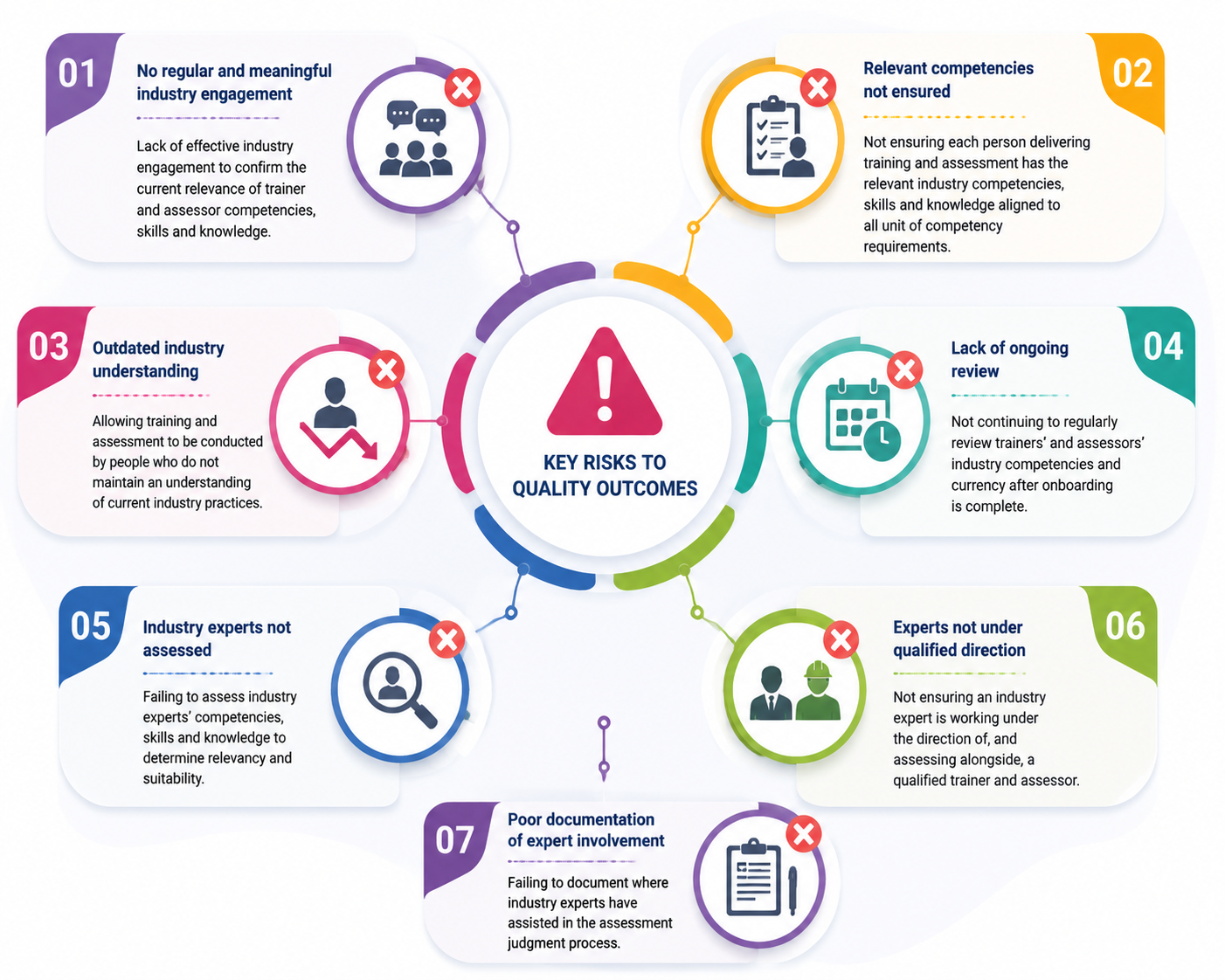
ASQA does not specify a fixed cadence. The Practice Guide expects regular review and lists ‘Not continuing to regularly review the trainers’ and assessors’ industry competencies and currency after the completion of the onboarding process’ as a known risk. Most RTOs review at least annually, with mid-year checks where industry change is rapid.
Yes. ASQA’s example activities specifically include ‘all trainers and assessors, and those working under direction’ in the requirement to maintain an understanding of current industry practices.
ASQA states experts are engaged by reference to the requirements of the training product or the specific VET student cohort, and in response to a specific need for the expert to be engaged. The engagement is purpose-driven.
ASQA states experts are only authorised to work under the direction of a person with the appropriate credentials per the Credential Policy. Where the expert is involved in assessment judgment, they conduct the assessment alongside the trainer or assessor.
Documented industry competencies, skills and knowledge directly relevant to the training product; the rationale for engagement; the working-under-direction arrangement; the alongside-assessment rule where they contribute to judgement; and organisational oversight of the training or assessment they are involved in delivering.
ASQA flags as a known risk ‘Failing to document where industry experts have assisted in the assessment judgement process.’ The expert’s involvement should be recorded against the student, the unit, and the qualified assessor.
No. ASQA’s example activities expressly state RTOs should authenticate industry competencies for trainers and assessors, including industry experts and those engaged by your third parties.’ Third-party staff are inside the same currency perimeter.
ASQA’s known risks list flags two recurring patterns: not having mechanisms for regular and meaningful industry engagement that confirm current industry relevance, and not continuing to regularly review industry competencies and currency after onboarding. Both are addressed by an active Industry Engagement Plan and a calendarised annual currency review.
“Trainer & Assessor Manual (2025 Edition) — by VET Resources”
A practical, audit-ready register and engagement plan built directly from ASQA’s Trainer and Assessor Competencies Practice Guide. Pre-mapped to ASQA’s Standard 3.3 performance indicators, example activities, known risks, and self-assurance questions — covering trainers, assessors, those working under direction, third-party staff, and industry experts.
Standard 3.3 is a present-tense standard. The question it asks is not ‘what did this person do twenty years ago?’ but ‘what is this person doing now to maintain an understanding of current industry practice?’. ASQA’s Practice Guide makes the expectation explicit and lists the activities that count.
The next blog in this series — Blog 5 — is the practical 90-day playbook for the full Quality Area 3 build. Subscribe so you don’t miss it.