


The way RTOs send their training data to the government is being modernised. A new legislative instrument — the Data Provision Requirements (Data Streamlining) Amendment 2026 — starts on 1 October 2026. It plugs your reporting into a new national rulebook (the VET Information Standard) and a new online system (STARS). Every RTO must be reporting the new way by 31 December 2028.

Right now, most RTOs collect student and training data during the year, then submit it once a year as an AVETMISS file (a flat-text NAT file). By the time that data is published, it can be well over a year old. That’s too slow for governments trying to plan skills and funding.
The reform fixes that by moving to three connected pieces. Here’s what each one is, in everyday terms:
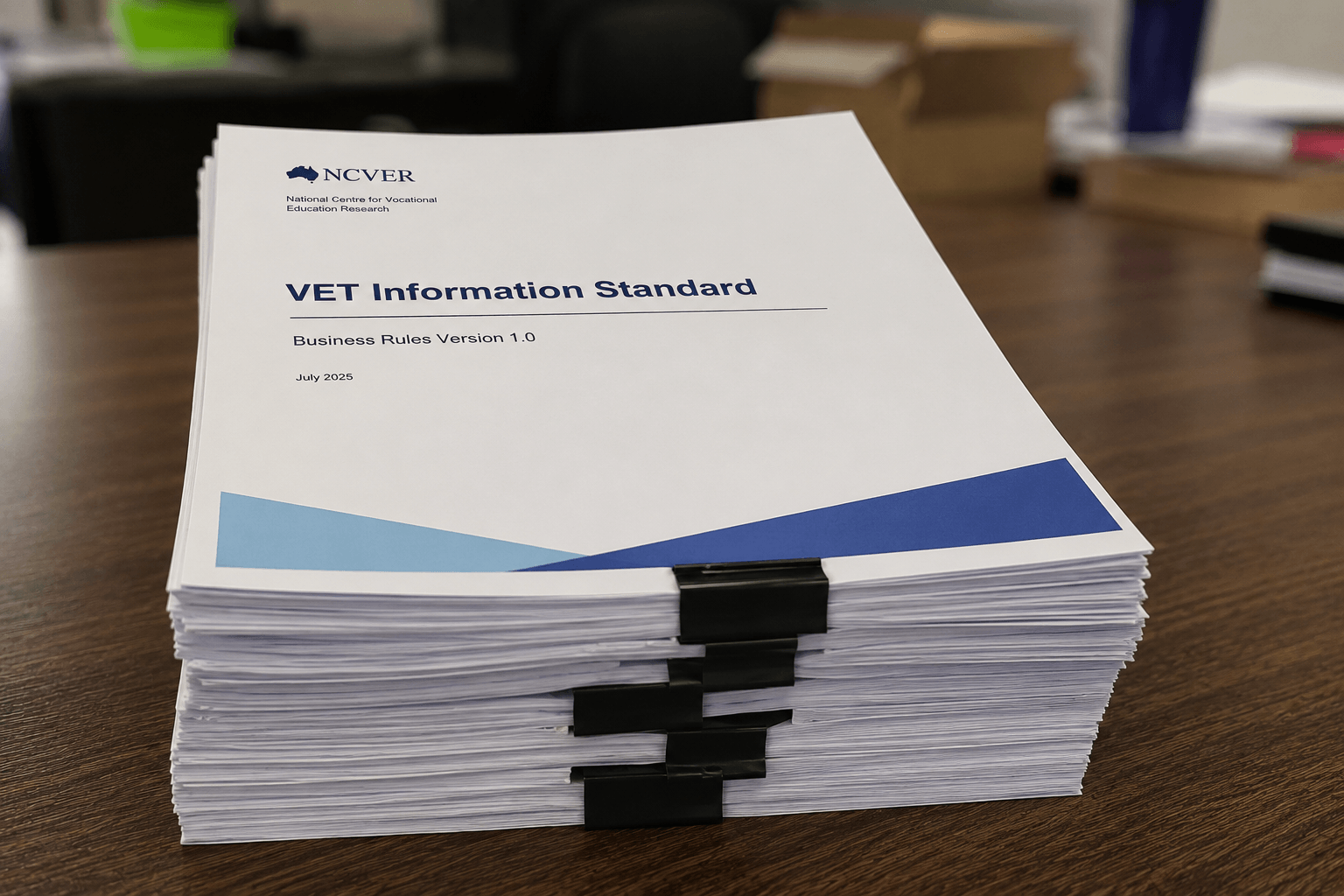
Think of this as the updated instruction manual for what data you report and how it must look. Skills Ministers approved the list of reportable data elements in July 2024, and NCVER has since added the technical and business rules. It replaces the old AVETMISS-only way of describing your data.
STARS (the Student Training Activity Reporting System) is the new national “post office” for VET data. It sits between your student system and the government. You send your data into STARS; STARS checks it and sends validation feedback straight back to you if something’s wrong. It’s built for more frequent submissions and near-real-time data — and it gives you one single channel instead of duplicated reporting to different bodies.
This is the legal instrument that makes it official. It amends the Data Provision Requirements 2020 (the rules made under section 187 of the NVETR Act 2011) so they point to the new VET Information Standard. Because the DPRs are part of the VET Quality Framework, following them is a condition of your registration — the same legal weight as the Standards. This is the piece that starts on 1 October 2026.

Imagine you used to post one big parcel of paperwork to the government once a year. The reform replaces that with a smart online drop-box (STARS) where you lodge smaller updates regularly, using a new standard form (the VET Information Standard), and a new law (the 2026 amendment) says you must use it. Your student software is the machine that packs and sends the parcels — so it has to be upgraded first.
| When | What happens | What you should be doing |
|---|---|---|
| Now (2026) | Stage-1 rollout underway. Fee-for-service-only RTOs and SMS vendors invited to join first. | Talk to your SMS vendor. Start cleaning your data. Read NCVER’s guidance. |
| 1 October 2026 | Amended DPRs legally commence. | Understand your obligations. The transition is non-negotiable, not optional. |
| 2026 to 2028 | Progressive, staged rollout across the sector. | Move to the new Standard as your SMS and jurisdiction become ready. Test early. |
| 31 December 2028 | Reporting under the new Standard becomes MANDATORY for all RTOs. | Be fully live on STARS via the VET Information Standard before this date. |
Heads-up: the government has said these dates may shift as they work with the sector, and they’ll communicate changes. Treat 31 December 2028 as the firm outer limit and aim to be done well before it.
Special note for WA and Victoria
If your RTO is registered with the WA Training Accreditation Council (TAC) or the Victorian Registration and Qualifications Authority (VRQA) rather than ASQA, your transition timing and terms may differ. Confirm directly with your registering body — don’t assume the national timeline applies to you unchanged.
You don’t need to be a data expert to manage this well. Follow these steps in order. This is the plan we’d run for our own RTOs.

Put one person in charge. Name a single “VDS transition owner” who reports to the CEO. This can’t be “everyone”, or it becomes no-one.

Contact your SMS vendor and get it in writing. Ask three questions: (a) Will your system support the VET Information Standard and connect to STARS? (b) By what date? (c) Will there be extra cost or a new version we must upgrade to? Keep their written answer on file.
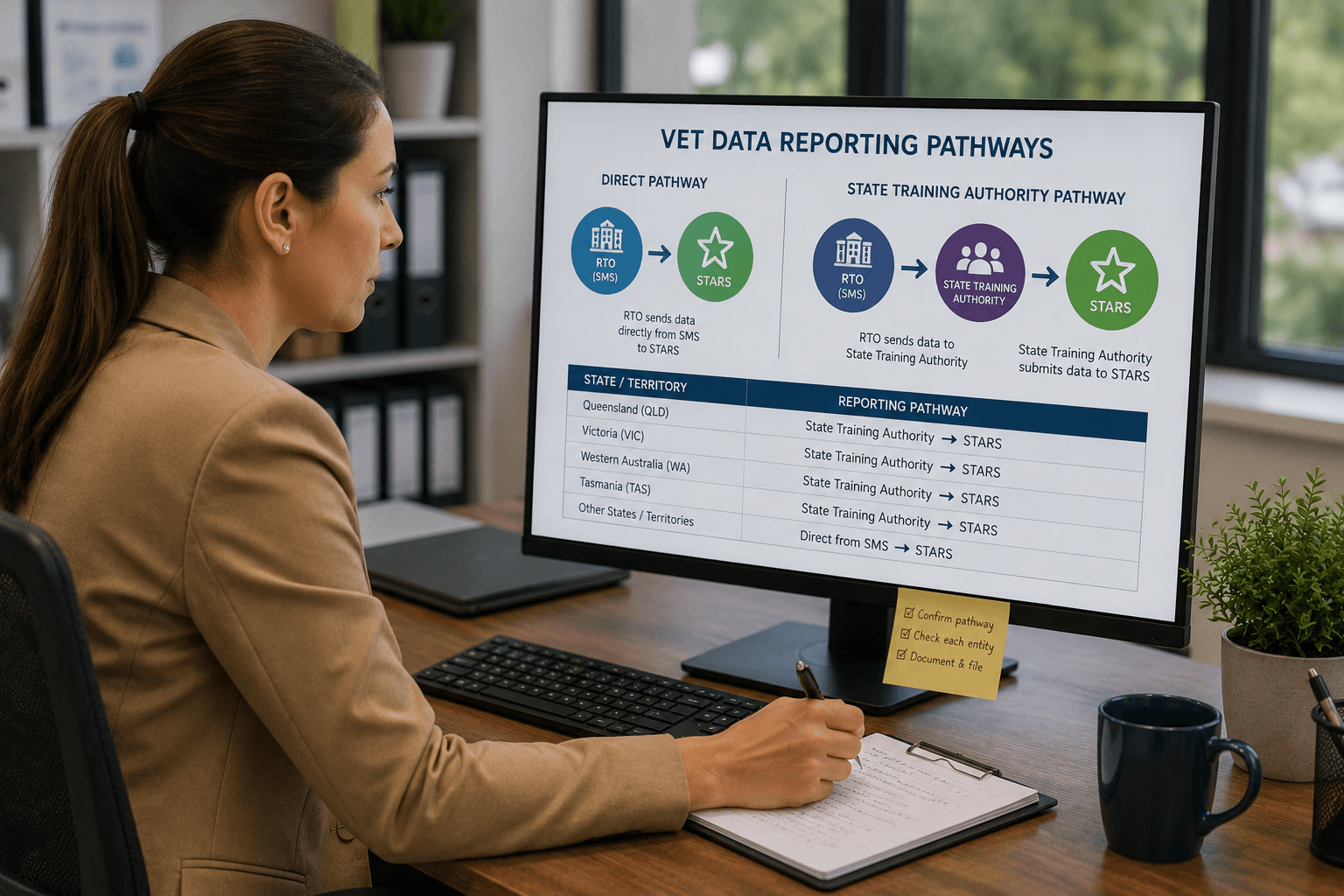
Find out your reporting pathway. Most RTOs will send data from their SMS straight into STARS. But if you deliver government-funded training in QLD, TAS, VIC or WA, you may report via your State Training Authority, who passes it on. Confirm which applies to each of your entities.

Clean your data now. More frequent reporting means errors show up faster and more often. Fix messy USIs, missing fields, wrong unit codes and duplicate records while you still report annually — before the system starts checking you in near-real-time.

Read NCVER’s guidance and the Guide to RTO Data Provision Requirements. These are the plain-English companions to the law and tell you exactly how to report under the new Standard.

Train the people who touch data. Your admin, student-services and compliance staff enter this data every day. Give them a short briefing on what’s changing so mistakes don’t get baked in.

Test before you’re forced to. When your SMS supports it, do a trial submission through STARS, read the validation feedback, and fix issues in a calm environment — not against a deadline.

Put it on your governance risk register. Under the Standards for RTOs 2025, your governance must manage risk. A legislative change with an IT dependency belongs in front of your board or owners.
These are the real questions RTO owners, CEOs, compliance managers and admin teams are asking. Share this section with your whole team.
It’s a new legislative instrument (made by DEWR and NCVER) that updates the Data Provision Requirements 2020. It connects your data-reporting obligations to the new VET Information Standard and the STARS system. It commences on 1 October 2026 and is part of the wider VET Data Streamlining Program.
No — and don’t confuse the two. The Standards for RTOs 2025 are about how you train and assess. This change is about how you report your data. They’re separate reforms with separate instruments. Both matter, but they’re different projects.
Yes. It applies to all RTOs that report VET activity data. The only variation is timing and pathway — for example, WA/VRQA-registered providers should confirm specifics with their regulator, and the first rollout group is fee-for-service-only RTOs.
The law starts on 1 October 2026, and full compliance is mandatory by 31 December 2028. You have a transition window in between. Aim to be live well before the 2028 deadline.
STARS (Student Training Activity Reporting System) is the new national online system you’ll submit your data into. It sits between your student software and the government/NCVER. It checks your data and sends feedback back to you, and it’s designed for more frequent, near-real-time submissions through a single channel.
For most RTOs, no. Your Student Management System will send data to STARS automatically once it’s upgraded. You mainly deal with your SMS as you do now — the SMS does the talking to STARS. Very small RTOs may have simpler tools, but the goal is system-to-system reporting.
The old once-a-year AVETMISS-file way of reporting is being replaced by reporting under the VET Information Standard through STARS. The underlying data you already collect is largely the same — the program focuses on data RTOs already record. What changes is the standard it follows and how/how often it’s sent. Keep meeting your current AVETMISS obligations until you’ve transitioned.
It’s the new national rulebook that defines the data elements you report and the rules for how they must be formatted and submitted. Skills Ministers approved the core data elements in 2024, and NCVER added the technical detail. Your SMS needs to support it.
Mostly your software (SMS) provider. They build the connection to STARS and the support for the new Standard. Your job is to make sure they’re doing it on time, upgrade when they release it, keep your data clean, and test. This is why confirming your vendor’s readiness is the single most important early step.
This is your biggest risk. Because compliance with the DPRs is a condition of your registration, a vendor who can’t connect to STARS becomes YOUR problem with the regulator. Ask them now for their written VDS roadmap and go-live date. If they can’t give you one, start looking at alternatives well before 2028.
Yes — the whole point is “better data, faster.” Instead of one annual batch, you’ll report activity more frequently, moving toward near-real-time. The exact rhythm depends on your setup and SMS, but plan for far more regular reporting than today.
Two main pathways:
Which one applies depends on your training arrangements and funding. Confirm it for each entity.
STARS validates what you send and gives you feedback so you can fix problems. With more frequent reporting, errors surface sooner — which is good if your data is clean, and painful if it isn’t. That’s why cleaning your data before you transition matters so much.
The program focuses largely on data RTOs already record, and the VET Information Standard is a richer, more consistent dataset. Expect some additional or more precisely-defined elements rather than a completely new collection. Check the Guide to RTO Data Provision Requirements for the specifics that apply to you.
Yes — the new national system is built with contemporary security and cyber-security controls, and improved protections around how data is transferred and stored centrally. That’s one of the stated benefits of the reform.
Please don’t. Every RTO that gets hurt by a reform is the one that treated the mandatory date as the start date. Your SMS upgrade, data clean-up, staff training and testing all take time. Early movers transition calmly; late movers scramble and risk registration action.
Possibly. Your SMS vendor may release a new version, module or pricing tier to support the VET Information Standard and STARS. Budget for potential software costs, plus staff time for clean-up, training and testing. Ask your vendor about cost early so there are no surprises.
Yes, though your tools may be simpler. NCVER provides options for smaller providers (for example, data-entry tools for RTOs with fewer students). Talk to NCVER or your SMS provider about the simplest compliant pathway for your size.
Your VET activity-data obligations under this reform are the same in principle. But you’re carrying more at once — the Standards for RTOs 2025, the CRICOS environment, and ongoing integrity scrutiny. Treat data quality as a live regulatory risk, and remember your PRISMS/ESOS obligations are separate and continue as normal.
The government has said the timeline may shift as they work with the sector, and they’ll notify everyone through NCVER channels (NCVER News, the Data Support Bulletin, and the VET Information Standard website). Keep an eye on those, but keep progressing regardless.
Straight from the primary sources:
The VDS program also runs free online showcases every 10 weeks that any RTO can join for updates and Q&A.
Two things: (1) email your SMS vendor and ask for their written VDS/STARS readiness date, and (2) name your internal transition owner. Everything else follows from those.
Yes. We help RTOs de-risk this exact transition — assessing your SMS vendor’s readiness, mapping your reporting pathway, auditing your data quality against the new VET Information Standard, and building a transition plan your board can sign off. If you’d like a readiness check, get in touch.


