


AUR Training Package Release 9.0 was endorsed on 24 June 2026 and released on 9 July 2026, superseding Release 8.0 (endorsed March 2026). It introduces important updates for automotive training providers, including revised training products, updated competency requirements, and resource alignment considerations for RTOs. Automotive RTOs delivering AUR qualifications should review their training and assessment materials, mapping documents, learner resources, and audit-ready systems to ensure alignment with the latest release.
The automotive industry continues to evolve through advanced vehicle technologies, electric vehicles, hybrid systems, diagnostic equipment, and changing workplace practices. Therefore, keeping training resources current is essential for delivering industry-relevant, audit-ready training.
This guide explains what AUR Training Package Release 9.0 means for automotive RTOs, what areas may require review, and how providers can prepare their resources for successful implementation.

AUR Training Package Release 9.0 is the latest update to the Automotive Retail, Service and Repair Training Package, released to ensure automotive qualifications and units continue reflecting current industry requirements. Releases have come in quick succession — 7.0, 7.1, 7.2, 8.0, and now 9.0 — a reminder that AUR is a fast-moving package and RTOs need an ongoing monitoring process rather than a one-off update.
The Automotive Retail, Service and Repair (AUR) Training Package supports nationally recognised training for automotive industries, including:
Automotive RTOs use AUR qualifications and units to train future automotive technicians, mechanics, and industry professionals.

The official details of current training products should always be checked through Training.gov.au, the Australian Government’s national register for vocational education and training products.
Training package updates directly affect how RTOs design, deliver, and assess vocational training.
Even minor changes can impact:
Automotive training requires strong alignment between workplace expectations and assessment outcomes. For example, an automotive qualification may require learners to demonstrate skills using updated diagnostic technologies or equipment. If assessment resources do not reflect current industry practices, learners may not develop the required workplace capabilities.

Under the 2025 Standards for RTOs, which came into effect on 1 July 2025 and apply to all ASQA audits in 2026, RTOs must demonstrate through ongoing self-assurance that training and assessment practices remain current and suitable for their learners and industry context.
For automotive RTOs, Release 9.0 is an opportunity to review the connection between training package requirements, industry expectations, workshop delivery practices, assessment evidence, and learning materials — as one connected system, not a set of documents to update in isolation.
A complete review should consider what units the RTO delivers, which qualifications are in scope, which resources require updating, how trainers apply changes, and whether learners receive current information. The checklist below walks through that review step by step.
Qualifications define the skills and knowledge required for specific automotive roles. When qualification requirements change, RTOs should review packaging rules, core and elective unit selections, delivery sequencing, course structures, and learner progression pathways. Automotive providers should compare their current scope with the updated AUR qualification information available through Training.gov.au.

Units define the skills, knowledge, and assessment requirements learners must achieve. When units change, RTOs should review Elements and Performance Criteria, Performance Evidence, Knowledge Evidence, Assessment Conditions, and Foundation Skills. A mismatch between assessment resources and training products can create risk during validation activities or regulatory reviews.

Assessment tools should be checked for current unit codes, updated assessment benchmarks, practical task requirements, observation checklists, knowledge questions, and workplace evidence requirements. Because automotive training depends heavily on practical demonstration, assessment activities should reflect real workplace environments, including workshop procedures, diagnostic processes, safety requirements, equipment operation, and manufacturer instructions.
Automotive RTOs looking for structured assessment solutions can explore AUR Training Package Resources from VET Resources. These resources can support providers reviewing their automotive learning and assessment materials while maintaining their own contextualisation and quality assurance processes.
Outdated learning materials can create gaps between classroom learning and workplace expectations. Automotive learner resources should reflect current industry areas such as vehicle diagnostic technology, electronic systems, safety procedures, workshop practices, and emerging automotive technologies. According to the International Energy Agency (IEA), global electric vehicle adoption has continued to increase, creating greater demand for skills related to EV technologies and supporting infrastructure. Automotive RTOs must ensure training resources prepare learners for current and emerging industry requirements.

A TAS explains how an RTO delivers training and assessment for a qualification or unit. After an AUR Training Package update, RTOs should review training product information, delivery methods, assessment approaches, trainer requirements, facilities and equipment, industry consultation evidence, and resource requirements. For example, if a qualification requires access to specific workshop equipment, the TAS should explain how learners will access appropriate facilities. VET Resources supports RTOs with audit-ready documentation and training solutions, including Training and Assessment Strategy resources designed to assist providers in reviewing their delivery systems.

Automotive RPL resources must align with current unit requirements after an AUR Training Package update. RTOs should review candidate self-assessment forms, evidence checklists, interview questions, practical demonstration activities, and assessor decision records. Updated RPL resources help ensure candidates are assessed against current workplace expectations. Automotive providers can explore RPL Assessment Resources to support their review process.

Automotive RTOs should review all digital learning systems to ensure learners and trainers access current AUR resources. Many RTOs store materials across an LMS, student portals, trainer resource folders, online assessment platforms, and document management systems. After an update, providers should search existing digital content for outdated unit references, remove superseded files, upload approved updated resources, confirm trainers are using the correct versions, and archive previous documents for recordkeeping. This is especially important in automotive training, where learners often move between theory content, demonstrations, simulations, and practical workshop activities.

Confirm current qualification and unit information through Training.gov.au, including qualification details, unit requirements, packaging rules, assessment conditions, and companion documents.
Determine which qualifications and units your RTO delivers by reviewing scope of registration, delivery locations, student cohorts, trainer allocation, and third-party arrangements.
Check assessment tasks, marking guides, observation checklists, practical demonstrations, knowledge assessments, and mapping documents to ensure activities reflect current unit requirements.
Review learner guides, presentations, workshop manuals, practical instructions, and online learning content so they reflect current industry technology and workplace expectations.
Confirm resources are valid, reliable, flexible, and fair. Maintain effective training and assessment practices that support quality outcomes under the 2025 Standards for RTOs.
Ensure trainers and assessors understand what changed, when changes apply, which resources were updated, and how assessments should be delivered.
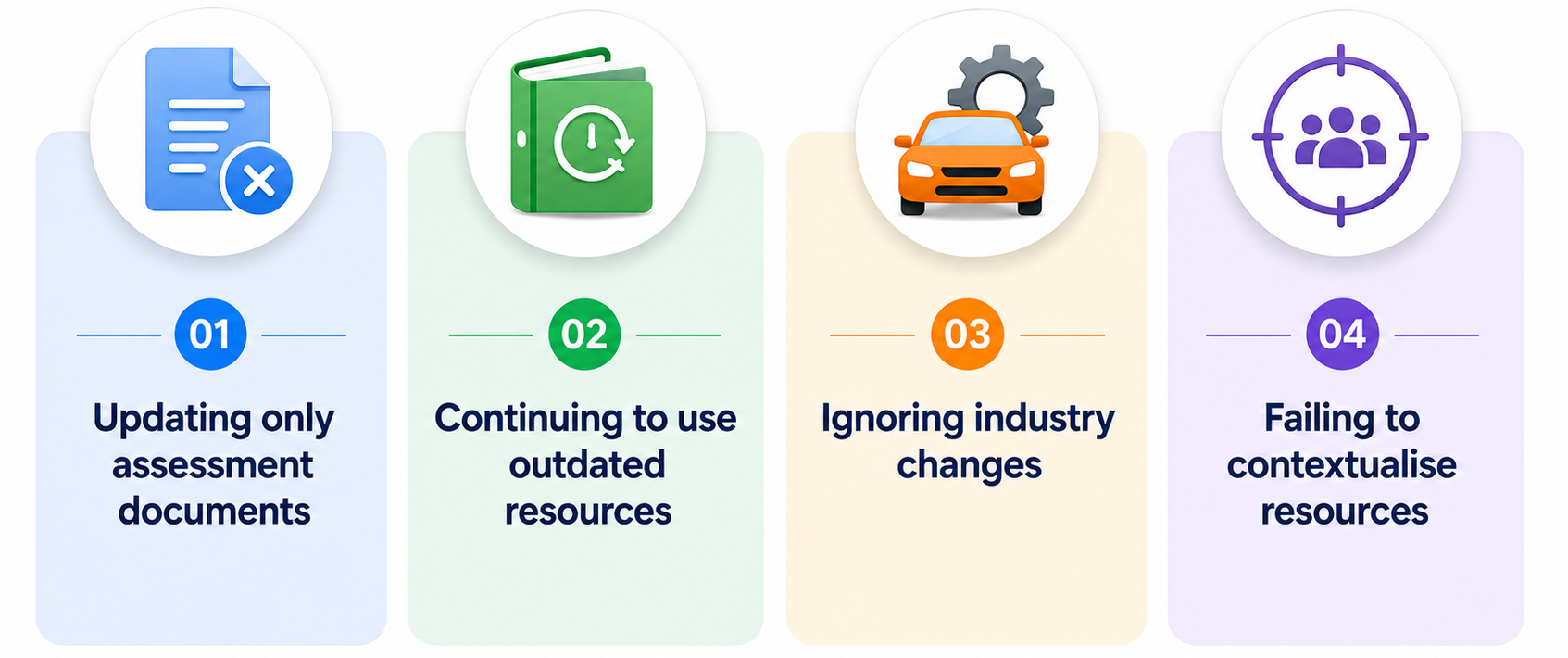
Updating only assessment documents. A complete review should include assessment tools, mapping documents, learner resources, trainer guides, TAS documents, and LMS content — not assessments alone.
Continuing to use outdated resources. RTOs should maintain clear version control, with every resource showing a version number, approval date, review date, and responsible person.
Ignoring industry changes. Automotive technology moves quickly. Modern automotive training increasingly includes electric vehicles, hybrid systems, advanced driver assistance systems (ADAS), electronic diagnostics, and high-voltage safety procedures. Training should reflect current workplace practices.
Failing to contextualise resources. Purchased resources provide a foundation, but RTOs must ensure materials suit their learners, delivery environment, industry context, and assessment conditions. RTOs remain responsible for ensuring resources are appropriate for their training model.
VET Resources provides training and assessment solutions designed to support RTOs delivering nationally recognised training. Automotive RTOs reviewing AUR Training Package Release 9.0 can access resources that support learning delivery, assessment development, audit-ready documentation, trainer support, and resource management.
Explore relevant AUR Training Package Resources to support automotive training delivery. VET Resources also provides structured Learning and Assessment Kits that help RTOs manage learner materials, assessment activities, and trainer resources — supporting qualification delivery, unit assessment requirements, learner engagement, and evidence collection.
RTOs should always review, contextualise, and approve resources through their own quality systems before implementation.
Training package changes are part of the Australian VET system. Rather than reacting after each update, RTOs can establish ongoing monitoring processes: regularly reviewing Training.gov.au updates, maintaining resource registers, scheduling validation activities, consulting industry representatives, and reviewing learner feedback. This proactive approach reduces disruption and supports continuous improvement.
AUR Training Package Release 9.0 is an opportunity for automotive RTOs to review and strengthen their training delivery systems. The most effective approach isn’t simply replacing documents — it’s evaluating the complete training ecosystem: assessment resources, learner materials, trainer documentation, TAS documents, digital platforms, and compliance records.
Automotive technology continues to evolve rapidly. RTOs that maintain current resources and strong audit-ready quality systems can better support learners and industry needs, delivering training that stays aligned with the future of the automotive industry.

An update to the Automotive Retail, Service and Repair Training Package, endorsed 24 June 2026 and released 9 July 2026, keeping automotive qualifications and units aligned with current industry requirements.
To maintain compliance, assessment validity, industry relevance, and quality learner outcomes under the 2025 Standards for RTOs.
Training.gov.au, Australia’s official national register for VET training products.
Yes, if the update affects the delivery model, qualification structure, resources, equipment, or assessment approach.
Only if they remain accurate and aligned with current training package requirements — review and contextualise before continued use.
With automotive training materials, assessment resources, and Audit-Ready solutions. Explore VET Resources for support with training package resources and RTO delivery requirements.


