


You have a busy schedule, are trying to improve your skills, and found your perfect online course that fits your needs. But how do you track your progress across different platforms and devices? How do you keep track of your last session learning without losing your temper? Well, that’s where SCORM comes in! No matter how you access your course, your learning journey is tracked and well-maintained here.
In this blog, you will get everything you need to know about SCORM and how it benefits the learners. Before diving in, let’s start with the basics of knowing what SCORM is.
SCORM stands for Sharable Content Object Reference Model.
SCORM is a set of technical standards used in e-learning to ensure that online content can be easily shared, reused, and integrated across the Learning Management System (LMS). It defines how online courses communicate with LMS, such as tracking scores, time spent on the course, and learner progress.

Content Objects: These are the individual learning models or components within the course.
Sequencing: SCORM enables the sequencing of content and ensures that the learners follow a defined learning path.
Tracking: SCORM keeps track of learner interactions, including completion status, score, and time spent.
SCORM is the modern Learning Management System that makes it easier to track the learner progress by managing, tracking and reporting.
For learners engaging with SCORM-compliant content, they gain experience by interacting with the online learning modules.
Here is the breakdown of how SCORM works from a user perspective:
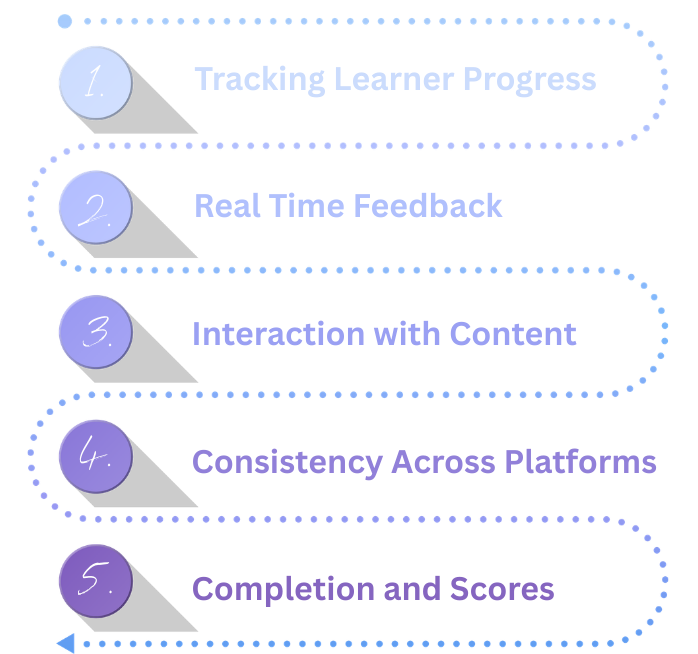
When you start an e-Learning course, SCORM records your actions within the course, such as what model they have completed, your quiz scores, the amount of time you spend on each activity, and even allows bookmarking so the learner can resume the course from the point they left off.
SCORM allows instructors to see learners’ progress in real time, so they can provide immediate feedback wherever it is necessary.
Depending on the SCORM version and course design, users might navigate through content in a linear(one section at a time) or flexible way (choosing their favourite topic).
SCORM ensures that learning data is tracked uniformly across different systems, so whether you’re using Blackboard or any other LMS, your progress is recorded.
Each course comes with the completion criteria so learners can see if they have completed all necessary components. It also helps in tracking scores of quizzes or tests.
SCORM provides several features that help learners manage their time effectively during their online learning journey. Here are some time management SCORM highlights:
SCORM tracks and displays learners’ progress, this helps the learners to understand how much time they need to allocate to complete the course and motivates them to stay on track.
SCORM allows learners to stop the course at any time and the system will remember where they left off. Even after multiple sessions, it helps the learner to resume exactly from where they left off.
Many SCORM course quizzes may have time limits. This teaches learners to manage time and answer questions effectively in the given time period.
Once after completing your assessments SCORM provides immediate feedback that allows learners to understand their performance and adjust their focus on remaining content.
Some SCORM complaint LMS platforms allow instructors to set deadlines or send reminders to learners about upcoming milestones or completion dates. These notifications help learners manage their time better by reminding them to stay on track.
SCORM allows self paced learning where learners can control how quickly they progress through the course. So learners can spend more time on their tough topics and less time on familiar ones.
SCORM benefits the learner by enhancing their engagement.
Here is the breakdown of SCORM features that impact the learner’s daily experience:
SCORM tracks your learning progress, keeps you motivated, and helps you achieve your goal easily. Understanding its core features can help learners optimise the learning experience and ensure they are on the right track to success.
By utilising SCORM, both learners and instructors can take advantage of its data tracking, manage and monitor progress.
SCORM stands for Sharable Content Object Reference Model.
SCROM is a set of technical standards used in e-learning to ensure that online content can be easily shared, reused, and integrated across the Learning Management System (LMS).
SCORM records your learning, quiz score, time taken to complete the activity, and bookmarks learners’ last learning, so that you can resume from where you left off.
There are 3 key components of SCORM, which include content object, sequencing, and tracking, which provide consistent data across the LMS.
VET resources provide the SCORM e-learning package, which effectively engages with the learner via interactive activities, playfully learning through quizzes, and real-time insight.
No, learners can choose their interested topic and gain knowledge.
