

Standard 1.5

Standard 1.5 – RTO Validation 2025: Risk-Based Validation Done Right

As an expert consultant with over 15 years’ experience working with Registered Training Organisations (RTOs) across Australia, I have seen firsthand the challenges many providers face when implementing the risk-based validation model under the new 2025 Standards—especially Standard 1.5. This blog cuts through the noise to explain how to get validation right, avoid common pitfalls, and embrace continuous improvement as a compliance advantage.


Risk Based Validation
Risk Based Validation Under Standard

Understanding Risk-Based Validation Under Standard 1.5

The 2025 Standards usher in a transformational approach to validation. Gone is the rigid 5-year validation cycle; instead, validation frequency and scope depend on risk factors such as recent changes, feedback, or identified issues. Validation must start by sampling at least two units and expand as needed to address gaps and instil confidence in assessment outcomes.

If no risk then need to follow 5 years validation plan.

Common Validation Issues I See as a Consultant

Despite clear guidance from ASQA, many RTOs struggle with effective validation. Here are the top issues I encounter:
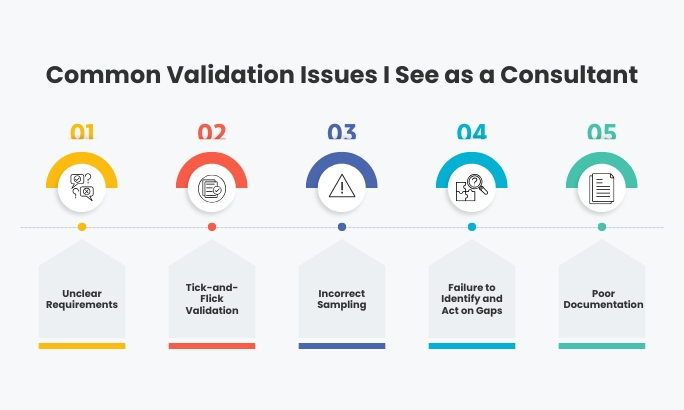
  • Unclear Requirements: Many RTOs attempt to validate all units at once, leading to rushed, low-quality reviews that spread resources too thin.
  • Tick-and-Flick Validation: Validation documents often contain only “yes/no” boxes, lacking commentary or critical analysis, which fails to identify serious gaps.
  • Incorrect Sampling: Instead of statistically valid samples, RTOs frequently review very few files, providing no confidence in assessment reliability.
  • Failure to Identify and Act on Gaps: Validation meetings sometimes end without actionable improvements or updates to assessment tools.
  • Poor Documentation: Missing or unsigned reports, no evidence of changes made, and absent continuous improvement records create huge audit risks.
Common Validation Issues Infographics

Case Study: The Turnaround of a Non-Compliant RTO

Consider an RTO I recently advised, “ABC Academy” (name changed). During an audit, ASQA flagged significant validation weaknesses:

  • Validation was a tick-box exercise, covering all units superficially with no detailed feedback.
  • Sample sizes were tiny – only 2 files for dozens of students.
  • No records showed validation outcomes or improvements.
  • Assessment tools were outdated, and compliance culture was weak.

Faced with potential sanctions, ABC Academy voluntarily engaged in a remediation plan guided by the ASQA Practice Guide for Standard 1.5.

Steps Taken for Turnaround:
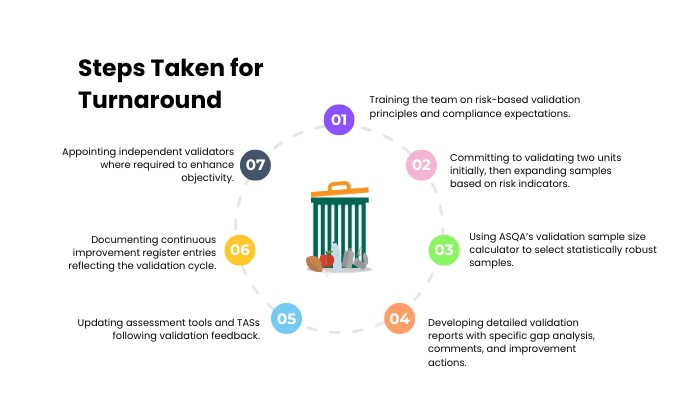
  1. Training the team on risk-based validation principles and compliance expectations.
  2. Committing to validating two units initially, then expanding samples based on risk indicators.
  3. Using ASQA’s validation sample size calculator to select statistically robust samples.
  4. Developing detailed validation reports with specific gap analysis, comments, and improvement actions.
  5. Updating assessment tools and TASs following validation feedback.
  6. Documenting continuous improvement register entries reflecting the validation cycle.
  7. Appointing independent validators where required to enhance objectivity.
Taken For Turnaround

Within six months, ABC Academy moved from high risk to audit-ready, demonstrating continuous compliance and improving assessment quality sustainably.

A Practical Self-Assurance Plan for RTOs: How to Dominate Standard 1.5 Compliance

Based on my experience and the ASQA Practice Guide 1.5, here’s a straightforward plan RTOs can adopt to master validation compliance:

Step1

Understand Requirements

  • Begin with validating a minimum of two units per training product.
  • Expand validation scope systematically based on data, feedback, and risk profiles.
Step3

Build a Skilled Validation Team

  • Include qualified trainers/assessors with current industry and vocational competency.
  • Engage independent validators as per Credential Policy and best practice.
Step4

Produce Comprehensive Documentation

  • Create detailed, signed validation form and assessment documents.
  • Document gaps, corrective actions, and evidence of changes.
  • Maintain a continuous improvement register for all validation activities.
Step5

Integrate Validation with Continuous Improvement

  • Use validation outcomes proactively to update tools, TASs, and processes.
  • Embed ongoing feedback loops into your quality assurance framework.
Step6

Provide Team Training & Awareness

  • Conduct workshops to ensure all assessors and compliance staff understand validation expectations and processes.

Download Your Free Expert Validation Form Template

To support RTOs on their validation journey, I am providing a free, fully compliant validation form template designed to facilitate meaningful, documented assessment validation aligned with Standard 1.5 and ASQA’s current guidance.

This tool makes it easy to:

  • Capture detailed gap analysis and improvement actions
  • Support robust sample selection and independent validation
  • Generate audit-ready documentation with traceable continuous improvement
Free Expert Validation

FAQs on Standard 1.5

Risk-based validation means validation activities are conducted based on the level of risk associated with training products or assessment practices. Rather than validating all units on a fixed term (like every 5 years), RTOs must focus validation where risks are identified—such as poor outcomes, changes to assessments, or critical feedback—to ensure quality is maintained and continuous improvement is effective.

ASQA requires validating at least two units of competency initially. If during validation gaps or concerns emerge, your sample must expand to encompass a broader range of units until you are confident in the integrity of your assessments.

Statistical representativeness is critical. The sample of assessment evidence reviewed should adequately reflect the diversity of learners, delivery modes, and assessment tools. ASQA provides an official Validation Sample Size Calculator to assist RTOs in selecting the appropriate number of assessments to validate.

The validation team must include trainers and assessors who are:

  • Competent in the training product,
  • Up-to-date with industry requirements,
  • Free of conflicts of interest related to the assessments being validated,
  • Independent validators must be included for certain qualifications such as TAE40122 to comply with the Credential Policy.
  • Tick-and-flick validations with superficial yes/no responses lacking meaningful analysis,
  • Reviewing too few samples, undermining reliability,
  • Failure to identify and address gaps in assessment tools or processes,
  • Poor documentation, missing reports, or unsigned validation records,
  • Attempting to validate all units at once without focusing on risk or quality concerns.

Validation outcomes must be recorded comprehensively with:

  • Signed validation form detailing findings and improvement actions,
  • Commentary explaining identified gaps and plans for rectification,
  • Evidence of updates to assessment tools or Training and Assessment Strategies (TAS),
  • Continuous improvement register entries showing how validation results lead to quality enhancements.

Validation frequency under the 2025 Standards is not fixed. It should be based on:

  • Identified risks or issues arising from feedback or audit findings,
  • Changes to assessment tools or training products,
  • Regular cycles for ongoing monitoring, especially in high-risk or new areas.

Non-compliance can lead to audit findings, sanctions, or in severe cases, suspension of registration. Early identification and corrective action, such as voluntarily instituting a thorough validation remediation plan, can help mitigate regulatory consequences.

While internal validators are necessary, independence enhances fairness and impartiality. For certain qualifications, like TAE40122, independent validators are mandatory to meet compliance under the Credential Policy requirements.

Yes, ASQA provides practical resources, including:

  • The Validation Sample Size Calculator,
  • Practice Guides detailing expectations under Standard 1.5,
  • Templates and fact sheets for conducting and recording validation activities.

Additionally, as a consultant with 15+ years, I offer a free, fully compliant validation form template to assist RTOs in implementing robust validation processes easily.

References:

Final Thoughts: Why Risk-Based Validation Is Your RTO’s Compliance and Quality Win

Risk-based validation is not just a regulatory obligation—it’s a pivotal quality assurance tool that improves training outcomes, builds confidence in assessments, and future-proofs your RTO against audit risks.

Failure to take validation seriously, as seen in numerous RTOs, invites non-compliance consequences. But when implemented thoughtfully, it becomes a differentiator that showcases leadership in training excellence.

Use this opportunity to lead your RTO’s compliance culture, champion continuous improvement, and let your validation processes work for you.

References:

Disclaimer:
The information presented on the VET Resources blog is for general guidance only. While we strive for accuracy, we cannot guarantee the completeness or timeliness of the information. VET Resources is not responsible for any errors or omissions, or for the results obtained from the use of this information. Always consult a professional for advice tailored to your circumstances.

Related Products

Get Free Sample


    TALK TO OUR EXPERTS NOW! DIAL 1800 959 958

      Get A Free Sample