Recognition of Prior Learning (RPL) is one of the most misunderstood and misapplied areas of compliance. Under the Standards for RTOs 2025, Standard 1.6 requires RTOs to:
- Inform students of RPL opportunities.
- Make RPL decisions based on valid evidence.
- Document those decisions in a way that is fair, transparent, consistent, and protects the integrity of the training product.
Done well, RPL saves learners time and money, supports workforce mobility, and keeps RTOs audit-ready. Done poorly, it’s a fast track to non-compliance.
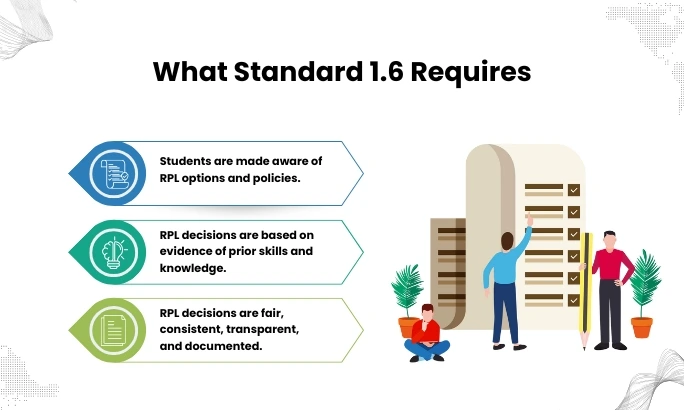
What Standard 1.6 Requires
Your RTO must demonstrate that:
- Students are made aware of RPL options and policies.
- RPL decisions are based on evidence of prior skills and knowledge.
- RPL decisions are fair, consistent, transparent, and documented.
Common RPL Non-Compliances (What I See as a Consultant)
Using full assessment tools instead of RPL kits
- RTOs hand candidates the same assessment given to classroom students.
- This ignores the principle of RPL (recognising existing competence, not re-testing).
Poorly designed or unclear RPL kits
- Instructions are vague, leaving candidates confused.
- No clear guidance on what evidence is required.
Competency conversation not recorded
- Oral questioning happens but is never documented.
- No record of assessor judgement.
Practical observation missing or incomplete
- Observable behaviours not detailed enough for consistent marking.
- Workplace tasks not recorded in logbooks or assessor reports.
Weak RPL mapping
- Evidence not clearly mapped to unit requirements.
- Gaps left unaddressed.
Assessor evidence collection inconsistent
- Some assessors gather full portfolios; others accept CVs only.
- No moderation, leading to inconsistent outcomes.
These are the exact issues auditors pick up during site visits.
Case Study – Certificate III in Individual Support (CHC33021)
Audit Context:
An RTO offering Certificate III in Individual Support was audited.

Findings:
- Candidates applying for RPL were given the full classroom assessment instead of a dedicated RPL kit.
- No competency conversations recorded.
- No practical observation forms.
- No mapping document linking evidence to the unit requirements.
- RPL outcomes inconsistent between assessors.
Compliance Action Taken:
We developed a structured RPL Kit that included:

- Candidate Kit with clear instructions.
- Competency Conversation Record template for assessors.
- Practical Observation Checklist with observable behaviours.
- Third-Party Report for workplace supervisors.
- RPL Mapping Document aligning evidence to training.gov.au requirements.
Outcome:
- Students had a fair, structured process for recognition.
- Assessors had clarity and consistency.
- Audit rectification accepted, with RTO back in compliance.
Self-Assurance Steps for Standard 1.6
To avoid RPL-related non-compliance:
Use a proper RPL Kit
(candidate, assessor, mapping, practical, third-party).
Train assessors
on how to run competency conversations and record them.
Document practical observations
with clear observable behaviours.
Map evidence
carefully to every unit requirement.
Moderate assessor judgements
for consistency.
Keep records
of all RPL decisions and link outcomes to your Continuous Improvement Register.
FAQs on Standard 1.6
Recognition of Prior Learning (RPL) is an assessment pathway where an RTO recognises a student’s existing skills, knowledge, and experience (gained from work, life, or study) against the requirements of a training product — without them needing to re-learn what they already know.
Yes. Under the Standards for RTOs 2025, every RTO must make students aware of their right to seek RPL for all qualifications and units on scope.
- RPL: Based on evidence of skills/knowledge from work or study (formal or informal).
- Credit Transfer: Based on certificates/statements of attainment from other RTOs for equivalent units.
- Candidate application and self-assessment.
- Evidence collection (portfolio, workplace docs, third-party reports).
- Competency conversation (structured interview).
- Practical observation (with observable behaviours).
- Mapping of all evidence to unit requirements.
- Fair, transparent, consistent assessor decision documented.
Yes, if the student can provide sufficient, valid, authentic, and current evidence for all units. However, if gaps exist, they must complete additional training/assessment.
- Work samples (policies, procedures, reports).
- Logbooks or workplace records.
- Employer/supervisor references.
- Third-party reports.
- Challenge tests.
- Observed demonstrations.
- Using full student assessments instead of RPL kits.
- No evidence mapping to training.gov.au requirements.
- No competency conversations or observations recorded.
- Inconsistent assessor decisions across students.
- Poor record-keeping (no documented decision-making process).
Auditors will review:
- RPL kits in use (candidate + assessor + mapping docs).
- Completed RPL files (with evidence and assessor comments).
- Moderation of assessor decisions.
- Whether students were informed of RPL during enrolment.
With ChatGPT and AI tools, students may submit work that isn’t their own. RTOs must have authenticity checks, such as:
- Live competency conversations.
- Oral questioning based on submitted evidence.
- Practical observations.
- AI-detection software where applicable.
Yes — AI can help draft RPL guides, map evidence, or organise portfolios. But assessors must validate accuracy and contextualisation. AI cannot replace professional judgement.
- Fake or AI-generated documents.
- Difficulty verifying overseas evidence.
- Cloud storage security and data integrity.
Yes. As industries face skills gaps, RPL provides a faster way to recognise existing worker skills and get them job-ready without duplicating training.
Likely yes, provided they can be mapped to unit requirements and authenticity/currency can be confirmed.
RTOs can accept overseas evidence, but assessors must confirm it matches Australian training package standards. This often requires supplementary evidence or challenge testing.
Only if:
- The evidence provided is insufficient, invalid, or not authentic.
- The RTO cannot reasonably assess the evidence against the training product.
Decisions must always be documented and justified.
- Review RPL kits annually.
- Moderate assessor RPL decisions for consistency.
- Collect student feedback on clarity of RPL instructions.
- Keep a continuous improvement register of changes.
- Student application forms.
- Evidence submitted.
- Mapping documents.
- Assessor competency conversation records.
- Practical observation checklists.
- Final decision + rationale.
A strong RPL kit includes six key components, each ensuring the process is fair, consistent, and audit-ready:
- RPL Application Form – student applies for RPL and declares prior learning.
- Candidate Kit – clear instructions, self-assessment checklist, and guidance on evidence required.
- Competency Conversation Record – assessor notes from structured interview questions, with space for student responses and assessor comments.
- Practical Demonstration / Observation Checklist – records observable behaviours against unit performance criteria.
- Third-Party Report – completed by an employer or supervisor confirming skills in the workplace.
- RPL Mapping Document – maps all evidence to the training.gov.au requirements (performance criteria, knowledge evidence, foundation skills).
- Outcome Form – records final assessor judgement, rationale, and student acknowledgement.
- Templates for each form above (candidate + assessor).
- Evidence guides explaining what counts as valid, sufficient, authentic, and current evidence.
- Assessor marking guides for competency conversations and observations.
- Mapping templates linking evidence to unit requirements.
- Continuous improvement register link so outcomes feed back into system review.
RPL is not about shortcuts – it’s about recognising real competence fairly and consistently. With the right kits, training, and evidence, your RTO can boost student satisfaction, reduce duplication, and stay audit-ready.
Disclaimer:
The information presented on the VET Resources blog is for general guidance only. While we strive for accuracy, we cannot guarantee the completeness or timeliness of the information. VET Resources is not responsible for any errors or omissions, or for the results obtained from the use of this information. Always consult a professional for advice tailored to your circumstances.