


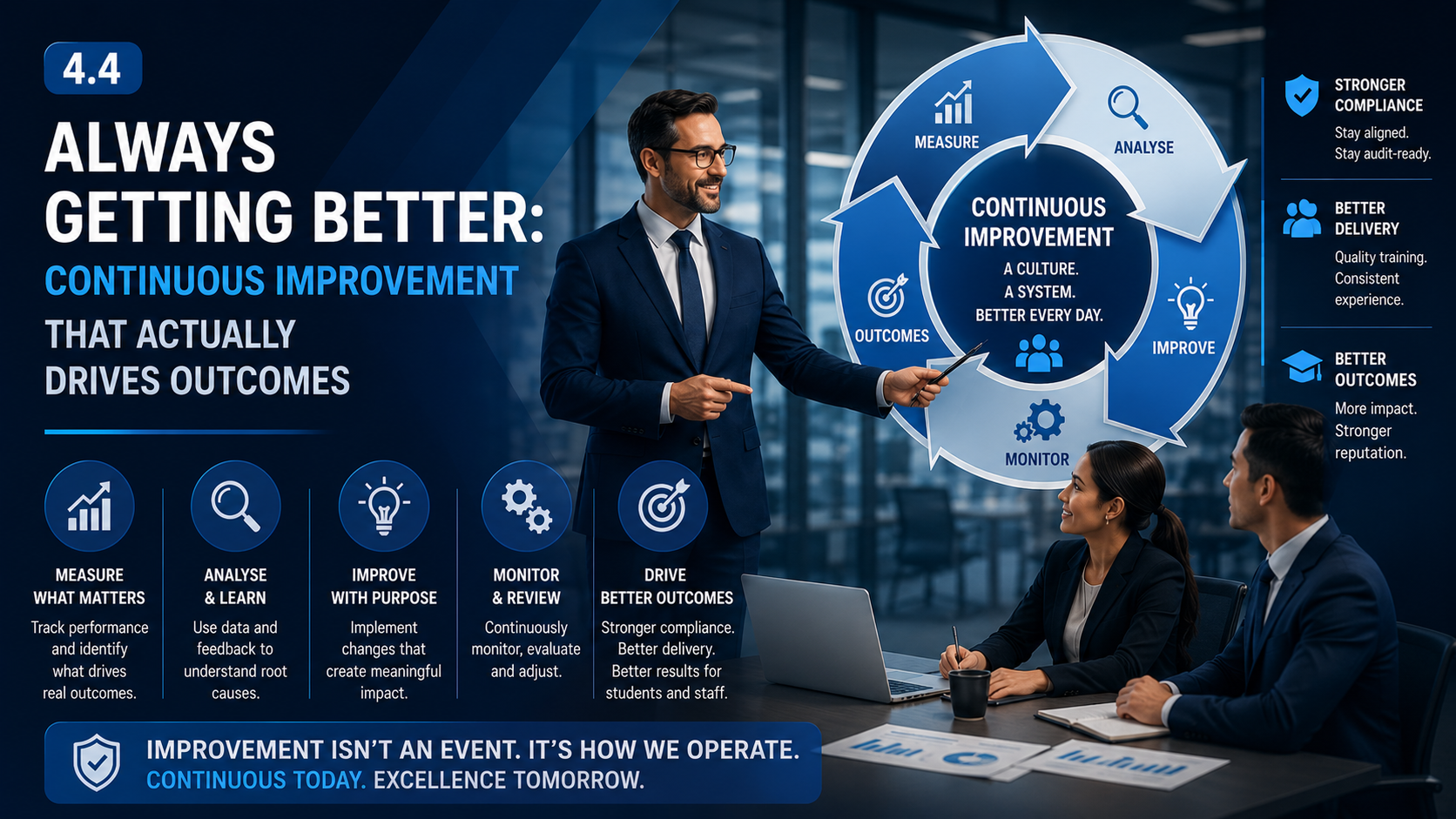
Most RTOs treat continuous improvement as a folder. ASQA treats it as a system. That gap is where audit findings live.
Walk into ten RTOs, and you’ll find ten CI registers — most of them written by a panicked compliance manager three weeks before auditing, populated with vague entries like ‘reviewed assessments’ and ‘updated policy’, and never reopened. That isn’t a continuous improvement. That’s a compliance theatre prop.
RTO Standard 4.4 under the 2025 Outcome Standards explicitly requires that an NVR registered training organisation undertake systematic monitoring and evaluation of the organisation to support quality delivery and the continuous improvement of services. The keyword is systematic — not occasional, not reactive, not annual, not panicked.

This blog unpacks RTO Standard 4.4 the way a 16+ year operator would — what the Standard actually says, the human psychology behind why most RTOs fail it, ASQA’s Practice Guide expectations, the leader’s playbook, FAQs, and a free downloadable lead magnet at the end.
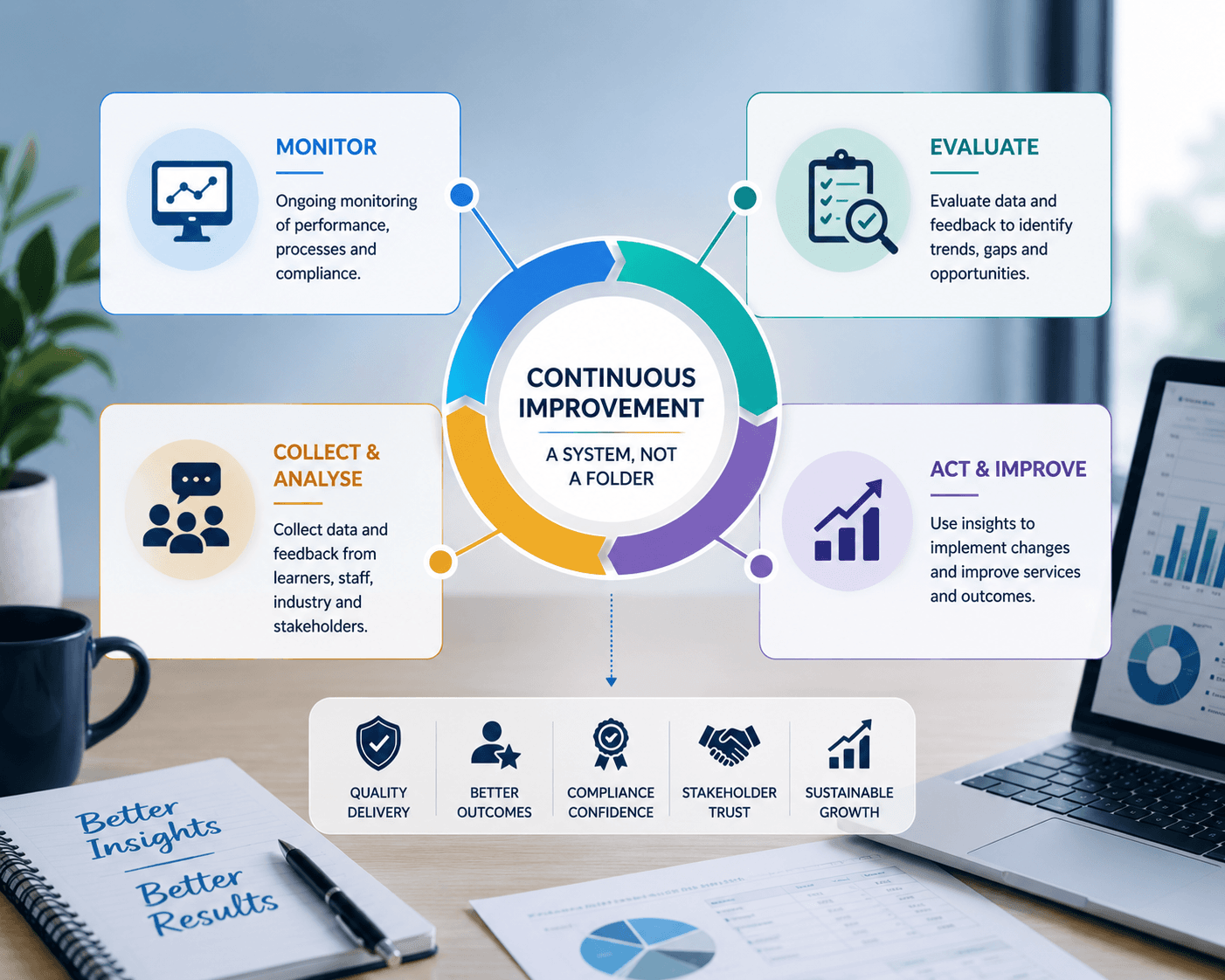
Outcome RTO Standard 4.4 requires the RTO to demonstrate it has:
Translation: ASQA wants to see a CI engine that runs continuously, captures the right inputs from the right people, identifies real issues, drives real action, and proves the action worked. Not a folder. A system.
Here’s the psychology most consultants skip.
Three deeply human biases sabotage continuous improvement in many RTOs:
ASQA’s Practice Guide attacks all three. It expects systematised monitoring, multi-source feedback, root cause analysis, documented outcomes, and post-implementation review. CI must be linked to data, root cause and outcome — not just a register of activities.
There is a correct order to building RTO Standard 4.4 evidence. Most RTOs do it backwards — they list actions first, then back-fill the data and rationale. The right sequence is:
Skip the data layer (steps 1–3), and your CI register becomes wishful thinking.
| Expectation | What it means in practice |
|---|---|
| Systematic monitoring | A documented compliance calendar/assurance program covering every obligation; regular evaluation of every operational function |
| Multi-source feedback | Lawful collection from students, staff, industry, regulators, State/Territory training authorities, and employers — with multiple data points, not a single annual survey |
| Trend and root cause analysis | Identifying trends from complaints and feedback; analysing student completion data for emerging issues; documenting root cause, not just symptoms |
| Documented CI outcomes | Documented systems and tools to collect, analyse and record outcomes of CI activities — actions, owners, dates, and outcomes |
| Sector and operational risk lens | CI response considers sector risks as well as operational risks — not just internal blind spots |
| Third-party CI | Regular review of services delivered by third parties; evidence that third parties are continuously improving and meeting their agreement |
| Proactive disclosure to ASQA | Self-identified compliance issues disclosed to ASQA, with documented rectification — treated as a positive indicator |
| Reasonable, risk-proportionate timeframes | Action on emerging issues and improvement opportunities within timeframes proportionate to student and sector risk |
| Validation-to-CI loop | Validation outcomes incorporated into the CI system and addressed effectively |
| Post-implementation monitoring | Practice changes are monitored after implementation as part of an ongoing cycle, not a one-off fix |

If you cannot answer any of these with documented evidence, you have an RTO Standard 4.4 gap.
These are the recurring reasons RTOs fail Quality Area 4 in 2025:
CI register lists actions, but no outcomes or post-implementation reviews
Surveys collected but never analysed or actioned
Validation findings not linked to CI actions
Third-party services not reviewed for CI
No compliance calendar or assurance program
CI is reactive — only triggered by complaints, audits or rectifications
Generic templates used without contextualisation
Only one feedback source (e.g. student QI surveys) — industry, employers and STAs are missing
Staff not engaged in CI; ideas concentrated at the executive level only
CI activity not visible at governance level — no minutes, no decisions
Data collection done without privacy compliance (Privacy Act, APPs)
RTO Standard 4.4 isn’t a compliance burden — it’s the engine that keeps your RTO compliance competitive and credible. The 2025 Outcome Standards are deliberately built around outcomes, not paperwork. ASQA wants to see that your RTO can monitor itself, identify issues, act on them, prove they were fixed, and disclose openly when it gets things wrong. The RTOs that win the next decade aren’t the ones with the thickest CI folder. They’re the ones with the sharpest CI rhythm — fast feedback, honest analysis, decisive action, and visible outcomes. Done properly, 4.4 becomes your compounding advantage. Done badly, it becomes the standing audit finding that erodes everything else.

Monitoring is the data-and-observation layer — what you see. CI is the decision and action layer that responds to what you do. ASQA expects both to be linked, with evidence that the second flows from the first.
No — but you must analyse all of it, identify trends, and act on systemic issues with a documented rationale for what is actioned and what isn’t. Selective action without recorded reasoning is a finding waiting to happen.
Every validation outcome — whether confirming or identifying issues — must be assessed for CI implications and recorded against the CI register. ASQA explicitly expects validation of outcomes to be incorporated into the CI system.
ASQA explicitly identifies proactive disclosure of self-identified non-compliance as a positive indicator of self-assurance. Hiding issues is the higher risk — it accelerates regulatory escalation if discovered.
After implementing a CI action, you check whether the change actually fixed the issue and is sustained — typically 30-, 60-, and 90-day reviews. ASQA wants evidence that the loop is closed, not just that the action was completed.
Yes — they serve different purposes but must connect. Risks identified under 4.3 often generate CI actions under 4.4. Combining them tends to dilute both.
VET students, staff, industry, regulators, State and Territory training authorities, and employers of current or former VET students — collected through lawful, privacy-compliant mechanisms with multiple touchpoints.
Monthly at the executive level; quarterly review at the governance level. Adjust frequency upward for higher-risk scope, larger student volumes, CRICOS providers, or RTOs in rectification.
4.1 sets the leadership culture that takes CI seriously. 4.2 defines who owns what in the CI system. 4.3 surfaces risks that flow into the CI engine. 4.4 closes the loop. The four operate as one governance system.
A CI register that lists actions but no outcomes — and no post-implementation review. Auditors look for the closed loop. Without it, the RTO can describe activity but not improvement.
A ready-to-use, audit-ready Training & Assessor Manual designed to help RTOs strengthen trainer compliance, assessment practices, industry engagement, validation participation, and operational consistency under the Standards for RTOs 2025.
👉 DM “TRAINER” on Instagram or LinkedIn, or email VET Resources to receive your free copy.
Standard 4.4 is the engine that keeps your RTO honest. Monitor systematically. Listen broadly. Analyse for root cause. Act decisively. Confirm the change worked. Disclose what didn’t.
The RTOs that get this right don’t just pass audits. They build a compounding advantage — every cycle makes the next cycle better. That’s how a small RTO becomes a sector benchmark, and how a CRICOS provider earns the kind of regulatory trust that survives every reform cycle.