

If your RTO has a compliance incident, nine times out of ten you’ll trace it back to one sentence: “I thought someone else was handling that.”
That’s not a process problem. That’s a Standard 4.2 problem. Roles look clean on the org chart and chaotic in real life. Trainers assume the admin will check it. Admin assumes the compliance manager will check it. The compliance manager assumes the CEO signed it off. The CEO assumes the system worked. ASQA arrives — and nobody owns it.
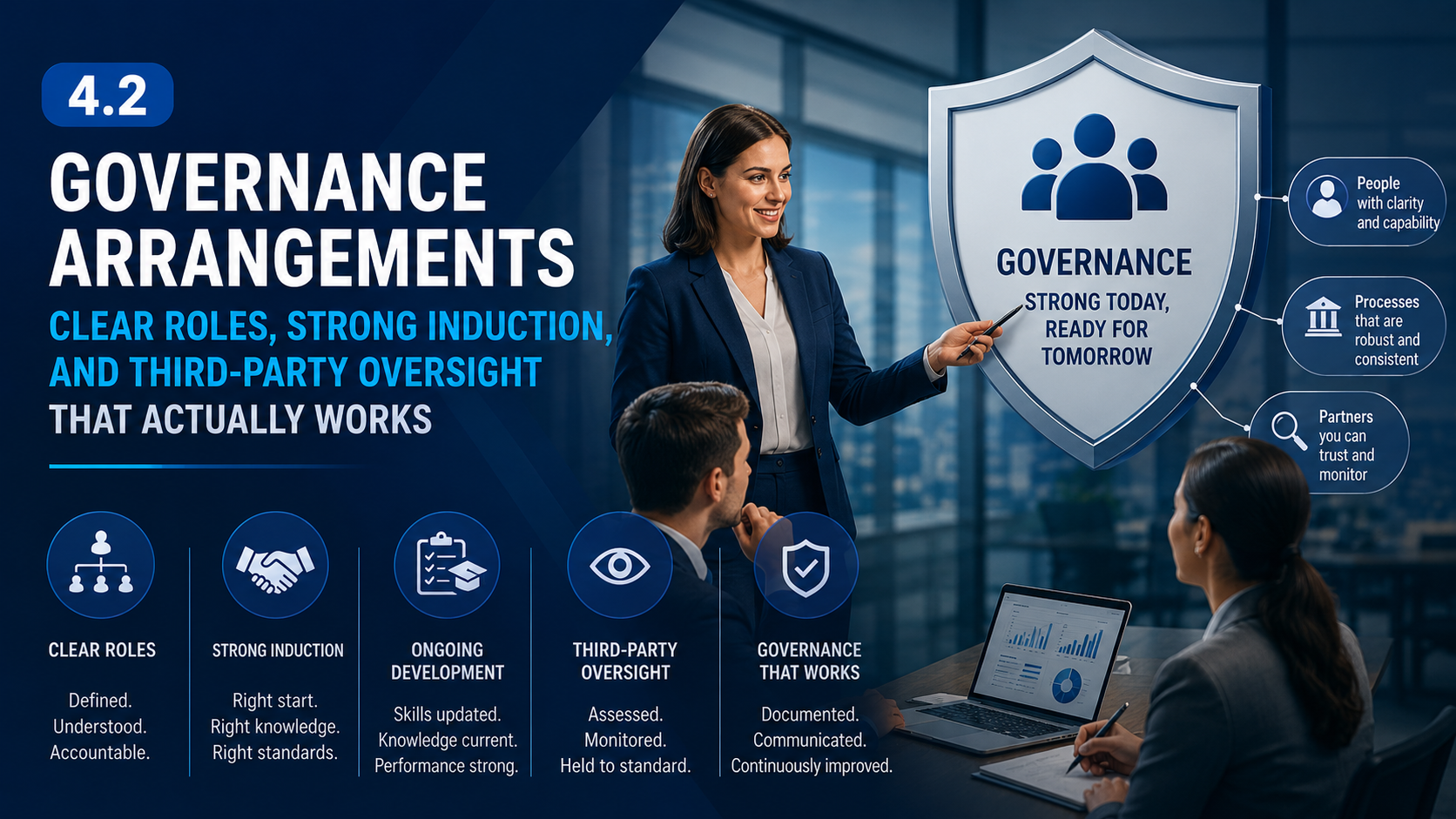
Standard 4.2 under the 2025 Outcome Standards exists to kill that ambiguity. It is built on one principle: an RTO’s governance is only as strong as the clarity, capability, and accountability of the people inside it — including third parties acting in your name.

This blog unpacks Standard 4.2 the way a 16+ year operator would — covering what the Standard actually says, the human psychology behind why most RTOs fail it, ASQA’s Practice Guide expectations, the leader’s playbook, FAQs, and a free downloadable lead magnet at the end.
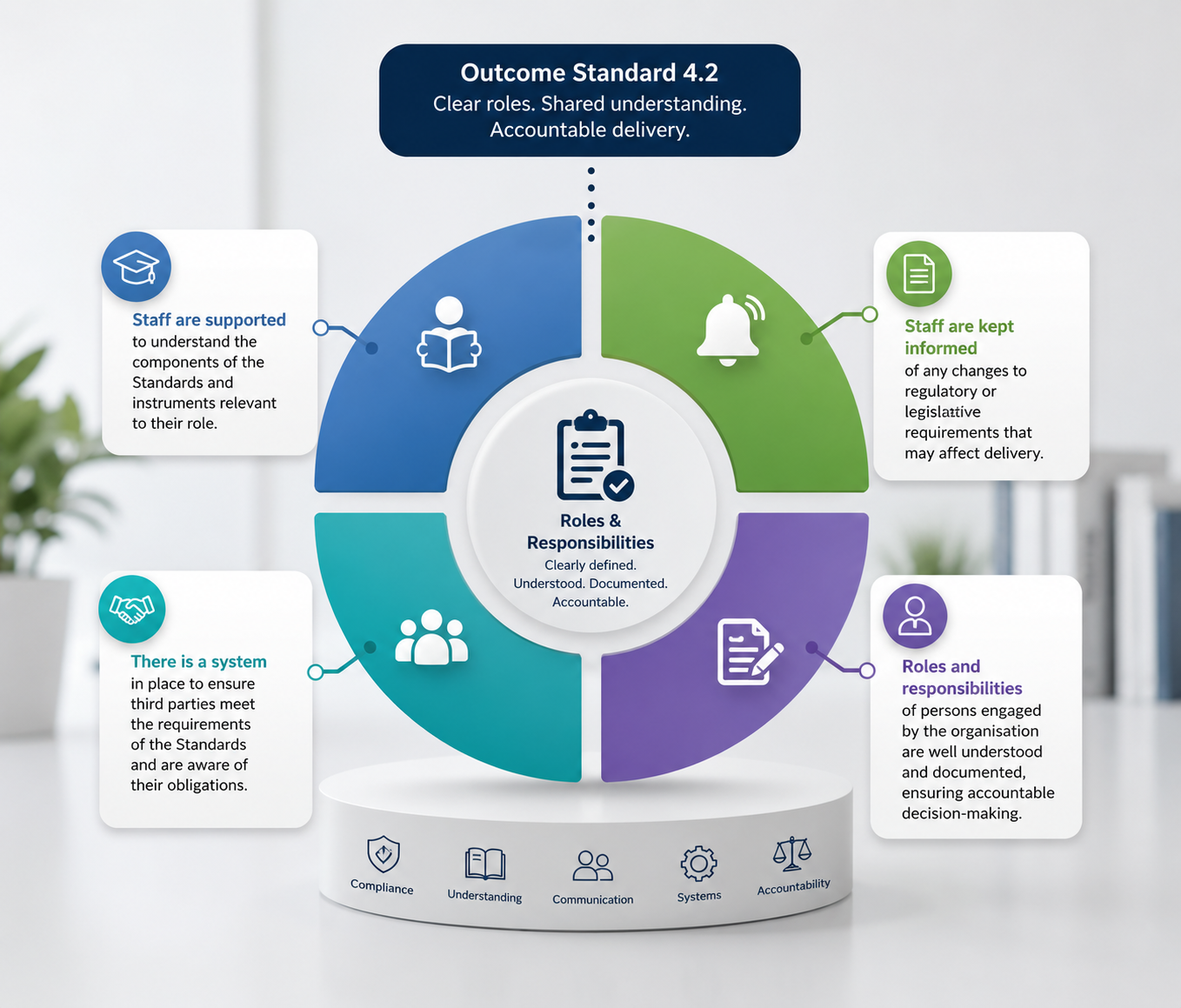
Outcome Standard 4.2 requires that the roles and responsibilities of NVR registered training organisation staff and third parties are clearly defined and understood.
To demonstrate this, the RTO must show that:
Translation: ASQA wants to see that every person — employed, contracted, or third-party — knows what they are responsible for, knows what the Standards demand of them, and is actively supported to stay current. You can outsource the work. You cannot outsource the responsibility.
Here’s the psychology most consultants skip.
Three deeply human biases sabotage governance arrangements in almost every RTO:
ASQA’s Practice Guide directly targets these biases. It expects documented accountabilities, active supervision rhythms, and visible third-party monitoring — not assumed competence and goodwill.
There is a correct order to building Standard 4.2 evidence. Most RTOs do it backwards — they hire first, induct casually, and govern third parties only when something breaks. The right sequence is:
Skip step 1 or 2 and the rest is theatre.
ASQA’s Leadership and Accountability Practice Guide makes the 4.2 expectations very clear:
| Expectation | What it means in practice |
| Documented accountabilities | Position descriptions, delegations matrix, organisational chart, current and accurate; staff can describe their role in their own words |
| Standards literacy | Staff (and third-party staff) were supported to understand the Outcome Standards and Compliance Requirements relevant to their role |
| Regulatory change communication | A system to inform staff and third parties of any regulatory or legislative change that affects delivery |
| Third-party oversight | Written agreements, induction, active monitoring, evidence of compliance, and documented response if obligations are not met |
| Compliance culture | Staff supported and encouraged to proactively raise compliance and integrity issues — particularly where student wellbeing or outcomes are at risk |
| Decision-making delegations | Documented delegations adhered to by all staff; no shadow decisions or undocumented authorities |
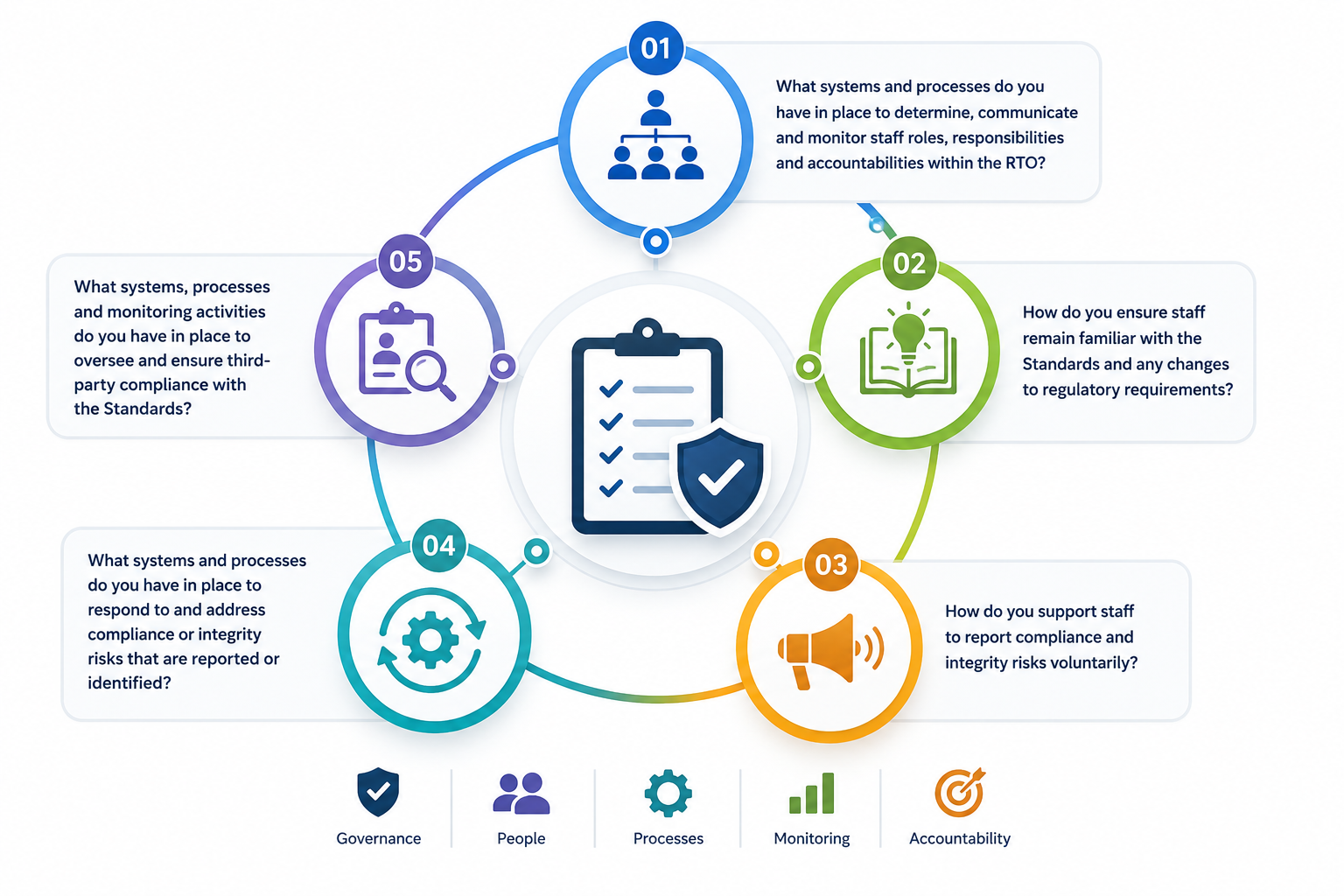
ASQA also identifies the most common known risks under 4.2:
Use these as your internal audit prompts — they are taken directly from the Practice Guide:
If you cannot answer any of these with documented evidence, you have a 4.2 gap
After 16+ years sitting across hundreds of audits, validations and CRICOS applications, here’s what separates the RTOs that pass cleanly from the ones that crumble on 4.2:
These are the recurring reasons RTOs fail Standard 4.2 in 2025:
Position descriptions exist, but don’t match what the person actually does day-to-day
Induction records missing for trainers and assessors hired in the last 12 months
No evidence of regulatory change communication to staff after the 1 July 2025 transition
Third-party agreements expired, auto-renewed without review, or had missing breach clauses
Education agents (CRICOS) performing functions outside their scope without RTO oversight
No evidence of monitoring third-party delivery quality or student outcomes
Delegations matrix non-existent, or routinely bypassed in practice
Casuals and contractors are treated as “invisible” for compliance purposes
Off-the-shelf compliance systems used without contextualisation to the RTO’s actual operations
Staff unable to articulate the Standards relevant to their role during ASQA interviews
Standard 4.2 isn’t an HR exercise. It’s a leadership exercise disguised as one. Every undocumented role, every untrained third party, every unmonitored agent is a future audit finding waiting to surface.
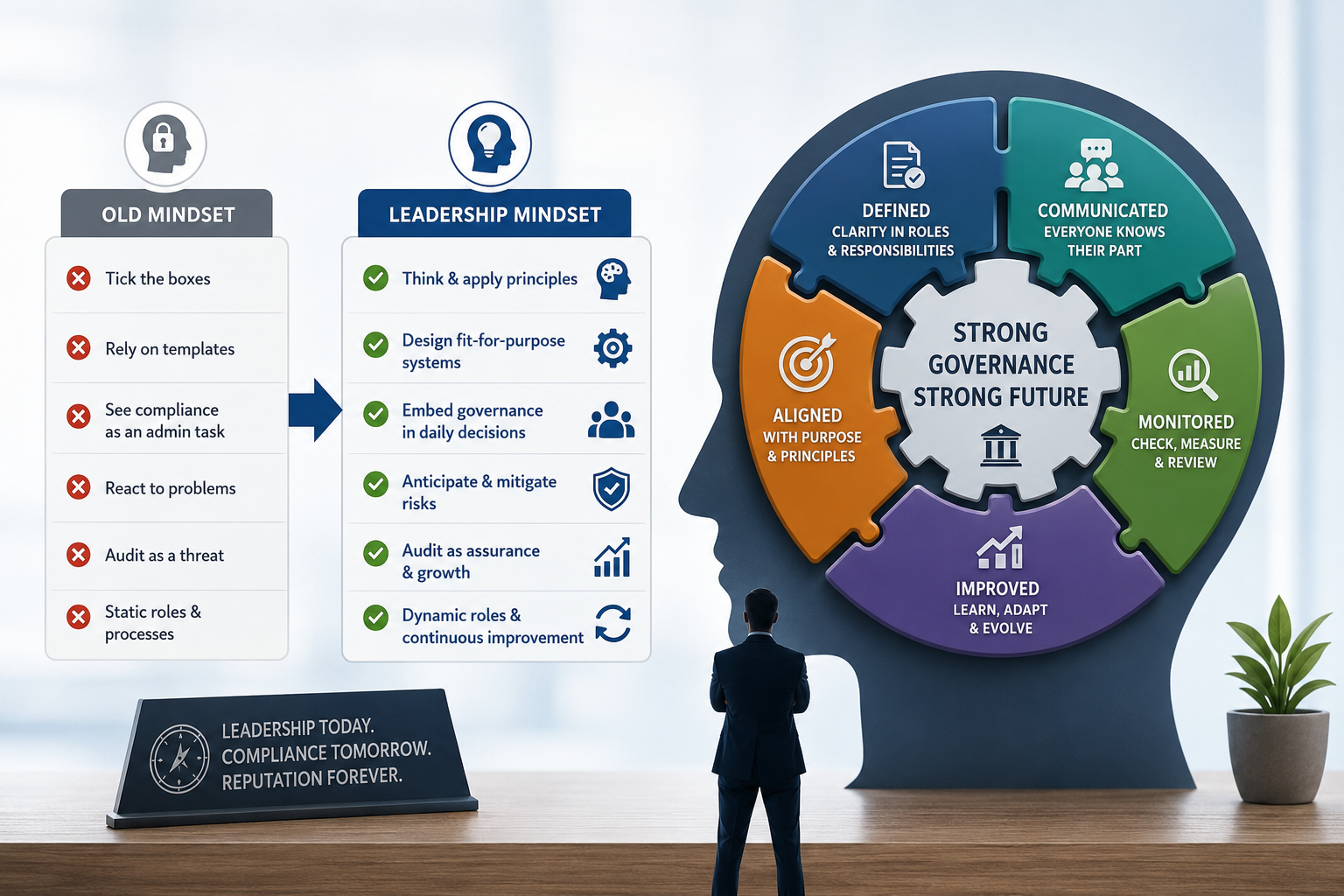
The 2025 Outcome Standards are deliberately principle-based. ASQA expects RTOs to think — not just paste templates. The RTOs that win the next decade will be the ones whose leaders treat governance arrangements as a living system: defined, communicated, monitored, and continuously improved.
Yes. Anyone delivering services on the RTO’s behalf — employed, contracted, casual, volunteer, or third-party — falls under governance accountability. If they perform RTO functions or interact with students, the Standard applies.
At minimum: role responsibilities, the relevant Outcome Standards and Compliance Requirements, RTO policies and procedures, systems and platforms, WHS, privacy, student-facing protocols, complaint and integrity reporting channels, and (for CRICOS) the National Code 2018, ESOS Act, and PRISMS expectations. Evidence of completion must be retained.
Quarterly performance monitoring, annual full agreement and compliance review, and immediate review on any complaint, incident, or material change. ASQA expects documented evidence of all three layers.
For CRICOS providers, agents are governed by the National Code 2018 and fall under the RTO’s governance accountability under 4.2. They must be inducted, trained, monitored, and held to documented performance and conduct standards.
Yes. Position descriptions describe the role; a delegations matrix defines decision authorities — who can approve enrolments, refunds, withdrawals, contracts, expenditure, scope changes, and rectifications. ASQA expects both.
The old Standards focused on written agreements with third parties. The 2025 Standards expand this to active oversight — induction, ongoing monitoring, performance review, and documented response to non-compliance. The bar is higher.
Yes. The Standard is principle-based, not prescriptive. A small RTO can comply with simple documents — provided roles, induction, monitoring, third-party oversight and regulatory change communication are documented and demonstrable.
Through dated bulletins, meeting minutes, training records, email communications, knowledge checks, or structured all-staff briefings. ASQA wants to see that staff were informed when and that they understood the change.
Two patterns dominate: trainers and assessors without documented role-specific induction, and third-party agreements without active monitoring evidence. Both are easily fixed and consistently missed.
4.1 sets the leadership culture. 4.2 makes that culture operational by defining roles and oversight. 4.3 layers risk management on top. 4.4 closes the loop with continuous improvement. The four Standards are designed to operate as one governance system.
Refresh your delegations matrix, run a role-specific induction refresh for every staff member, review every third-party agreement against the 2025 Standards, document a regulatory change communication rhythm, and run an internal self-assurance review using the ASQA self-assurance questions.
A practical, audit-ready self-assessment checklist mapped directly to ASQA’s Practice Guide – Leadership and Accountability. Use it to test your RTO’s governance arrangements before ASQA does.
Standard 4.2 is where governance stops being theory and becomes operational. It’s the Standard that decides whether your RTO scales with control or unravels under pressure.
Define the roles. Document the authorities. Induct every person who touches your delivery. Monitor every third party that carries your name. Communicate every regulatory change. Build the channels for staff to raise issues — and respond to them when they do.
The RTOs that get this right don’t just pass audits. They scale without chaos, defend their reputation by design, and earn the kind of trust that compounds for decades.