

In the vocational education and training (VET) sector, assessment is critical. It not only ensures that learners meet the necessary competencies but also helps Registered Training Organisations (RTOs) maintain compliance with Australian Skills Quality Authority (ASQA) standards. One of the most essential resources in the assessment process is the Assessment Kit. These kits streamline the assessment workflow, ensuring that both trainers and learners have everything they need for fair, transparent, and consistent evaluation.
Whether you are an RTO manager, trainer, or assessor, understanding the components of an Assessment Kit is key to conducting compliant assessments. The right set of tools can help you save time, increase efficiency, and reduce administrative burdens while ensuring that all necessary competencies are met. Vetresources, a leading provider of VET resources, offers comprehensive, ASQA-compliant Assessment Kits that are designed to meet the highest standards of the VET sector.
In this guide, we’ll walk you through the various components of an Assessment Kit, detailing each element’s purpose and importance. From Trainer Assessment Packs to Work Placement Task Booklets, we’ll explain how each part of the kit helps streamline the assessment process and maintain compliance with industry standards.
When it comes to providing high-quality assessment kits, Vetresources stands out as a trusted partner for RTOs and trainers. Their resources are designed to meet ASQA compliance requirements, ensure consistency, and support assessors in conducting thorough and efficient evaluations. With Vetresources, you gain access to customizable, user-friendly kits that streamline your assessment process and improve learner outcomes. Let’s explore why Vetresources is the go-to choice for RTOs looking to optimize their assessment practices.

Did You Know?
With more than 4,000 RTOs across Australia, each must ensure their
assessment kits meet strict ASQA standards for valid, reliable, and consistent
training and assessment processes.
The Assessment Kit is an indispensable tool for any RTO delivering nationally recognised training and qualifications. These kits are the foundation of the assessment process, providing trainers with the necessary documents to assess learners effectively and in compliance with ASQA standards. The primary function of the Assessment Kit is to support the RTO in conducting assessments that are:
| Assessment Quality | Purpose |
|---|---|
| Valid | Ensures that the assessment methods and evidence collected accurately reflect the learner’s competence in the required areas. |
| Reliable | Ensures that assessment decisions are consistent, regardless of the assessor. |
| Fair | Ensures that the assessment process is transparent and equitable for all learners, regardless of their background or experience. |
| Flexible | Allows for various methods of assessment to cater to different learning styles and work environments. |
Without a well-structured Assessment Kit, trainers would face significant challenges in maintaining consistency and transparency in their evaluations, leading to potential compliance issues. Furthermore, RTOs would struggle to meet ASQA’s requirements for evidence and documentation.
Why Assessment Kits Matter
Effective assessment practices ensure that learners are evaluated in a way that reflects their skills and knowledge, offering them a fair chance at receiving the qualifications they deserve. Moreover, RTOs must prove to ASQA that they follow an efficient, compliant assessment process. The Assessment Kit provides a structured approach to documenting and assessing learners’ competencies, which is crucial for maintaining compliance with the VET Quality Framework.
Now that we understand the importance of Assessment Kits, let’s dive deeper into each essential component. These documents work together to streamline the assessment process and ensure compliance.
Trainer Assessment Pack
The Trainer Assessment Packis one of the most crucial elements of the Assessment Kit. It provides trainers with all the necessary tools and resources for assessing learners’ competencies fairly and consistently. Key elements typically included in this pack are:
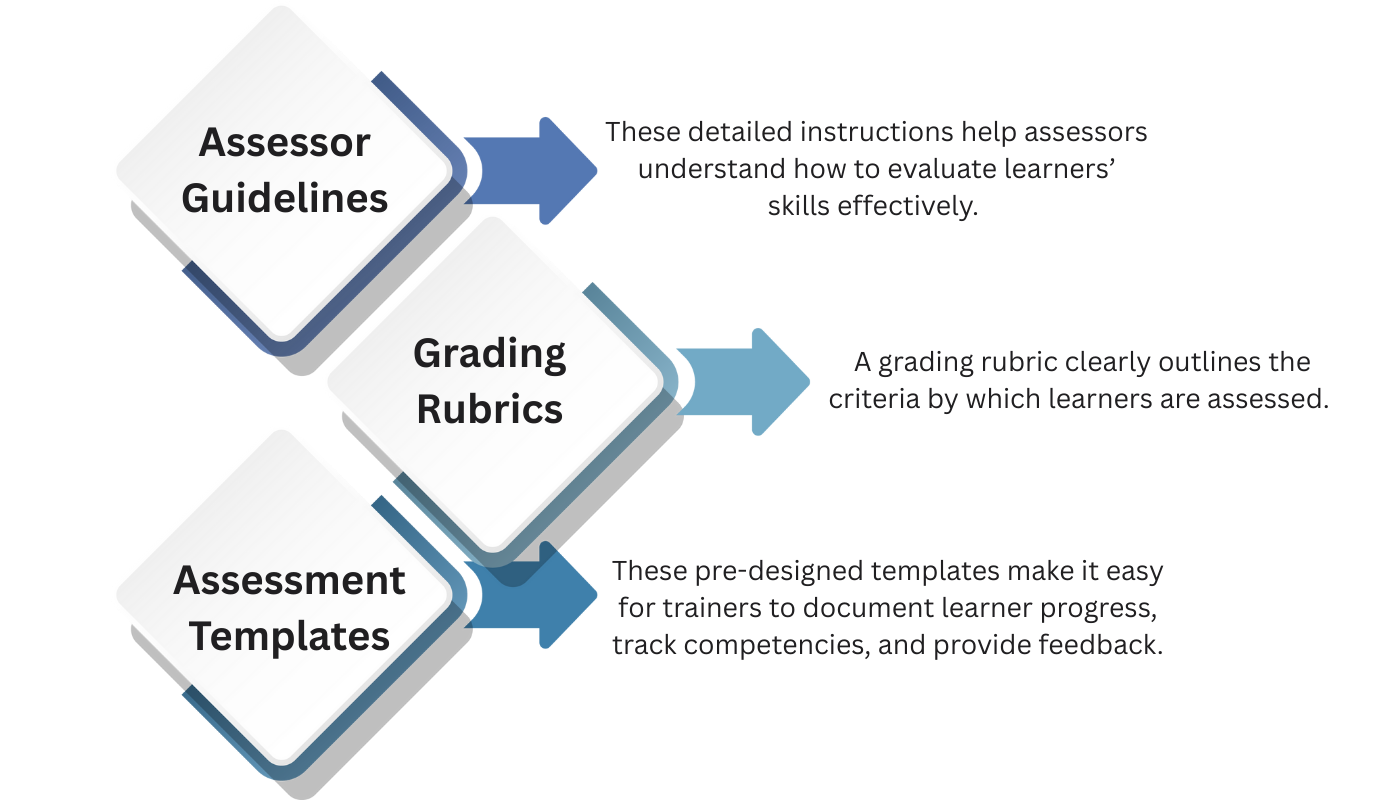
The Trainer Assessment Pack ensures that assessors can conduct evaluations that are standardized across the board, providing a transparent and consistent approach to assessing learners.
Unit Assessment Pack
The Unit Assessment Pack is used to assess learners’ competency in specific units of the qualification they are pursuing. It includes detailed instructions on how to assess the learning outcomes associated with a particular unit. The Unit Assessment Pack typically contains:
| Element | Description |
|---|---|
| Assessment Criteria | Clear benchmarks that outline the skills and knowledge the learner must demonstrate in order to achieve competency in a unit. |
| Assessment Activities | Practical or written exercises that allow learners to demonstrate their knowledge and abilities. These activities can range from written tests to practical scenarios and simulations. |
| Feedback Forms | Templates for providing structured feedback to learners, outlining areas of strength and areas for improvement. |
The Unit Assessment Pack ensures that each unit is assessed in alignment with the requirements of the qualification and the training package, maintaining the integrity of the learning process.
Assessment Instruction Pack
The Assessment Instruction Pack serves as a guide for both trainers and learners on how to approach an assessment. This pack includes:
This pack is essential for ensuring that both learners and trainers are aligned on the expectations and process of each assessment, reducing confusion and supporting smooth completion of assessments.
Observation Checklist
The Observation Checklist is a structured tool used by trainers to document their observations of a learner’s practical skills. This checklist typically includes:
| Checklist Element | Purpose |
|---|---|
| Task Descriptions | A detailed breakdown of the specific tasks the learner is required to perform, helping assessors focus on relevant skills. |
| Criteria for Evaluation | Clear competencies or behaviours that must be demonstrated, ensuring a fair and consistent evaluation process. |
| Assessment Ratings | Scales that allow the assessor to rate the learner’s performance, such as “Satisfactory”, “Unsatisfactory”, or “Needs Improvement”. |
The Observation Checklist is particularly useful for assessing practical, hands-on skills in work environments or simulated settings, providing a comprehensive way to document competency.
Work Placement Instruction Pack
The Work Placement Instruction Pack is designed to help learners apply their skills in a real-world context. It includes:
| Element | Purpose |
|---|---|
| Work Placement Guidelines | These guidelines provide instructions on how learners should demonstrate their competencies in the workplace, ensuring they meet industry standards. |
| Roles and Responsibilities | Clear definitions of the roles of the learner, the workplace supervisor, and the trainer during the placement. |
| Workplace Assessment Procedures | A step-by-step guide on how to assess learners during their work placements, ensuring that the process is transparent and consistent. |
This pack ensures that learners have a structured and supportive environment in which to demonstrate their competencies, while also allowing trainers to assess them in a real-world setting.
Unit Mapping Document
The Unit Mapping Document is used to map the evidence gathered during the assessment process to the required units of competency. This document helps trainers determine if the evidence provided by the learner is sufficient and aligned with the necessary competencies. Key features include:
| Feature | Purpose |
|---|---|
| Competency Units | A list of the units of competency required by the training package, providing clarity on what must be assessed. |
| Evidence Criteria | Instructions on how to assess and map the learner’s evidence to each unit of competency. |
| Assessment Notes | Space for trainers to add notes on the evidence and its relevance, ensuring thorough documentation. |
The Unit Mapping Document is critical for ensuring that all evidence is aligned with the competencies and that no gaps are left unaddressed during the assessment process.
Work Placement Observation Booklet
The Work Placement Observation Booklet documents the learner’s performance during their work placement. This booklet is typically used by workplace supervisors to assess the learner’s skills in a real-world context. It includes:
| Section | Purpose |
|---|---|
| Observation Forms | Structured templates that guide the supervisor in documenting the learner’s performance. |
| Competency Assessments | A space for the supervisor to rate the learner’s competency in various skills. |
| Feedback Sections | Space for providing feedback on the learner’s strengths and areas for improvement. |
The Work Placement Observation Booklet is essential for ensuring that the learner’s performance in the workplace is properly documented and evaluated against the required competencies.
Work Placement Task Booklet (Assessor and Student Copies)
The Work Placement Task Booklet helps both assessors and learners track the tasks completed during the work placement. The booklet includes:
| Version | Purpose |
|---|---|
| Assessor Copy | For trainers to record their observations, assessments, and feedback. |
| Student Copy | For learners to track their own progress and reflect on their performance. |
This dual-version booklet ensures both parties stay aligned on the tasks, competencies, and feedback, making the assessment process more transparent.
Additional Documents if Required in Assessment
In some cases, additional documents may be needed for specific assessments. These could include:
These additional documents ensure that RTOs can address any special requirements during the assessment process.
Vetresources is the leading provider of high-quality, ASQA-compliant assessment kits, designed to meet the specific needs of RTOs and trainers. Here’s why Vetresources stands out:
| Feature | Why Vetresources is the Best |
|---|---|
| Comprehensive and Customizable Kits | Vetresources offers a complete suite of assessment tools, ensuring RTOs have everything they need for effective assessment. |
| ASQA Compliance | All Vetresources kits are designed with ASQA standards in mind, so RTOs can be confident that they are meeting regulatory requirements. |
| User-Friendly | The resources are straightforward, intuitive, and easy to use, making it easier for trainers and learners to follow. |
| Expert-Designed | Developed by experts with extensive experience in the VET sector, Vetresources’ kits are tailored to meet the challenges trainers face daily. |
Vetresources is your trusted partner for creating an efficient, compliant, and streamlined assessment process that helps trainers and learners succeed.
A comprehensive assessment kit helps RTOs achieve several objectives:
| Objective | Benefit |
|---|---|
| Standardisation | Ensures that assessments are conducted consistently across different trainers, making the evaluation process fair and transparent. |
| Efficiency | Saves time by providing pre-designed templates and guidelines, reducing the administrative burden on trainers and RTOs. |
| Compliance | Meets ASQA’s rigorous standards for assessment, ensuring that RTOs stay compliant with industry regulations. |
| Support for Trainers and Learners | Provides trainers with the resources they need to evaluate learners effectively, while giving learners clear guidance on expectations. |
ASQA has stringent requirements for the VET sector, and RTOs must demonstrate that their assessment processes are valid, reliable, flexible, and fair. A comprehensive assessment kit ensures that RTOs can:
By investing in well-designed assessment kits, RTOs can easily maintain their compliance with ASQA standards.
| Challenge | Solution |
|---|---|
| Inconsistent Feedback | Train assessors to provide consistent, objective feedback to ensure fairness. |
| Inadequate Evidence | Provide learners with clear guidance on the types of evidence they need to submit and offer support if necessary. |
| Administrative Overload | Consider using digital assessment tools to streamline the process and reduce paperwork. |
An Assessment Kit provides RTOs with the tools and templates needed to assess learners’ competencies fairly, efficiently, and in compliance with ASQA standards.
Make sure your kit includes all the required documents, such as assessment plans, feedback forms, observation checklists, and mapping documents. Regularly review your kits against the latest training package requirements.
The Work Placement Observation Booklet helps document the learner’s performance in the workplace. It provides space for supervisors to assess and give feedback on the learner’s skills and knowledge during the placement.