


Assessment tools are the backbone of quality training and compliant assessment in Australia’s VET sector. For Registered Training Organisations (RTOs), trainers, and assessors, understanding assessment tools isn’t optional—it’s essential for learner success, audit readiness, and regulatory compliance. In this ultimate guide, we break down what assessment tools are, why they matter, how to build them correctly, and how to ensure they meet ASQA requirements. Whether you’re new to assessment tool design or refining existing tools, this guide will give you practical clarity and confidence.
An assessment tool is a structured resource used to collect evidence and judge whether a learner has met the requirements of a unit of competency. It outlines what is being assessed, how it is assessed, and how decisions are made.
Assessment tools may include:
Well-designed assessment tools ensure assessments are consistent, fair, valid, and reliable across all learners.
Assessment tools do more than measure learner performance—they protect your RTO.
Strong assessment tools help RTOs:
Poorly designed tools, on the other hand, are one of the most common causes of audit findings.
A compliant and effective assessment tool should include the following elements:
Learners must understand:
Clear instructions reduce confusion and support valid evidence collection.
Tasks should directly assess the skills and knowledge listed in the unit of competency. These may include:
Each task must clearly link to the unit requirements.
This section outlines:
Clear conditions help maintain assessment integrity.
Assessment tools must specify:
Evidence must be valid, sufficient, current, and authentic.
Assessors need clear benchmarks to make consistent decisions. These should:
Every assessment tool must meet these two critical frameworks:
Assessment must be:
Evidence must be:
Your assessment tools should clearly demonstrate how these requirements are met.
Trainers conduct formative assessments throughout the course to monitor learner progress.
Examples include quizzes, short tasks, and practice activities.
Summative assessments evaluate final competency at the end of training.
Examples include final projects, exams, and practical demonstrations.
Both types play an important role in effective training delivery.
RTOs work with learners from varied backgrounds. Strong assessment tools:
Contextualising assessments to industry and learner needs improves engagement and outcomes.
Assessment tools should never remain static. You should review them:
Regular reviews help ensure ongoing compliance and relevance.
Some frequent issues seen during audits include:
Avoiding these mistakes starts with a strong assessment design.
Understanding assessment tools is fundamental to delivering high-quality, compliant training. When built correctly, assessment tools support fair assessment decisions, confident learners, and audit-ready RTOs.
By focusing on clarity, alignment with units of competency, and compliance with ASQA requirements, you can create assessment tools that truly measure competence and stand up to scrutiny.
If you want your RTO to deliver consistent, compliant, and learner-focused assessments, mastering assessment tools is the place to start.
The assessment tool is a set of documents that is required to assess the knowledge and skills of one or more units of competency. You need to include at least two to three assessment tasks/instruments with different assessment methods (Assessment methods can be written questions, practical demonstration, project, etc).
The assessment tool can be used to collect specific evidence from students so the trainer can make a better judgment that the student has the skills and knowledge to meet the unit/s requirements.
The well-written assessment tool will be useful to collect student evidence in a fairly easy manner, and it also provides good guidelines for a trainer to guide the student’s work.
Most of the people have their own style and process to develop the assessment tool. I find the following process simple and effective.
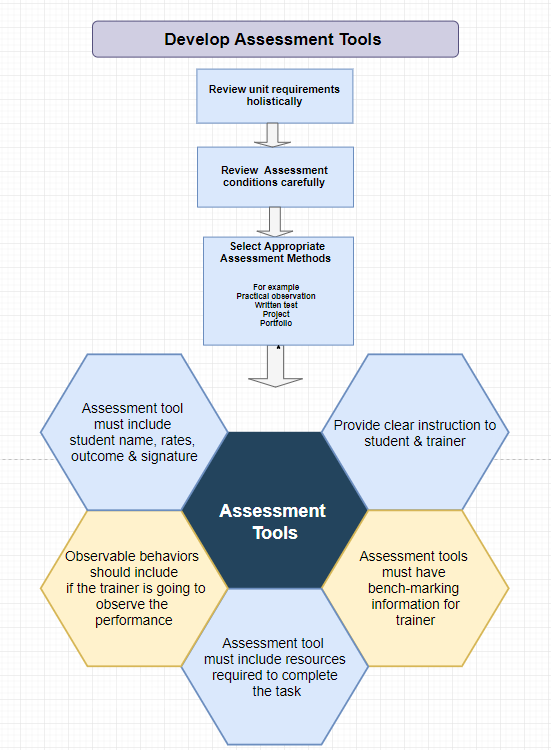
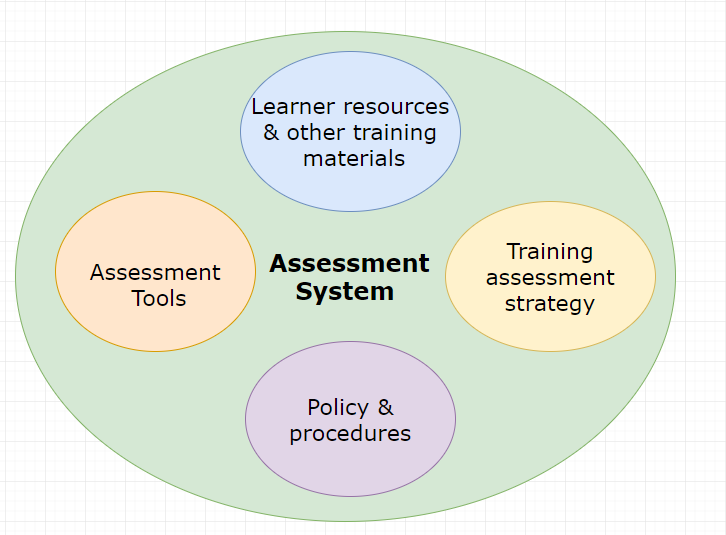
According to ASQA, the assessment system is a collection of documented policies and procedures, including assessment material and tools to make sure assessment is consistent and fulfils the principles of assessment and rules of evidence.
Note: To read more about the principle of assessment and rules of evidence, follow the link: https://www.asqa.gov.au/standards/chapter-4/clauses-1.8-1.12
So, the assessment system is a big tree, and the assessment tool is one of the important branches.
Need Help To Find quality Assessment and Learner resources? Click here to find quality assessment and learning resources