


A trainer holding a TAE qualification is not the same as a trainer being compliant under RTO Standard 3.2. The 2025 Standards make one thing clear: holding the credential is only the starting point — not the full compliance test
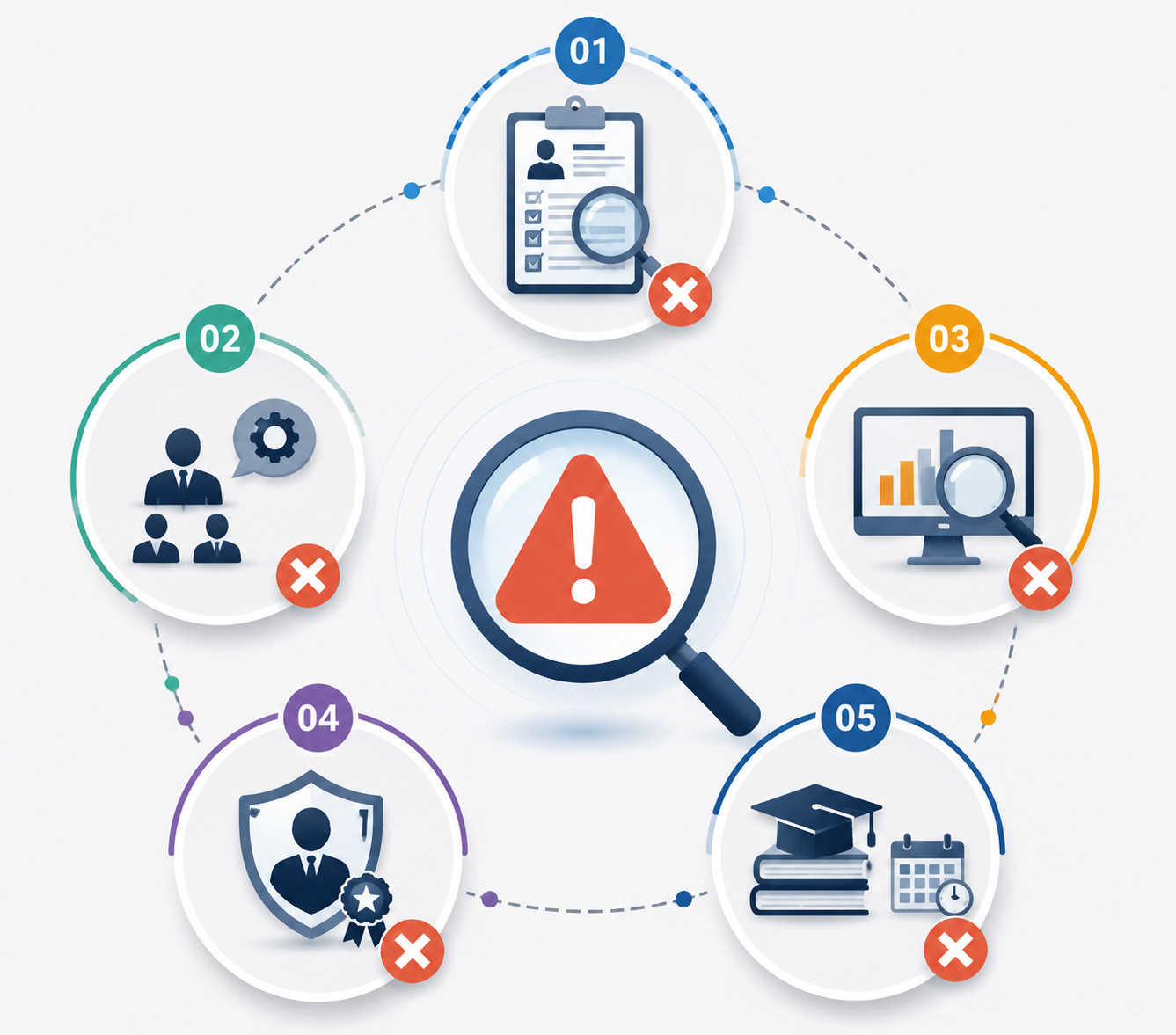
RTO Standard 3.2 isn’t asking what’s on the certificate. It’s asking whether the RTO has authenticated the credential, whether the person is operating within the Credential Policy, whether anyone working under direction is properly supervised, whether assessment judgements are protected, and whether trainer and assessor skills are kept current through structured PD. Five tests. One Standard. Most RTOs only do one — they collect the certificate and file it.
This is the credential trap. A roster full of TAE40122 graduates, all ‘qualified on paper’, none of them tracked through the Credential Policy lens that ASQA now applies. The audit finding writes itself.
This blog unpacks RTO Standard 3.2 the way a 16+ year operator would — what the Standard actually says, the human psychology behind why most RTOs fail it, ASQA’s Trainer and Assessor Competencies Practice Guide and Credential Policy Practice Guide, the leader’s playbook, FAQs, and a free downloadable lead magnet at the end.

Outcome RTO Standard 3.2: “Training and assessment is delivered to VET students by credentialled people with current skills and knowledge in training and assessment.”
An NVR registered training organisation demonstrates:
Translation: ASQA expects three live systems — credential authentication, working-under-direction supervision and quality assurance, and structured PD that keeps training and assessment skills current. Each must be evidenced. None can be assumed.
Three deeply human biases sabotage credential compliance in almost every RTO:
ASQA’s Practice Guide turns these blind spots into regulatory expectations. The 2025 Standards require systematised credential assurance — not a folder of certificates, but a live system that authenticates, supervises, protects assessment integrity, and keeps PD purposeful.
There is a correct order to building RTO Standard 3.2 evidence. Most RTOs do it backwards — they collect first, verify later. The right sequence is:
Skip step 1 or 5, and you have a roster, not a compliant workforce.
| Expectation | What ASQA expects you to demonstrate |
| Credential Policy compliance | Systems that ensure all persons involved in training and assessment always meet the requirements of the Credential Policy |
| Scope-of-credential controls | Mechanisms ensuring people do not perform training and assessment tasks beyond the scope of their credentials |
| Authentication of credentials | How the RTO authenticates the relevant credentials held by trainers and assessors |
| Working under direction — supervision | Supervision and guidance arrangements that reflect the skills and knowledge of the person, including skills and knowledge relating to engaging and supporting VET students |
| Working under direction — quality assuranc | How the RTO assures the quality of practice for those working under direction |
| Working under direction — assessment firewall | How the RTO ensures the person is not making assessment judgements |
| Working under the direction of a supervisor with the capability | How the supervisor has sufficient support to perform the supervisory role and is appropriately skilled and qualified |
| Trainer and assessor currency (PD) | How staff involved in training and assessment maintain up-to-date trainer and assessor skills, including: internal/external courses, workshops, seminars, conferences; higher-level qualifications in training and assessment; activities maintaining understanding of current industry practice; relevant publications on VET and competency-based training and assessment; learning networks; validation or moderation activities; shadowing/mentoring with other trainers and assessors |
If you cannot answer any of these with documented evidence, you have an RTO Standard 3.2 gap.
Credential authentication relies on a single certificate copy with no verification process
TAE qualifications are accepted without checking equivalence or supersession against the Credential Policy
Scope-of-credential rules undocumented — people deliver trainers operating beyond their qualification scope undetected
Working-under-direction arrangements informal, undocumented, or applied inconsistently
Quality assurance of under-direction practice is limited to verbal feedback with no records
Assessment judgements being signed by under-direction staff because the firewall is undocumented
Supervisor capability not assessed — supervisors lack time, training, or qualifications to supervise effectively
PD collected as certificates without alignment to role, training products, or current and emerging practice
PD time not allocated in workload — trainers expected to do PD outside paid hours
Third-party trainers are held to lower credential standards than direct staff
RTO Standard 3.2 is no longer a recruitment activity. It’s an ongoing assurance system. The RTOs that scale safely treat credentials as a living regulatory asset — authenticated, scope-bounded, supervision-protected, and PD-supported. Done badly, the credential trap turns ‘qualified on paper’ into the audit finding that triggers conditions on registration.
The 2025 Outcome Standards make the expectation clear. ASQA wants evidence that the RTO knows who is credentialed to do what, that working-under-direction arrangements are real and monitored, that assessment judgements are protected, and that professional development is purposeful rather than ad hoc. The Credential Policy also makes clear that people working under direction may deliver training and contribute to assessment activities, but they are not permitted to make assessment judgments unless they hold the required credentials.
The Credential Policy is the regulatory instrument that specifies the appropriate credentials a person must hold to deliver training and/or assessment. Standard 3.2 explicitly requires training and assessment to only be delivered by persons who hold the appropriate credentials as specified in the Credential Policy.
ASQA does not prescribe a specific method, but identifies the absence of a system as a known risk. Best practice is verifying the qualification through the issuing RTO or via training.gov.au records, retaining authentication evidence, and re-verifying at defined cycles or at any role/scope change.
An arrangement permitted by the Credential Policy where a person can deliver training or assessment under the supervision of an appropriately credentialled trainer or assessor. ASQA requires the RTO to ensure the person does not make assessment judgements and is delivering quality training and assessment.
No. Standard 3.2 explicitly requires the RTO to ensure the person is not making assessment judgements. The assessment judgement must be made by the credentialled trainer or assessor. This is a hard rule and a common audit finding.
Supervision and guidance must be reflective of the skills and knowledge of the under-direction person, including skills and knowledge relating to engaging and supporting VET students. The supervisor must be appropriately skilled and qualified, and have sufficient support to perform the role.
ASQA expects documented mechanisms — observation, sampling, periodic reviews, and feedback — that demonstrate the RTO is systematically reviewing the quality of work produced by those working under its direction. ASQA identifies the absence of this as a known risk.
ASQA examples include: internal/external courses, workshops, industry seminars and conferences; recent completion of a higher-level qualification in training and assessment practice; activities maintaining understanding of current industry practice; relevant VET and competency-based training/assessment publications; learning networks; validation or moderation activities; and shadowing or mentoring with other trainers and assessors.
No. ASQA explicitly identifies ad-hoc PD as a known risk to quality outcomes. PD must be considered for its suitability to understanding current and emerging training practices — meaning structured, planned, and purposeful, not opportunistic.
3.1 is the workforce system — staffing, recruitment, PD framework. 3.2 is the credential layer — authentication, working-under-direction, training and assessment currency. 3.3 is the industry currency layer — relevance, level, current industry practice. The three operate as one workforce stack.
An RTO that cannot evidence its credential authentication system, or that has working-under-direction arrangements without documented supervision, quality assurance, and assessment-judgement controls. Auditors test this by selecting one trainer and asking for the full evidence chain — most RTOs cannot produce it within the audit window.
Run a credential authentication sweep against the Credential Policy; build or refresh the Trainer & Assessor Matrix with scope-of-credential boundaries; document every working-under-direction arrangement with supervisor, supervision plan, QA method, and assessment-judgement firewall; build an annual PD plan per trainer/assessor with allocated time; and self-assure using ASQA’s published questions.
“Trainer & Assessor Credientials (2025 Edition) — by VET Resources”
A ready-to-use, audit-ready Credential & PD Register built directly from ASQA’s Practice Guide – Trainer and Assessor Competencies. Pre-mapped against the Credential Policy with fields for credential authentication, scope-of-credential boundaries, working-under-direction supervision, assessment-judgement firewall, supervisor capability, and structured annual PD plan per trainer.
👉 DM “CREDENTIALS” on Instagram or LinkedIn, or email VET Resources to receive your free copy.
The credential trap isn’t a paperwork problem. It’s a systems problem. RTOs that survive 2025–2030 will be the ones with live credential authentication, supervised under-direction practice, protected assessment judgements, and structured PD — all evidenced, all auditable, all the time.
Done properly, Standard 3.2 becomes a trust layer that makes every other Standard easier — students learn from properly credentialled people, assessment judgements are defensible, and audits become routine.

